Consider the least glamorous item in an air-conditioning repair: the part that is somewhere else. A technician can diagnose a fault, explain the remedy and have a willing customer. Yet the job waits until the right component arrives. In that interval sits an entire business opportunity. Watsco has spent decades organizing itself around it.
- Distributes HVAC/R equipment and supplies to professional contractors.
- Keeps local distributor identities while sharing capital and technology.
- Digital ordering reached 37% of sales in the year to June 2026.
The Miami company distributes heating, air-conditioning and refrigeration equipment, parts and supplies. Its immediate customers are contractors and dealers, rather than the households sweating through a breakdown. That distinction explains much of its behavior. Watsco succeeds when the people buying from it can finish work, sell another installation and come back tomorrow.
01The name on the warehouse matters
Watsco’s corporate history reaches back to a tool-and-supply predecessor founded in 1947; the Florida corporation dates to 1956. The decisive turn came in 1989, when it bought 80% of Gemaire Distributors. A parts manufacturer was becoming a distributor. By 1998, it had sold its manufacturing operation. The opportunity was moving from making components to getting equipment into the right hands.
What followed was acquisition without compulsory sameness. Watsco generally retains acquired businesses’ trade names, management and sales teams. Baker, Gemaire and East Coast Metal remain recognizable businesses. Headquarters supplies capital and specialist support; local leaders keep authority over their markets. For a contractor who trusts the counter staff, the familiar name is part of what Watsco bought.
Employee ownership reinforces that arrangement. Watsco offers stock-based equity plans intended to connect employees’ decisions with long-term shareholder outcomes. The arrangement asks a local manager to think beyond the next sale without abandoning knowledge of the neighborhood. It is a cultural claim with a concrete mechanism behind it: employees can own a piece of the parent.
The idea remains active. In October 2026, Watsco announced completion of its Granite Group acquisition, adding a plumbing and HVAC distributor with 82 locations and approximately $500 million in sales. The agreed consideration was $505 million, subject to adjustment: 80% cash and 20% stock. Granite told customers, “The Granite Group will remain The Granite Group.”
“The Granite Group will remain The Granite Group.”
The Granite Group · September 2026
02The other inventory is information
Physical inventory still pays the bills. Contractors need air conditioners, furnaces, heat pumps, motors, refrigerant and the uncelebrated installation supplies that make a system usable. Watsco buys products from manufacturers and resells them through its distribution businesses. The spread must cover warehouses, labor, transport, technology and the money tied up on shelves.
The software attacks the waiting around those shelves. HVAC Pro+ mobile apps and e-commerce tools let customers check availability, see pricing, consult product information and order around the clock. For a repair business, knowing whether a component exists nearby can matter as much as knowing its price. A catalog becomes useful when it answers a question at the job site.
This is an expensive habit. In July 2026, Watsco reported more than $250 million invested in digital platforms over five years, with annual spending running at approximately $68 million. E-commerce represented 37% of trailing-year sales. That is meaningful adoption inside a business whose product still needs a truck.
03Help the customer make the next sale
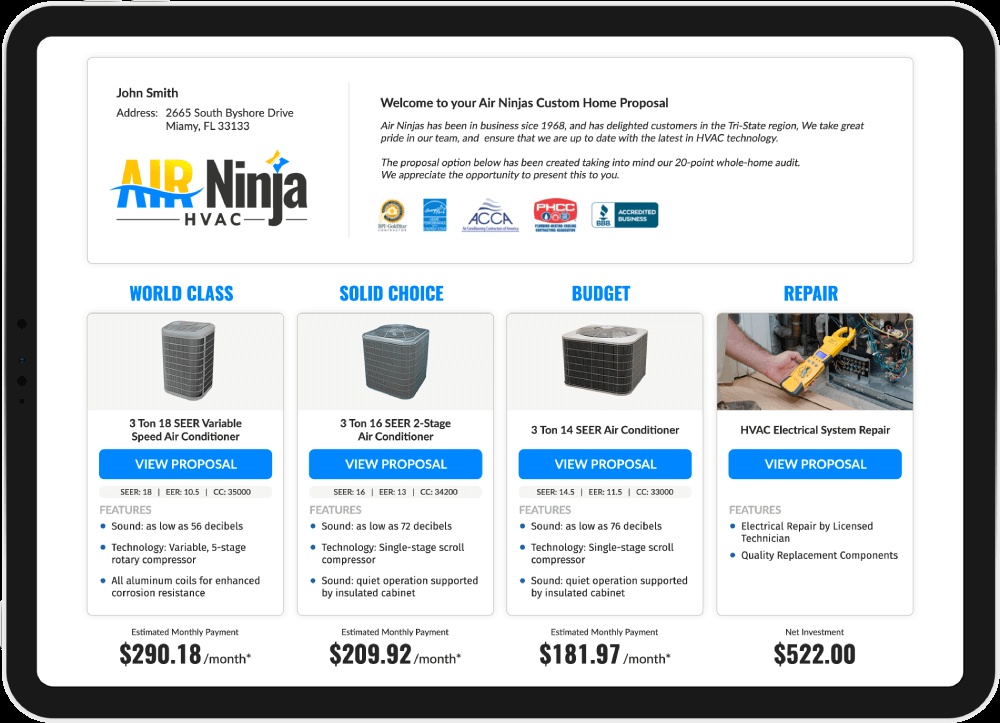
OnCall Air moves the intervention into the homeowner’s decision. Contractors can assemble interactive proposals, show equipment choices and include financing estimates. Connections to participating distributors provide live costs and inventory. The customer can compare an upgrade with a simpler system, rather than decipher an improvised estimate. The platform supplements field-service software and integrates with ServiceTitan and Housecall Pro.
The distinction between transactions matters here. Watsco reported $1.9 billion in gross merchandise value through OnCall Air during the twelve months ended June 2026. That describes products sold through contractors’ proposals; it is not an extra $1.9 billion to add to Watsco’s revenue. The ambition is straightforward: help customers sell more work, and earn more of their purchasing.
An interested contractor can start with a demonstration and check distributor compatibility. OnCall Air uses monthly, usage-based subscriptions without an annual contract. Its own guidance favors businesses willing to present digital proposals. Non-connected products require the contractor to maintain their pricing and information. The convenience depends on keeping the underlying details current.
04The year the shelves got complicated
The strain of the recent transition was operational. In 2025, the industry moved to equipment using A2L refrigerants, forcing Watsco to convert more than $1 billion of inventory to new products. It invested in logistics, training and people. Inventory peaked at $2.1 billion before falling to $1.4 billion at year-end. Availability had a substantial cash cost.
For all its digital progress, Watsco’s 2025 revenue fell 5% to $7.24 billion. Operating income declined 8%. By the second quarter of 2026, revenue was growing again, but gross margin was 27.5%, compared with 29.3% a year earlier. Management explained that earlier manufacturer pricing actions and transition effects had flattered the comparison. A smoother ordering process cannot manufacture household demand.
The business also depends heavily on its suppliers. Carrier and its affiliates accounted for 62% of purchases in 2025. The relationship is deeper than a supply contract: Watsco and Carrier formed their first distribution joint venture in 2009. That alignment brings brands and reach, alongside exposure when a critical supplier cannot deliver.
Stocking the transition took cash. Unwinding it released cash.
05A useful idea, with conditions attached
Ferguson, Winsupply, R.E. Michel and regional distributors compete for the same contractor’s business. Watsco’s proposition combines nearby inventory, technical expertise, manufacturer relationships and shared digital tools. Its scale helps fund the combination. The test remains wonderfully local: can this branch help this technician complete this job?
There is a climate argument hiding in that transaction, too. Heat pumps and efficient systems must be understood, financed and installed before they can save energy. In a 2022 interview, president A.J. Nahmad said measuring the avoided emissions from equipment sales sharpened Watsco’s focus: “it stunned us, it motivated us.” The company began talking more deliberately about helping contractors present efficient options.
The transferable lesson is to improve the customer’s work while preserving the relationships that make the sale possible. It needs patient capital, dependable product data and local managers worth trusting. Expensive equipment, weak construction demand or disrupted supply can still spoil the arithmetic. A contractor gets little comfort from elegant software if the needed unit is missing. The last mile remains stubbornly physical.