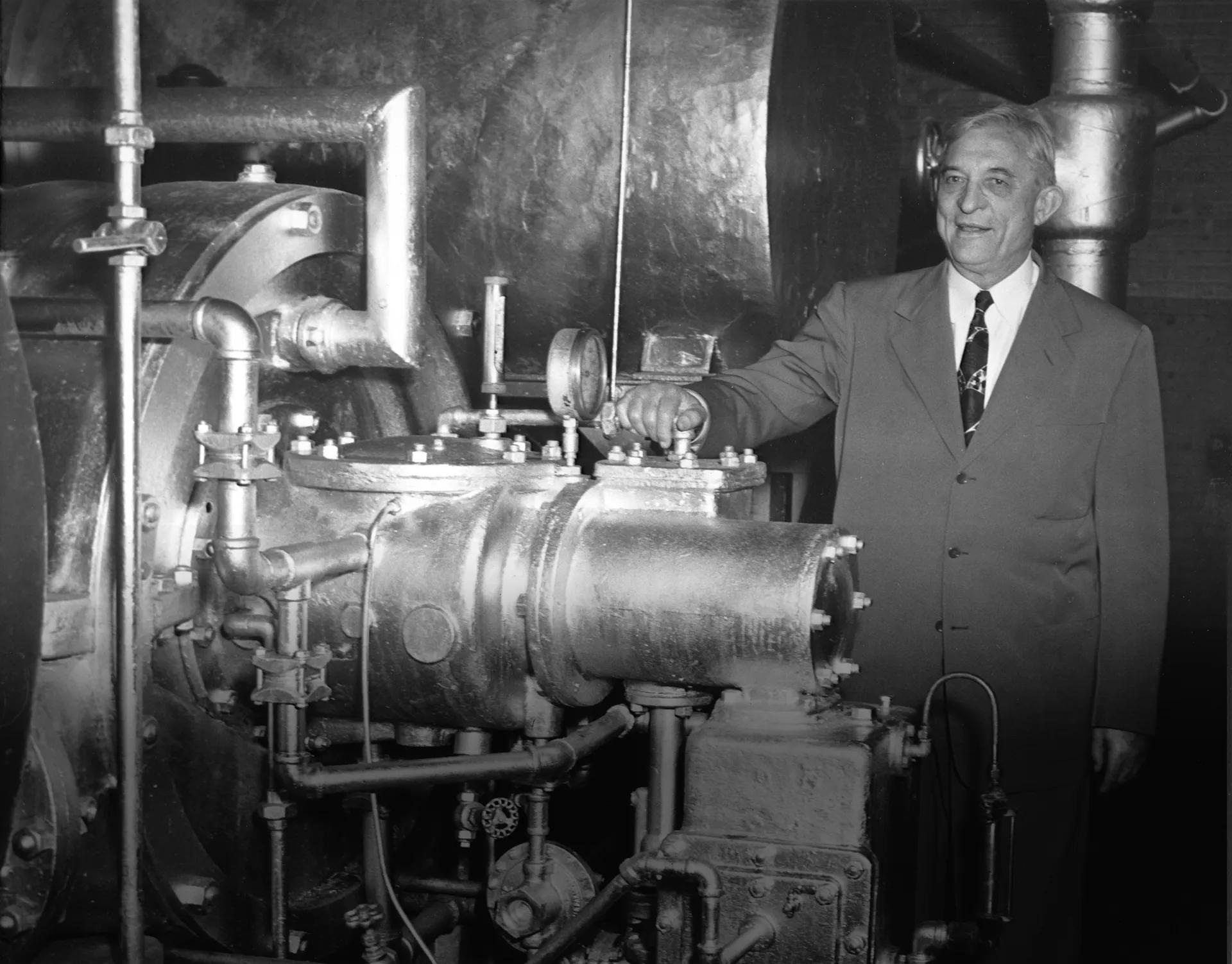
In the summer of 1902, the trouble at a Brooklyn printing plant was the paper. Humidity changed its dimensions between passes through the presses. Colors that should have lined up wandered apart. The customer, Sackett & Wilhelms, needed a room whose air behaved predictably. A young Buffalo Forge engineer named Willis Carrier drew a system to make that happen.
That is an unexpectedly useful place to begin understanding Carrier today. The company’s first problem was a production defect. Its solution changed the conditions surrounding the machine. Comfort cooling, the thing most people associate with its blue oval, grew out of that more particular industrial need.
- Find the expensive variable: humidity spoiled printing; heat threatens computing.
- Sell the whole system: equipment, controls, monitoring and maintenance.
- Pay for focus: a $14.2 billion acquisition helped remake the portfolio.
By 1915, Carrier and six colleagues had formed Carrier Engineering Corporation. Carrier’s own history puts their pooled capital at $32,600. Today’s publicly traded Carrier Global is a much larger proposition: roughly 47,000 employees and customers in about 150 countries. Yet the original question still fits. Which part of the environment is making the customer’s work harder?
02The machine is only the beginning
A homeowner wants reliable heating and cooling. A hospital needs controlled indoor conditions. A food transporter needs the cargo to arrive cold. A data-center operator needs heat removed continuously, including when computing demand surges. Carrier supplies hardware for these jobs, then sells ways to operate and maintain it.
The range includes air conditioners, furnaces, heat pumps, chillers, building controls and transport refrigeration. Its portfolio stretches beyond the Carrier label to Bryant, Toshiba HVAC, Viessmann and Automated Logic. Those brands put it into different buying channels and different buildings. A residential installer and the engineer specifying a large cooling plant are distinct routes to a customer.
The business model follows the equipment through its working life. Product sales bring in the initial revenue; replacement parts, maintenance, repairs and connected services extend the relationship. In 2025, Carrier reported $19.17 billion in product sales and $2.57 billion in service sales. Those accounting categories are useful, though aftermarket activity also includes products such as spare parts.
BluEdge packages service into tiers. Abound HVAC Performance supplies monitoring, alerts and reports for connected equipment. The practical attraction is straightforward: notice deterioration while there is still time to schedule a repair. For a buyer, the useful comparison is the installed system’s lifetime cost, including energy, maintenance and interruptions. A service contract is only useful when its coverage matches the equipment and the work being done.
03A $14.2 billion change of direction
Carrier became independent of United Technologies in 2020. Three years later it announced a sharper direction: acquire Viessmann Climate Solutions and leave much of fire, security and commercial refrigeration. Electrification, energy efficiency and demand for lower-emission equipment were the stated opportunities behind the move.
The Viessmann purchase closed in January 2024 at $14.2 billion in total consideration, including approximately $11.2 billion in cash and $3 billion in shares. It brought European residential and light-commercial expertise, heat pumps, home energy products and a direct-to-installer channel. Viessmann’s family became a substantial shareholder; Max Viessmann joined Carrier’s board.
There was also money coming back. Honeywell bought Carrier’s Global Access Solutions business in a transaction announced at $4.95 billion. Other exits removed industrial fire, commercial refrigeration and residential and commercial fire businesses during 2024. This was a deliberate reallocation of capital toward climate systems.
The market did not reward that direction evenly. Carrier’s 2025 sales fell 3% to $21.75 billion. In the fourth quarter, weaker residential demand and distributors reducing inventory weighed on results. Commercial HVAC and aftermarket grew at double-digit rates for the full year, excluding NORESCO. Different customers were moving on different clocks.
“We continue to control the controllables”
David Gitlin, Chairman & CEO · February 2026
Reported net sales, rounded. Portfolio changes affect comparability. Bars begin at zero.
04The next customer is the grid
Consider a heat pump paired with a battery. The purchasing decision begins with heating and cooling, but the system can also change when a home draws electricity. Charge the battery earlier; use stored energy during a peak. The opportunity depends on tariffs, equipment, weather and the utility’s rules.
Carrier’s March 2025 Google Cloud partnership proposed bringing battery-enabled HVAC together with energy forecasting and Google’s WeatherNext models. The aim was to coordinate household energy use and ease grid pressure. That announcement describes a development effort and intended benefits; it does not establish a universal savings rate for homeowners.
Commercial buildings bring another coordination problem: equipment and software have to work together. In July 2026, Carrier acquired building-automation company 75F. Its wireless sensors and cloud software add to a collection that includes WebCTRL controls, Abound analytics and Nlyte data-center management. Carrier’s proposition is increasingly about connecting these pieces.
Here the competitive test gets interesting. Daikin, Trane, Johnson Controls, Lennox and Mitsubishi Electric are alternatives across parts of HVAC. Carrier’s pitch combines its equipment, brands, distribution and service with digital controls. A buyer should test that integration against the actual building: compatible assets, commissioning effort, local technicians and contract coverage all matter.
Conceptual flow of the announced Carrier-Google Cloud initiative. Savings depend on the installation and tariff.
05Same problem. Hotter machines.
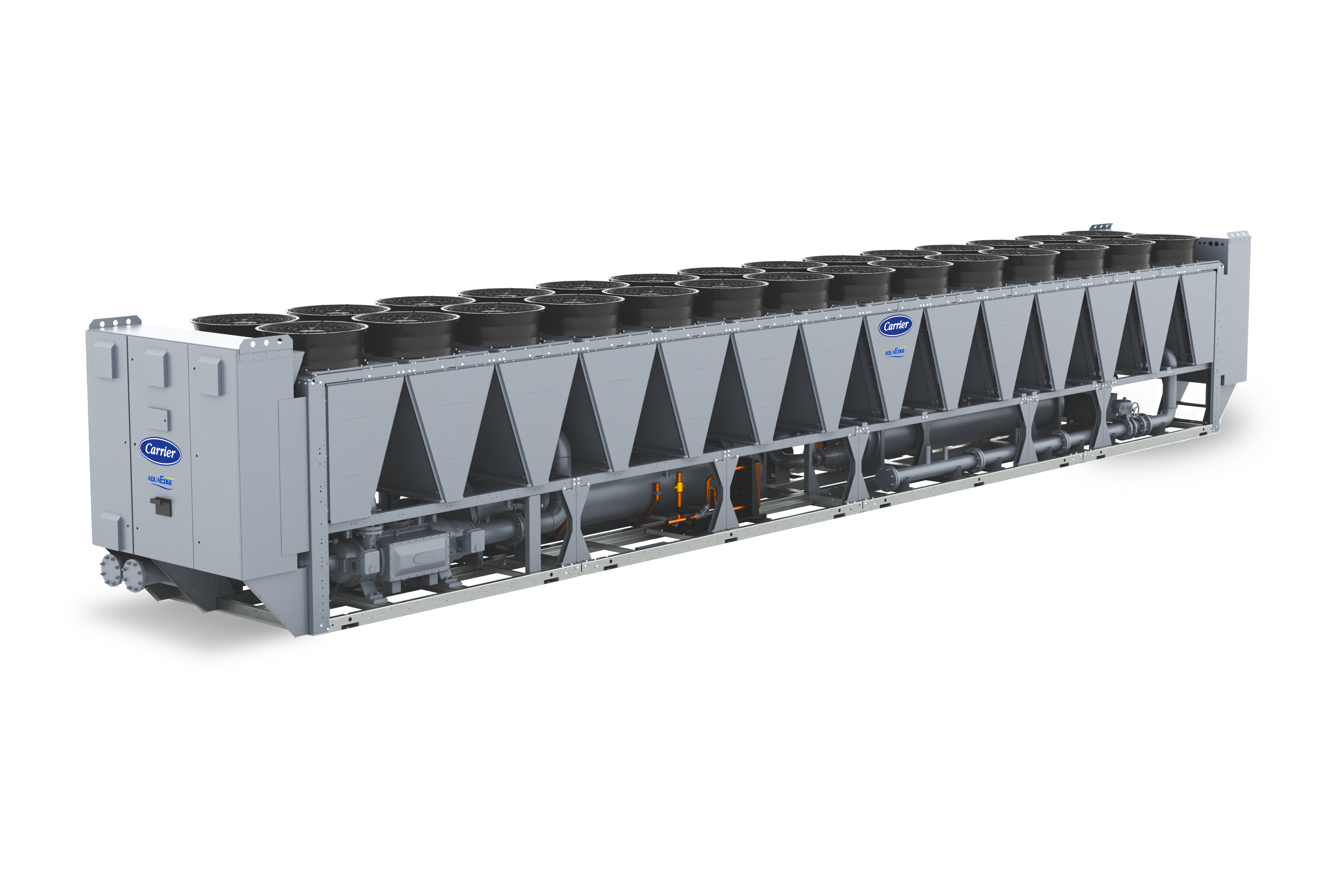
Data centers make the old industrial logic visible again. Carrier launched QuantumLeap in February 2025, grouping thermal equipment, controls and service for computing facilities. Its offering includes chillers and coolant distribution units for direct-to-chip liquid cooling. The customer is buying the conditions under which expensive processors can keep working.
By the second quarter of 2026, Carrier reported data-center orders up more than 300% year over year, excluding NORESCO and Riello. It raised its full-year sales outlook to about $23 billion. That is guidance, and orders still have to become delivered equipment and revenue. In October, its Charlotte-made chillers won North Carolina’s large-business manufacturing competition. Even the factory floor was getting a turn in the spotlight.
The lesson readers can copy is practical. Find the constraint surrounding the customer’s work, then price the full cost of removing it. For a building owner, that means measuring energy use and downtime before choosing hardware or a service plan. The case weakens when installation costs overwhelm savings, compatible equipment is absent or local service cannot deliver. The printer’s paper demanded steady conditions. A century later, the expensive machines still do.
Follow the current
Explore Carrier’s website, its brands, company news and quarterly results.
Connect on LinkedIn, X, Instagram and Facebook. Watch the official YouTube channel or the data-center product overview.