In a photograph taken at the New York Stock Exchange on June 16, 1994, Albert Nahmad has his young son beside him. Watsco is marking its arrival on the exchange. A.J. Nahmad is still years away from joining the business. The picture has acquired a second meaning with age: the boy would eventually become president of the company his father had already spent more than two decades running.
There is something useful about a business photograph that takes thirty years to develop its plot. Nahmad’s career rewards that sort of attention. Acquisitions supply the milestones, but the spaces between them contain the more interesting work: persuading people to stay, giving them reasons to grow and deciding which decisions belong in Miami.
He has been Watsco’s chairman and chief executive since 1972. In a business built around supplying air conditioners, heating systems and replacement parts, his recurring proposition is surprisingly personal. A family can sell its company, keep its name and continue running the place. The buyer brings resources. The people who know the customers retain room to act.
The engineer changes direction
Nahmad’s route to that arrangement began in Panama, where he grew up and attended Canal Zone schools. He graduated with Balboa High School’s class of 1958, then studied in the United States. His mechanical engineering degree came from the University of New Mexico in 1962; a master’s in industrial administration followed at Purdue in 1963.
Before Watsco, he worked in New York as a management consultant at Arthur Young and as a group vice president at W.R. Grace. That background put engineering alongside the practical questions of running organizations. He moved to Miami to lead Watsco, an existing company whose business then centered on manufacturing.
The consequential change came well into his tenure. In 1988, Nahmad decided to turn the company’s strategic attention toward distribution. Watsco began building its HVAC distribution network in 1989. The distinction is important to his biography: he inherited a business and later chose a different direction for it. Familiarity had not made the original business model sacred.
The early numbers show how quickly the new direction changed the company’s proportions. Revenue rose from $25 million in 1988 to $425 million in 1996. By then, Watsco had acquired 16 distributors and established positions across the Sunbelt and parts of the Midwest. The geography was practical: growing populations, hot weather and equipment people wanted repaired promptly.
at Watsco
toward distribution
Enterprise partnership
president
The name stays above the door
A distributor’s assets include things that fit awkwardly into a spreadsheet: the branch manager who understands a contractor’s habits, the supplier relationship built over years, the trading name people recognize without thinking. Buying the company gives a new owner authority over those things. Exercising all that authority at once can be expensive.
Watsco generally keeps acquired businesses’ historical names, management teams and sales organizations. Its headquarters provides help with finance, procurement, technology and other specialist work. Local leaders continue building on their customer and supplier relationships. There are efficiencies to pursue, but the operating arrangement begins with continuity.
Nahmad described the attraction for family businesses on a 2021 earnings call: they want a buyer who will preserve their names and cultures. Watsco, he explained, offers support such as capital, technology and equity for key executives. That makes the sale a way to finance another chapter of the business. The founder can remain involved in writing it.
The autonomy comes with expectations. Albert’s approach combines demanding performance expectations with support for the people pursuing them. Local leaders receive resources to help them grow, along with responsibility for making those resources count. It is a helpful correction to the idea that leaving local leaders in charge means leaving them unchallenged.
Shared ownership supplies another connection between the branch and the parent company. Watsco offers several ways for employees to hold shares, including stock purchase and equity award programs. By 2022, its programs included restricted shares for key leaders, stock options for emerging talent and company stock in retirement-plan matching. The incentives ask employees to think beyond the next sales period.
“We like the ownership culture to be spread out.”
Albert Nahmad · second-quarter earnings call, 2025
The line is plain enough to pass unnoticed on an earnings call. It also explains how Nahmad wants authority and ownership to travel together. A local operator can have discretion over the business and a financial stake in the wider enterprise. For a company assembled through acquisitions, that gives people something in common without requiring identical signs above every door.
A bigger map, a smaller distance
In July 2009, Watsco launched Carrier Enterprise with Carrier. The venture combined 95 Carrier locations with 15 Watsco locations and gave Watsco an initial 60 percent interest. It expanded the network’s reach in the Sunbelt, Puerto Rico and export markets. It also made the relationship with a manufacturer part of the company’s ownership structure.
Further transactions took the partnership into the Northeast and Mexico in 2011. An agreement for Canadian distribution operations followed in 2012. Growth could now come through a relationship already established across several markets, as well as through the purchase of another independent business.
All this corporate architecture ultimately has to answer a contractor’s rather less ceremonial question: can I get the part? Watsco’s inventory spans equipment, motors, coils, thermostats, tubing, tools and the other items an installation or repair can require. Its service model puts weight on stocked locations, technical help and efficient collection or delivery.
That is why the network matters beyond its size. An additional branch can shorten a journey. An additional product can save a second stop. The grand language of geographic expansion becomes more convincing when it ends with a contractor getting back to the job.
Give the next generation something to change
When A.J. became president in January 2016, he had worked at Watsco since 2005 and had already led strategy and innovation. He took on additional day-to-day duties. Albert kept the chairman and CEO positions, with an emphasis on the longer view, culture and strategic objectives.
The younger Nahmad’s remit included changing how customers used the business. Watsco had been expanding its technology investments since 2012. By the time of his promotion, it had added more than 170 technology-focused employees and was developing mobile tools, online purchasing, product information systems and analytics for managers.
Those investments have become a substantial part of daily trade. For the twelve months ended June 30, 2026, e-commerce sales reached $2.7 billion, or 37 percent of Watsco’s sales. The company’s OnCallAir platform helps contractors prepare and present proposals to homeowners. The digital work sits alongside warehouses and local sales teams, handling another part of the same customer’s day.
The warehouse has an online door.
The family structure is explicit about what may follow. Watsco identifies A.J. as Albert’s named CEO successor. Albert’s daughter, Valerie Schimel, also serves on the board and leads the family foundation. Both children represent the next generation of the family’s ownership. Continuity here includes a plan for who will carry responsibility, as well as who will inherit shares.
A gallery for the class of 1958
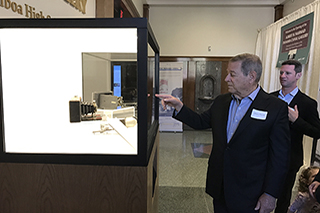
There is another place where Nahmad has put his name, and the dedication makes it worth a visit. The Albert H. Nahmad Panama Canal Gallery opened at the University of Florida’s Smathers Library on April 1, 2017. He dedicated it to his Balboa High School classmates. Several attended the opening.
The inaugural exhibition traced the Canal’s history from construction through its 2014 centennial. Nahmad established a fund supporting exhibitions in the gallery, at Canal Society gatherings and online. The gesture gave his school connections a public home, with room for other people to encounter the history.
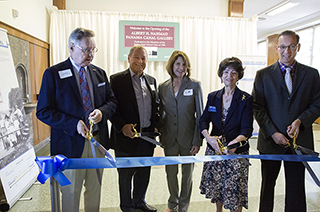
His connection to the Canal also involved public service. Following appointment by President Bill Clinton and Senate confirmation in 1994, he served on the Panama Canal Commission board through 1999, when the United States transferred the Canal to Panama. At the end of that year, he joined the Panama Canal Authority’s international advisory board.
The school connection has continued to produce something tangible. By January 2025, a further gift from Nahmad was supporting plans to digitize materials relating to Canal Zone schools. Photographs, programs and memorabilia were priorities, preserving records of the school experiences and friendships he remembered with affection. For someone accustomed to working with company histories, he has also helped keep a much earlier chapter available.
Still buying, still building
The recent deals show that the operating idea remains active. Watsco completed its purchase of Jackson Supply in June 2026. The business brought 25 Sunbelt locations and had recorded $230 million in sales in 2025. It kept its name, supplier relationships and leadership. Those details are the promise made concrete.
On October 12, 2026, Watsco completed the acquisition of The Granite Group, a plumbing and HVAC distributor with approximately $500 million in sales and 82 locations. Its existing team, led by Bill Condron, would continue running it independently. Watsco’s acquisition count since entering distribution had reached 74 businesses.
There is no guarantee that patience makes every quarter agreeable. Second-quarter 2026 operating income fell 12 percent from the previous year, even as Nahmad described a more stable market after the industry’s refrigerant transition. A company built for the long term still has to manage product changes, pricing and the uneven demands of the present.
That leaves Nahmad’s story open in a useful place. The executive in the 1994 photograph is still buying businesses. His son is helping change how they work. The next acquired company will arrive with its own habits, relationships and name. Nahmad’s proposition asks a buyer to be ambitious about the future while remaining curious about what already works. After the handshake, someone still has to open the branch in the morning.
Follow the business, revisit the history
- Watsco website
- Albert Nahmad on LinkedIn
- Watsco on X (company account)
- Watsco on LinkedIn (company account)
- Watsco presentations and earnings webcasts
- The Granite Group acquisition · October 2026
- Watsco’s 2024 annual report and the NYSE photograph
- Explore the Panama Canal Gallery opening
- Albert Nahmad’s Wall Street Transcript interview