Kathy Mazzarella was on her way to somebody else’s job interview when she got lost. She entered an office to ask for directions. The woman at the front desk had a suggestion: they were hiring, too. Would she like to take the employment tests? Three days later, on January 16, 1980, Mazzarella began work at Graybar. She was 19. A wrong turn had acquired a payroll number.
She had left college and returned to California without a settled plan. A job would pay the bills while she worked out what came next. Graybar, a distributor whose products keep buildings, factories and communications networks functioning, offered customer service work in an unfamiliar industry. She remembers being frightened, however confidently she tried to present herself. The future chief executive began by needing an opportunity.
When Roger Cutler, the manager interviewing her, asked what she wanted to become, she answered: president. Her father had taught her to aim at the top. Cutler took the answer seriously. It is a small detail with a long afterlife: before Mazzarella had learned the business, someone inside it was prepared to imagine her running it.
The promotion she didn’t get
The opening makes an excellent career story. The middle is more revealing. Years later, Mazzarella was a vice president with sales awards, long hours and a record she believed justified the next promotion. A man got the senior vice president job she wanted. Her first response was to consider leaving.
Her father supplied less consolation than instruction. People would watch what she did next, he told her. The disappointment was now a test of her judgment. She called the successful candidate, congratulated him and offered her support. Swallowing pride has never looked especially glamorous on a résumé, yet this particular phone call eventually helped her candidacy for chief executive.
A board member later told her that her response had changed his assessment. He had seen the competitive performer; now he saw someone who could put the company ahead of her own advancement. That distinction mattered when the board considered who should lead. The promotion she missed gave her a chance to demonstrate something her collection of wins had left untested.
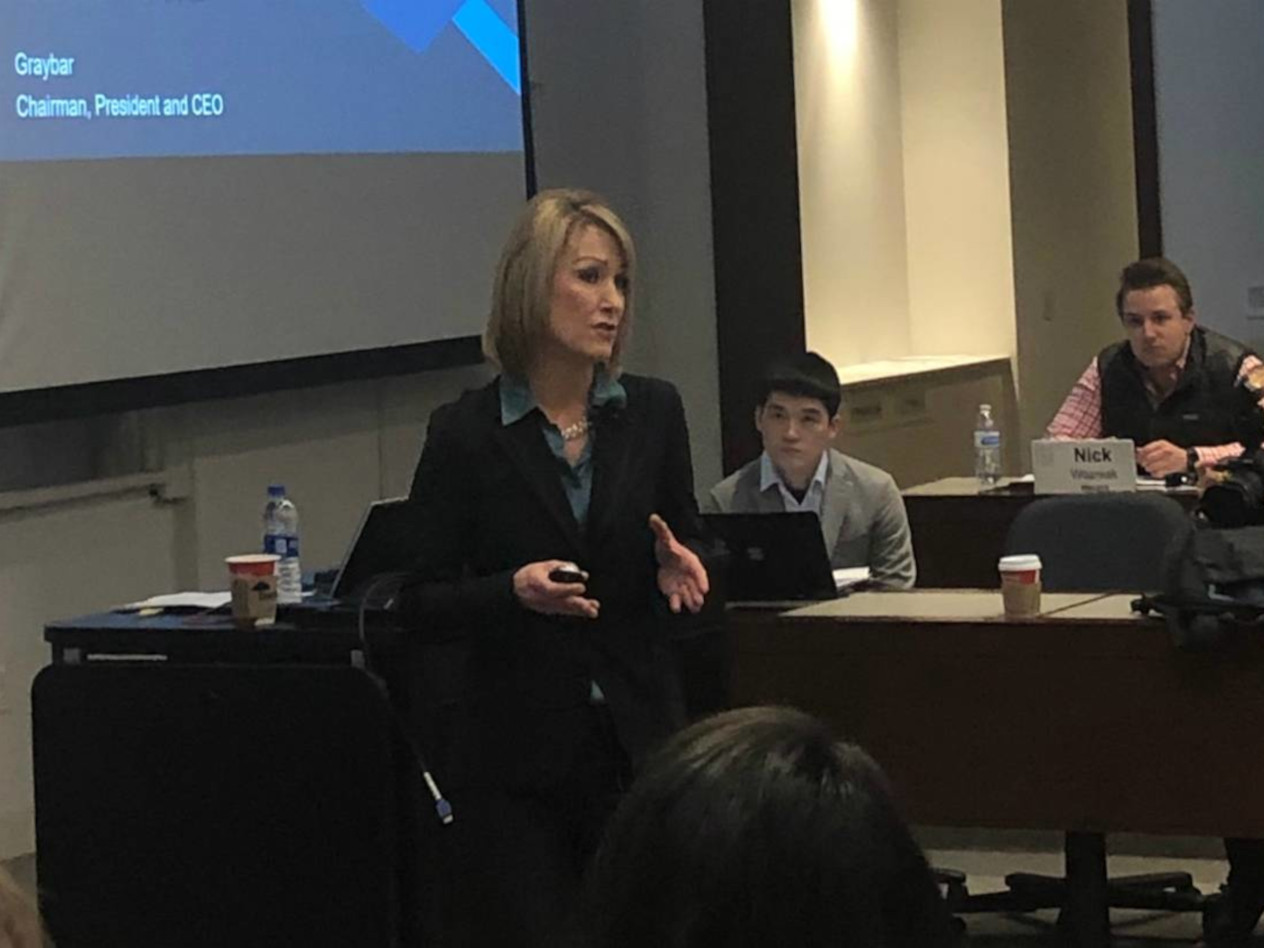
A career with several departments
Mazzarella’s progress through Graybar covered customer service, sales, field management and corporate product management before the senior executive assignments arrived. She became the company’s first female vice president in 1998. By the time she was appointed executive vice president and chief operating officer in 2010, she had worked across the parts of a business that often communicate through separate spreadsheets.
She became Graybar’s eleventh president and chief executive in June 2012, then chairman in January 2013. The sequence matters because it was an internal apprenticeship stretching over decades. She had encountered the company through customers, through the products being sold, through the people doing the selling and through the decisions made at headquarters. Her authority came with a working memory of those different perspectives.
Along the way, the college dropout resumed her education. She earned an associate degree in telecommunications engineering, a bachelor’s degree in applied behavioral sciences and an MBA while working. National Louis University and Webster University appear in her educational history. The mixture suits the eventual job: understanding equipment, understanding people and understanding a balance sheet all have their uses in distribution.
The assignment she turned down four times
Human resources was a detour she initially resisted. She recalls refusing the assignment four times, concerned that a traditionally female function might narrow the career she had built in sales. Eventually she negotiated conditions: she would retain strategic planning responsibilities and later return to another business role. She wanted to keep her connection to commercial decisions.
The assignment widened her understanding of governance and of the organization itself. It also gave her a closer view of what employees did for one another. Looking back, she credits that unwelcome turn with helping prepare her for the presidency. The episode gives her advice about opportunity some substance. She has accepted a job she did not want and subsequently reconsidered its value.
“Our culture of employee ownership anchors everything we do.”
Kathy Mazzarella
When the employees own the place
Graybar’s employee ownership predates Mazzarella’s arrival by half a century. The company traces its origins to 1869, became independent in 1925 and has been employee-owned since 1929. Mazzarella inherited an institution with a memory considerably longer than any chief executive’s tenure. Its owners include the people who built their working lives there.
In that setting, promotion from within has an unusually concrete meaning. The customer service representative who became president is an example employees can point to across a counter or a warehouse aisle. An ownership culture also asks an awkward, useful question of any change: what will this leave for the people who come after us?
Mazzarella acted on that concern before she became CEO. She helped establish Women Influencing Graybar’s Success, known as WINGS, to connect women through networking and mentoring in an industry dominated by men. In 2009 she was already writing about wanting her legacy to include the development of others. She described informal mentors as essential to her own progress and wanted those opportunities to circulate.
The group has endured. WINGS held a networking breakfast at Graybar’s fall national training conference in 2025. A breakfast is a modest unit of corporate history. For someone seeking a colleague, an introduction or advice about a next assignment, it can be a useful place to start.
The unromantic business of getting things there
The business underneath this story is practical. Graybar distributes electrical, industrial, automation and connectivity products, with logistics and supply chain services alongside them. Customers need materials that fit their projects, arrive when required and can be located before work stops. A construction schedule has limited patience for an eloquent explanation of a missing component.
The company ended 2025 with $12.9 billion in net sales, up 10.6%, and $431.4 million in net income. Those are company results, earned by the organization she leads. They provide scale for a career that began at a service desk and now includes decisions affecting a large North American distribution business.
Graybar net sales in 2025
Growth continued into 2026. Second-quarter sales reached $3.7689 billion, while net income attributable to Graybar was $158.6 million. Construction represented 61.4% of quarterly sales. The figures describe a company tied closely to physical investment, even as data centers, electrification and industrial automation create demand for the products moving through its network.
A software project with her name on the responsibility
Graybar Connect, the company’s business transformation program, began in 2023. Its purpose includes integrating technology, automating routine work and improving access to information. By the second quarter of 2025, Graybar reported completing the initial upgrade of its enterprise resource planning system. There is considerably less romance in an ERP upgrade than in an accidental job interview. Customers still need it to work.
Mazzarella has insisted that senior executives own the program’s workstreams and meet with the teams doing the work. Her account of the changes includes automating sales and use tax processes and removing manual tasks employees had long found cumbersome. Anonymous quarterly surveys give employees a way to comment on the transition. The intended benefit is time and attention returned to customers.
The question has expanded to artificial intelligence. In 2026, she discussed AI, organizational agility and advocacy with NAW chief executive Eric Hoplin. Graybar’s vice president of AI and digital transformation, Ed Fenton, has described a goal of saving people in sales, customer service and administrative roles a day of work each week. It remains a goal, a useful distinction when technology promises tend to arrive ahead of the results.
The people on either side of the desk
Her responsibilities now extend beyond Graybar. She chairs WM’s board, serves on Core & Main’s board and became chair of the National Association of Wholesaler-Distributors for 2026. She previously chaired the Federal Reserve Bank of St. Louis. These connections place a distributor’s view of operations, customers and employment in several different boardrooms.
There is a life beyond those rooms. She has spoken about enjoying cooking, reading and travel with her daughters; an earlier profile also listed taekwondo. Her public reflections give substantial credit to her husband, children, father, colleagues, customers and suppliers. The career may have one name at the top, but her own telling has an extensive supporting cast.
Roger Cutler supplied a particularly good closing scene. After she became president, he attended a retiree reunion and presented the nameplate from her first desk, which he had saved for years. He had believed she could reach the job she named at 19. He also wanted her to remember where she started. For a business built around keeping the right thing until somebody needs it, the gesture was rather well chosen.