The most expensive object in a factory is occasionally a missing C$20 part. Not because the part is special, but because a maintenance crew, production line or construction schedule is waiting for it. Gerrie Electric Wholesale Ltd. has spent nearly seven decades building a business around that mildly absurd equation. The Burlington, Ontario, company sells the familiar hardware of electrified life - wire, cable, breakers, enclosures, controls, lighting, network gear and industrial instruments. But the catalogue is only the visible layer. Underneath sits a system for making sure the right object appears near the right electrician before impatience becomes downtime.
Gerrie describes itself as one of Canada's largest independent electrical distributors. It is still family-owned, now in its third generation, with 24 Ontario locations, more than 400 team members and annual sales above C$200 million. Its customer list is broad by design: industrial plants, original-equipment manufacturers, contractors, institutions, commercial operators, utilities, public-sector buyers, network teams and retail shoppers. These groups buy different things, but they share one expensive dislike - waiting.
The product is the part - and the absence of panic
Founder Ken Gerrie's early service vehicle was nicknamed the “Panic Wagon,” a name that accidentally explains the whole market. Electrical distribution is most valuable when something has gone wrong, a deadline has moved forward or a drawing has changed after the crew arrived. The winning experience is not a glamorous unboxing. It is a counter person who understands the problem, local stock that actually exists and a route to the job site that does not consume the afternoon.
That is why Gerrie's branch network matters even as the company gets more digital. Customers can check price and stock online, manage invoices, build custom lists, scan barcodes in an app, send orders through EDI, auto-enter purchase orders by email or connect procurement platforms such as Ariba, Coupa and Jaggaer. The transaction gets faster. The branch remains close enough to handle whatever the software did not anticipate.
“We believe in the importance of having a physical presence in our cities and towns in Ontario.”Gerrie Electric, on its distribution-centre expansion
The company is differentiated less by one exclusive item than by how many chores it can remove around the item. Its supply-chain group audits storerooms, labels bins, sets minimum and maximum levels, replenishes inventory and provides mobile scanning. Its on-site container program can place a customized mini supply house at a large project. Its specialists stage automation systems before deployment, evaluate installed equipment, arrange remanufacturing and help tune control loops. Lighting teams pursue energy savings; wire specialists cut and manage cable; after-hours service exists for the moment the “Panic Wagon” idea becomes literal.
From catalogue to operating system
The C$6.1 million warehouse decision
By 2019, Gerrie was planning a different backbone. The documented constraint was not a spectacular collapse. It was a mostly manual distribution operation facing growth, e-commerce expectations and the ordinary errors and walking time that accumulate at scale. Then the pandemic made supply chains more visible and more fragile. Gerrie also moved quickly to supply personal protective equipment to Ontario manufacturers. The lesson was hard to miss: availability and workflow were becoming part of the product.
In 2021, the company consolidated distribution into a 76,000-square-foot Burlington facility. A C$1.4 million repayable contribution from FedDev Ontario supported the project, alongside C$4.7 million in private investment. The plan included automated storage and retrieval, digitized workflow and a central system that could see work across the warehouse. In disclosed financing, that is a C$6.1 million bet on making a low-drama business even less dramatic.
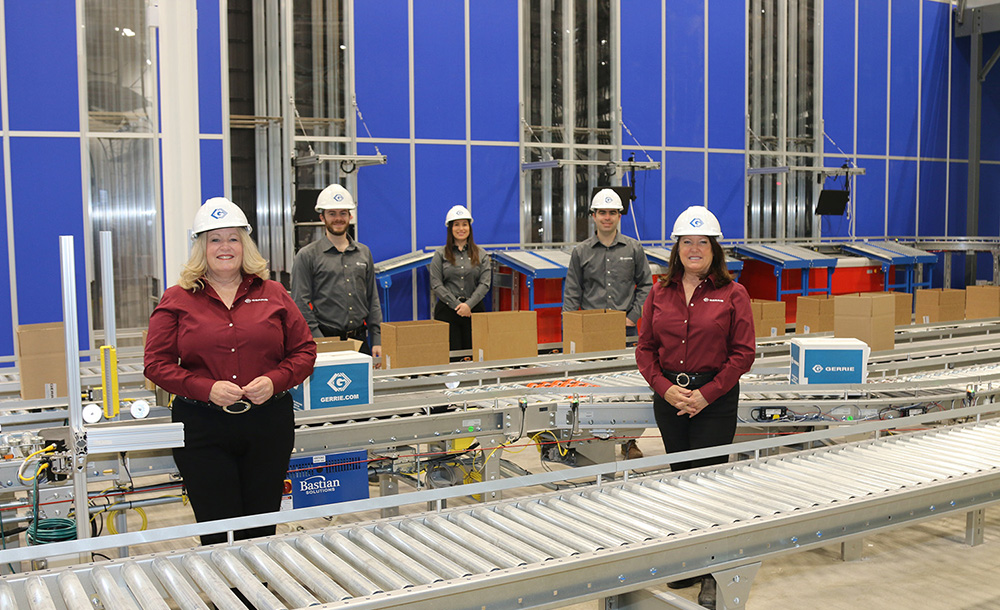
The first thing to “fail,” if one insists on the word, was the assumption that more growth could simply be absorbed by more manual motion. Gerrie and integrator Bastian Solutions installed an AutoStore system with Exacta warehouse software in roughly three months. The design was modular: more robots, bins and ports could be added as volume grew, with little or no downtime. That detail matters. A warehouse automation project is easier to approve when expansion does not require ripping out the first investment.
It also clarifies what changed management's mind. The company did not suddenly discover robots. Its Automation Group dates to 1982. What changed was the fit between available technology and a measurable bottleneck: domestic sales were growing, digital orders needed speed, and a manual warehouse could not remain the invisible glue forever. Automation moved from something Gerrie sold to factories into something it used on itself.
A wholesaler with software in its pockets
Gerrie's business model begins conventionally: buy products from manufacturers, hold inventory and resell to customers. Margin comes from distribution. The more interesting economics arrive when Gerrie becomes part of a customer's routine. A plant that lets the distributor monitor MRO inventory, standardize products and replenish stock is no longer shopping each part from scratch. A contractor using custom lists and barcode sheets is less likely to restart the search. An engineering team that stages a control system with a Gerrie specialist is buying reduced commissioning risk, not merely a box.
Manufacturer relationships deepen that offer. Gerrie has specialist groups around Rockwell Automation and ABB, and its public materials describe authorized support for Allen-Bradley products, installed-base evaluation and remanufacturing. SupplyForce connects the business to national agreements. Its public-sector relationship with OECM gives funded Ontario organizations a route to electrical products backed by local inventory, just-in-time delivery and standardized processes.
The competitive set includes national and regional distributors such as Westburne, Guillevin, Wesco, Franklin Empire, Graybar and other local supply houses. A customer can also buy direct from some manufacturers or use broad industrial e-commerce. Gerrie's answer is proximity plus complexity: if the purchase needs application knowledge, managed stock, a staged project, emergency access or several systems talking to one another, the lowest sticker price is not the whole bill.
What customers buy
Components, controls, lighting, cable, network gear and instruments.
What customers keep
Less idle labour, fewer stockouts, simpler purchasing and somebody to call when the plan meets reality.
The family company that planned to stay one
Gerrie's ownership story is unusually legible. Ken founded the company in 1957. His daughters, Heather Gerrie Kwant and Elaine Gerrie-Valentini, led the second generation as co-presidents and CEOs and were named Burlington's Distinguished Entrepreneurs in 2018. In 2023, Gerrie appointed Taylor Gerrie, Joanna Kwant and Jonathan Kwant to executive vice-president roles across operations, sales, e-commerce, marketing and vendor strategy. The announcement framed the moves explicitly as succession building blocks.
That long clock influences the culture the company advertises: training, benefits, a pension plan, work-life balance and branch teams empowered to operate like small local businesses within company guidelines. Gerrie is certified by WBE Canada as majority women-owned, lists ISO 9001 registration for locations and holds an EcoVadis Committed Badge. Awards are not operating results, but twelve consecutive years in Canada's Best Managed program, according to its 2026 announcement, suggest a company willing to keep submitting its homework.
The acquisition of FM Supply in 2022 shows the same preference for continuity. FM's Waterloo and Stratford locations kept operating under their existing name while gaining access to Gerrie's inventory and broader services. The seller's public explanation focused on customer traditions and values. In a relationship-heavy trade, “business as usual” can be the feature, not filler.
Make the annoying work part of the product.
- Measure the customer's expensive waiting: pickups, stockouts, duplicate POs, surplus and commissioning delays.
- Bundle one repeatable fix around the commodity: scanning, replenishment, staging or emergency access.
- Automate a proven bottleneck in modules, so capacity can expand without a second all-or-nothing project.
- Let digital tools handle routine transactions and keep local experts available for exceptions.
When the playbook does not work
This model needs repetition. Vendor-managed inventory makes sense when the same classes of parts move often enough to forecast. A nearby branch matters when availability, advice or response time outweighs a small price difference. Automation earns its keep when order density and labour savings are real. For one-off buyers, sporadic demand or purchases where every supplier is equally fast, the service layer can look like overhead. Customers must also be willing to share inventory data and standardize products; without that cooperation, the promised visibility remains a spreadsheet with better branding.
There is also a geographic limit. Gerrie's density is Ontario-based. Its national-agreement partners can extend reach, but the company's local advantage weakens where it lacks branches, fleet routes and specialists. The lesson to copy is not “buy warehouse robots.” It is to locate the recurring delay your customer resents, prove that removing it changes the economics and then build only as much machinery as the volume can support.
Gerrie began with the Panic Wagon because customers had panics. Sixty-nine years later, the vehicles, software and storerooms are more sophisticated, but the job is recognizable. Put the obscure part within reach. Know why it matters. Make tomorrow's emergency boring.