The Innovator File
Jackie Wu
He taught a drone to do the one warehouse job nobody wants - counting the inventory, in the dark, alone.
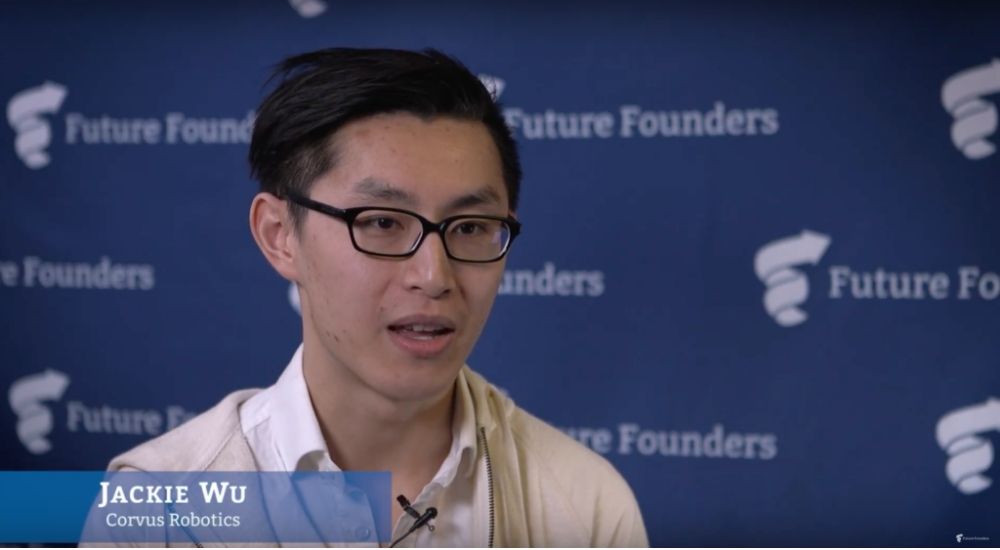
Jackie Wu - the roboticist who decided ladders and clipboards were beneath a modern warehouse.
He taught a drone to do the one warehouse job nobody wants - counting the inventory, in the dark, alone.
Somewhere right now, in a warehouse the size of a small town, a drone is lifting off the floor. No pilot. No beacons bolted to the racks. No GPS, no Wi-Fi handshake, no strip of fiducial stickers to follow. It rises into an aisle forty feet tall, reads a barcode that is torn and half in shadow, counts the pallets, and moves on. This is Corvus. And the person who decided a machine should do this is Jackie Wu.
Corvus Robotics makes what Wu calls the first and only fully autonomous inventory drone. The pitch is deceptively small: the drone flies the aisles at night, scans every pallet label, counts every box, and reports what is actually on the shelf versus what the system thinks is there. The pitch is also enormous, because inventory accuracy is the quiet leak under every supply chain, and the usual fix is a small army of people with barcode guns climbing ladders.
Most warehouse automation asks the building to change - install hundreds of beacons, string up markers, re-survey the whole floor every time the racks get rearranged. Wu built the opposite. His drones carry a real-time world model and figure out where they are on their own. Move the racks, and the drone shrugs and keeps flying.
The drones read barcodes that are damaged, faded, and compromised, because real warehouses are not clean rooms. Cameras, sensors, and industrial-grade scanners are stacked on a vehicle Corvus designs itself. That last part is the whole strategy.
Before the company, there was a pattern Wu could not un-see. He spent time inside warehouses across four continents, and everywhere the story was the same: people counting inventory by hand, badly, slowly, and expensively. Different languages, different flags, identical problem.
He trained for the fix without knowing it. At Northwestern University he earned undergraduate and master's degrees in robotics, concentrating on UAV controls, computer vision, and deep learning - the exact toolkit a flying inventory robot would need. In 2016 he was named a Future Founders Fellow, where a mentor summed him up in three words: full of energy.
The decision to found a company was, by his own account, a process of elimination. He tried the other paths first. None fit. So he made his own.
"Maybe I can paint something on the canvas of the world with my own efforts."
Named a Future Founders Fellow, a selective year-long program for top US student entrepreneurs. The mentor's verdict: "full of energy."
Co-founds Corvus Robotics, convinced that manual inventory counting is a problem worth a decade.
Corvus joins Y Combinator's Summer 2018 batch.
Raises a Series A to scale autonomous drone deployments.
Speaks at ProMat 2025 in Chicago on AI and computer vision in inventory tracking; Corvus wins the NextGen Supply Chain Solution Provider Award for Robotics.
In an industry that designs robots in America and quietly builds them overseas, Wu keeps engineering and manufacturing under one roof in California. He frames it as control, innovation, and resilience: when the design team and the factory share a hallway, customer feedback becomes a design change in real time, not a shipping delay measured in months.
Building the drone in-house means owning the data it collects and the way the AI is trained on it.
Engineering next to manufacturing turns a customer complaint into a hardware revision without waiting on an ocean.
Domestic production keeps the company standing when global logistics wobble - fitting, for a company that sells resilience.
Wu's endgame is the lights-out warehouse - a building where inventory takes care of itself around the clock while the humans do work that humans are actually good at. He is careful about the framing. Corvus is not selling the disappearance of workers; it is selling the end of the overtime scramble, where a warehouse hires a temporary crowd every quarter just to count what it already owns.
Keep the small skilled team. Retire the ladder. Let the drone fly the night shift.
"The lack of external infrastructure - of having to put up hundreds of beacons or come back and redo it if the racks change - is a key difference."
"Even though we all look different on the outside, we're all dealing with the exact same challenges in building a company."
It's the genus of crows and ravens - among the most intelligent birds on earth, and natural fliers. A fitting namesake for a thinking drone.
Wu didn't dream of being a founder. He tried the other avenues, found none fit, and arrived at entrepreneurship by ruling everything else out.
Corvus drones are built to scan labels that are torn, faded, and half-lit - the exact ones that jam a human scanner.