Breaking: Corvus One flies lights-out warehouses$18M Series A led by Spero Ventures & S2G VenturesClaimed 99.9% inventory accuracyNo GPS - No Wi-Fi - No fiducial markersLive in Kroger freezersAisles as narrow as 50 inches~1/4 of the Fortune 500 reportedly in pipelineBreaking: Corvus One flies lights-out warehouses$18M Series A led by Spero Ventures & S2G VenturesClaimed 99.9% inventory accuracyNo GPS - No Wi-Fi - No fiducial markersLive in Kroger freezersAisles as narrow as 50 inches~1/4 of the Fortune 500 reportedly in pipeline
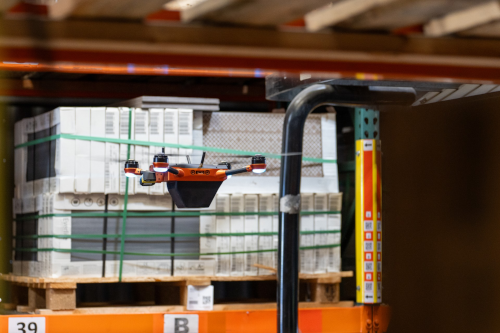
CORVUS ONE, mid-aisle, doing the one job nobody schedules a Saturday for: counting everything, twice, without complaining.
Company Profile / Robotics & AI
Corvus Robotics
The autonomous drone that counts your warehouse - no operator, no beacons, no overtime.
A bird-shaped idea, now flying for the Fortune 500
It is 3 a.m. in a distribution center somewhere off an interstate. The forklifts are parked. The lights are mostly off. And a small drone lifts off a landing pad, threads a 50-inch aisle, and starts reading barcodes nobody asked a human to read tonight.
That drone is Corvus One, and the company behind it is Corvus Robotics - a roughly 40-person robotics-and-AI outfit headquartered in Mountain View, California. Their pitch is refreshingly narrow: warehouses do not actually know what they own. Corvus makes them know, continuously, without sending a person up a ladder with a scanner and a grudge.
A quarter of the Fortune 500 is in our pipeline.Jackie Wu, Co-founder & CEO
The name is a small joke that happens to be true. Corvus is the genus of crows and ravens - among the smartest birds alive, the kind that solve puzzles and remember faces. A company that wanted to build a thinking drone could have picked a worse mascot.
The problem they saw
The warehouse that can't count
Here is the uncomfortable secret of modern logistics: the building full of stuff is often wrong about its own stuff. Pallets get misplaced. Counts drift. The annual physical inventory - the one where everything stops and everyone counts - is expensive, slow, and out of date the moment it finishes.
The usual fixes ask the building to change. Bolt up reflectors. Stick fiducial markers to the racks. Run Wi-Fi everywhere. Hand someone a ladder. Every one of those is friction, and friction is why most warehouses still count the way they did decades ago.
Other than a landing pad, its drone-powered system requires no infrastructure, is quick and easy to deploy.Marc Tarpenning, Spero Ventures (and Tesla co-founder)
Corvus' read on the problem was that the counting should be autonomous and the building should be left alone. Easy to say. The reason nobody had shipped it is that flying a drone indoors, with no GPS, between tall steel racks, in the dark, without crashing - is genuinely hard.
The founders' bet
Quiet for years, on purpose
Corvus Robotics started in 2017, with roots in the MIT robotics scene, and went through Y Combinator (S18). Co-founder and CEO Jackie Wu made a bet that looks obvious in hindsight and reckless at the time: that the hard part was not the drone but the brain, and that you could not fake your way past it with stickers on the walls.
So they stayed relatively quiet on sales and marketing for an unfashionably long time - years of engineering and validation while flashier robotics startups raised, pivoted, and occasionally vanished. The bet was that autonomy, done properly, would be worth the wait. Patience is rarely a venture virtue, which is exactly why it stands out here.
We were able to realize the benefits of the drone the day that it started flying.Bill Monk, GNC
The product
Corvus One: 14 cameras, one opinion
Corvus One is a fully autonomous, infrastructure-free inventory drone. It carries a reported 14 cameras and an onboard AI world model that builds its own map of the facility - no GPS, no Wi-Fi, no beacons, no fiducial markers. It flies the aisles, scans barcodes, records where every pallet and SKU sits, and feeds that into a near real-time picture that plugs into the warehouse management system.
99.9%claimed inventory accuracy
50"minimum aisle width
10%pallet racking freed up
24/7operator-free counting
The product line has grown beyond the original flyer. There is Corvus One Cold Chain, built to run cycle counts inside freezers - a place humans genuinely hate to spend their shift. There is Corvus Trident, an AI copilot for material handling equipment. And Corvus Cubic Audits turns all that captured data into auditing and compliance.
Embodied AI for inventory autonomy.Corvus Robotics, company tagline
The story so far
From lab to lights-out
Milestones
2017
Corvus Robotics founded, with roots in the MIT robotics community.
2018
Joins Y Combinator (Summer 2018 batch); raises early seed capital to scale inventory drones-as-a-service.
2017-23
Years of quiet engineering - building the autonomy stack and validating it in real facilities.
2024-10
Launches Corvus One for lights-out warehouses and announces an $18M Series A led by Spero Ventures and S2G Ventures.
2024-12
MIT News profiles how Corvus' drones precisely track warehouse inventories.
2026-02
Cold-chain system detailed: autonomous cycle counts inside frozen warehouses, including a live Kroger deployment.
The proof
The receipts, in dollars and logos
A drone that counts well is a demo. A drone that customers pay to keep flying is a business. In October 2024, Corvus closed an $18M Series A led by Spero Ventures and S2G Ventures, bringing total funding to roughly $33M. Spero's Marc Tarpenning - who also co-founded Tesla - is among the backers.
Funding raised, by round
USD, approximate / cumulative ~ $33M
Seed + early
~$15M
Series A (2024)
$18M
Total to date
~$33M
Bars scaled to total raised. The crow has been fed - twice - and is reportedly eyeing the Fortune 500 buffet.
The customer roster is the louder proof. Named accounts span retail, distribution, and manufacturing - and a freezer or two.
"Being able to run inventory checks 24/7 without operator assistance has been a game changer."
Austin Feagins, Staci Americas
"We definitely see Corvus as a long-term partner supporting our growth."
Reggy Soenarso, MSI
"We were able to realize the benefits of the drone the day that it started flying."
Bill Monk, GNC
The mission
Make the building count itself
Strip away the hardware and the mission is plain: give every warehouse continuous, accurate knowledge of what it holds, without spending human hours on a task humans find tedious and error-prone. Corvus calls it inventory autonomy. In practice it means the count stops being an event and becomes a feed.
Something like a quarter of the Fortune 500 is in our pipeline.Jackie Wu, Co-founder & CEO
There is an honest tension here worth naming. Autonomy in the warehouse is also a story about labor, and Corvus' clearest wins are the jobs people least want - the 3 a.m. count, the freezer cycle count, the ladder. Those are easier to automate precisely because nobody is fighting to keep them.
Return to the dark distribution center. A year ago, that building counted itself once a year and guessed the rest of the time. Now a drone lifts off every night, threads the racks, and the morning shift opens a dashboard that is already right.
The bet Corvus made in 2017 was that the warehouse should not have to change to be understood - the machine should do the changing. If they are right, the annual inventory count joins the fax machine in the museum of things we used to tolerate, and the smartest thing in the building turns out to be a small drone named after a crow.
No operator. No beacons. No overtime. Just a bird that counts.