BREAKING · OneTrack.AI puts eyes on the forklift DRONE DOWN · A crash on stage, 2,500 watching, zero panic AGE 15 · He built a full-scale Boeing 737 simulator 12 STITCHES · The injury that ended the drone era FROM MUNICH TO CHICAGO · via Salzburg and Northwestern BREAKING · OneTrack.AI puts eyes on the forklift DRONE DOWN · A crash on stage, 2,500 watching, zero panic AGE 15 · He built a full-scale Boeing 737 simulator 12 STITCHES · The injury that ended the drone era FROM MUNICH TO CHICAGO · via Salzburg and Northwestern
Founder · Engineer · OneTrack.AI

Marc Gyoengyoesi

Founder & CEO, OneTrack.AI · Chicago, IL

He bolts cameras to forklifts and teaches them to watch the warehouse for you. The factory floor already runs on sub-second precision. The warehouse, until recently, ran on binoculars.

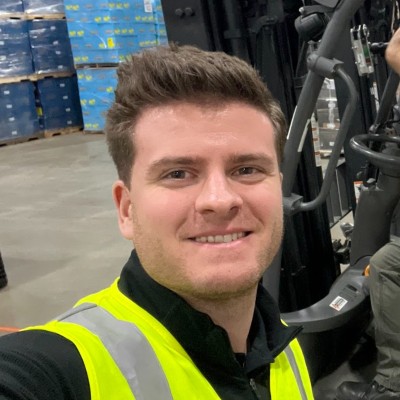
Marc Gyoengyoesi, founder and CEO of OneTrack.AI
The engineer who decided warehouses deserved better than ladders and luck.
The Dispatch

There is a Google Map for everywhere except the one room full of your money.

Walk into a modern car plant and the machines know exactly where every bolt is, down to the fraction of a second. Walk next door into the warehouse and someone is climbing a forklift with a pair of binoculars, squinting at a pallet three racks up, hoping it is the one the system swears is there. Marc Gyoengyoesi noticed that gap while building robots for BMW in Munich, and he has spent the better part of a decade closing it.

His company, OneTrack.AI, is a logistics operating system built on deep learning, computer vision and distributed computing. In plain terms: it puts AI cameras on the equipment that already moves through the building - the forklifts - and turns the resulting footage into something useful. Safety alerts when a driver takes a corner too fast. Proof that the right load went on the right truck. A running, searchable memory of what actually happened on the floor, measured across trillions of images and millions of hours of video.

The pitch is deceptively simple. Warehouses are blind. Marc gives them sight, then gives that sight a brain.

It was never about the things that flew. It was about what they could see. - the lesson behind the pivot
15
Age he built a 737 simulator
2,500
Watched the drone crash
12
Stitches, one pivot
Trillions
Of images, and counting
Origin Story

A boy in Salzburg, a flight deck in the bedroom.

Marc was born in Munich and grew up in Salzburg, the Austrian city better known for Mozart than for machine learning. At fifteen, while other teenagers were learning to drive, he built a full-scale Boeing 737 flight simulator. Not a video game. A cockpit. That detail tells you most of what you need to know about how his mind works: he does not want to play with the thing, he wants to build the thing.

He crossed the Atlantic to study computer science at Northwestern University. In his first year he took a robotics lab course taught by Assistant Professor Brenna Argall, and the trajectory was set. "Professor Argall and EECS 301 opened my eyes to the world of robotics," he has said. Two summers at BMW's Research and Innovation Center in Munich, building collaborative robots, gave him the other half of the equation: the messy reality of how machines and people share a factory.

Somewhere between the lecture hall and the assembly line, he found his problem. Production lines were precise. Warehouses were chaos. Why?

Field Notes

The dorm-room drones

His autonomous drones buzzed around the dormitory until the neighbors complained. That nuisance pushed him into The Garage, Northwestern's startup incubator, which he later called "absolutely instrumental in helping build the company." Annoyed roommates, it turns out, make excellent accelerators.

We have Google Maps for the outdoors, but we don't have anything like that indoors. - Marc Gyoengyoesi, on the gap he set out to close
The Famous Crash

The robot fell out of the sky. He kept the wreckage as a trophy.

September 2016. TechCrunch Disrupt, San Francisco. The Startup Battlefield stage, 2,500 people in the seats. Marc's company, Intelligent Flying Machines, had built an autonomous drone that scanned a warehouse aisle in about twenty minutes and flagged missing inventory before a human ever noticed. On stage, an electrical component failed. The drone crashed.

Most founders would have spent the next year pretending it did not happen. Marc framed it. The team finished the pitch, then kept the broken prototype, TechCrunch sign and all, as a keepsake. "It was a stupid thing, too," he said of the failure. And then the line that doubles as a philosophy: "People just don't care whether the robot crashes or not - they care what we build."

The crashes kept coming, and one of them cost him 12 stitches. That was the moment the engineer overruled the showman. If the cameras were the valuable part, why keep risking everything on the flying? He stopped building drones and started building OneTrack.

Exhibit A

"We weren't showing up with a finished product."

His read on demo-day disasters is unusually honest. The point of an early pitch is not perfection - it is to show people what you are reaching for. The relationships built in that room, crash and all, still matter to him years later.

The Pivot

From flight to sight

Indoors, he learned, "things are constantly moving around and you can't rely on any infrastructure." Fixed AI vision on forklifts beat fragile drones in the air. The hard-won lesson became the whole company.

The Long Arc

How a robotics class became a logistics OS.

~age 15
Builds a full-scale Boeing 737 flight simulator as a teenager in Salzburg.
2013-15
Two summers building collaborative robots at BMW in Munich; spots the warehouse visibility gap.
2014
Founds Intelligent Flying Machines, autonomous indoor inventory drones, while at Northwestern.
2015
IFM becomes a resident company at The Garage, Northwestern's entrepreneurship hub.
2016
Drone crashes on stage at TechCrunch Disrupt; featured at NVIDIA GTC.
2017
Graduates Northwestern; wins the Rice Business Plan Tech Innovation Prize and Oregon's New Venture Championship; pivots to computer vision and founds OneTrack.
2019
OneTrack's first commercial deployment of AI cameras on forklifts.
2020s
Scales OneTrack into an agentic-AI logistics operating system across North American warehouses.
The Work, Decoded

What a camera on a forklift actually buys you.

Safety

It watches the corners

Real-time alerts when driving gets risky, plus a record that turns near-misses into coaching instead of paperwork. Fewer incidents, less guesswork.

Accuracy

It proves the load

Shipment and load validation means the right product goes on the right truck. The footage is the receipt when something goes sideways.

Visibility

It remembers everything

Trillions of images become a searchable memory of the floor: fleet utilization, productivity, exceptions. The warehouse stops being a black box.

The Thesis

Why the warehouse stayed blind for so long.

For decades, the factory and the warehouse lived next to each other and evolved on opposite tracks. The factory floor was engineered to the millimeter, instrumented to the millisecond, optimized until a stalled line was a scandal. The warehouse, by contrast, was treated as a place where things waited. Pallets moved by hand and by habit. Inventory systems told you what should be there, almost never what was. The gap between those two numbers is where billions of dollars quietly disappear every year, and Marc has been blunt about it: "Lost inventory costs companies billions of dollars every year."

His insight was not that warehouses needed more software. They had software. They needed sight. The whole industry was making decisions on a map drawn from memory, while the physical world drifted out from under it. The drones were his first attempt to refresh that map continuously, flying the aisles between shifts, scanning, self-landing to recharge, uploading discrepancies before a person ever climbed a ladder. The technology worked. The form factor did not scale.

So he flipped the problem. Instead of building a flying machine to go look at the warehouse, he put the eyes on the machine that was already moving through it all day: the forklift. Every aisle a driver enters, every load picked up, every corner taken too fast - all of it becomes data, captured by AI vision sensors and processed at the edge. The map stopped being a snapshot and became a live feed. That is the quiet revolution OneTrack is selling. Not robots that replace people, but vision that makes the people and the building legible.

The Maths of Blindness

Should-be vs. is

Inventory systems track the should-be. Warehouses run on the is. The distance between the two is shrinkage, delay, and the worker on a forklift with binoculars. OneTrack's bet is that closing it pays for itself.

Edge of the Frame

From drone to fixed lens

Drones gave him the computer-vision stack. Forklifts gave him the distribution. The hardest part of indoor robotics, he found, is that nothing stays still and nothing can be assumed - so he stopped flying and started watching.

The Operator

A builder who reads failure as a spec, not a sentence.

There is a particular kind of founder who treats a public catastrophe as raw material. Marc is one of them. When his drone fell out of the air in front of 2,500 people, the instinct was not to hide the footage but to keep the wreck. The episode reads, in retrospect, like a thesis on how he runs things: ship early, expect the embarrassment, mine it for the relationships and the lessons, then iterate. "We weren't showing up with a finished product," he said - and he meant it as a defense of showing up at all.

That temperament traces back to the cockpit he built at fifteen and the robotics lab that hooked him at eighteen. He is, at his core, an engineer who happens to run a company, more interested in whether the thing works than in whether the demo dazzles. The pivot from drones to fixed cameras was not a retreat. It was the same instinct that builds a full-scale 737 instead of buying a flight-sim disc: go to the real version, even when the real version is harder. The 12 stitches simply made the decision urgent.

His ambition for OneTrack is stated plainly on the company's own terms - to connect physical operations with digital intelligence and make operational excellence effortless. Underneath the corporate phrasing is the same idea he has chased since Munich: give the indoor world the kind of continuous, machine-readable map the outdoor world already enjoys. If he is right, the warehouse of the future will not look like a sci-fi set full of robots. It will look like the warehouse of today, except it can finally see itself.

Ship early. Expect the crash. Keep the wreckage. Build the next one better. - the working method, distilled
In His Own Words

Eight lines that explain him.

"People just don't care whether the robot crashes or not - they care what we build."
"We have Google Maps for the outdoors, but we don't have anything like that indoors."
"Lost inventory costs companies billions of dollars every year."
"Indoors, things are constantly moving around and you can't rely on any infrastructure."
"We weren't showing up with a finished product."
"Professor Argall and EECS 301 opened my eyes to the world of robotics."
"The Garage has been absolutely instrumental in helping build the company."
"It was a stupid thing, too." - on the component that downed the drone
Marginalia

Five things worth knowing.

The Rolodex

Find Marc & OneTrack.