The startup hub got smaller. In an industry fond of measuring ambition in office floors, that is a mildly unfashionable opening. Yet Volta’s move from roughly 60,000 square feet to about 20,000 in downtown Halifax tells you more about its judgment than another ribbon-cutting photograph could. The people it served had changed how they worked. Eventually, the building had to catch up.
Today, Volta is concentrating on another change: helping Atlantic Canadians build companies and improve existing businesses with artificial intelligence. It offers founder support, a place to work, a community of peers and programs designed around doing something useful. The central question is commercial. Can a team find a problem important enough that somebody will pay to solve it?
That makes Volta an interesting participant in the AI rush. Its current offer puts customer demand and measured business results near the front of the conversation. For a founder with a clever demonstration and no buyers, the uncomfortable part starts there.
A mattress store, then a much bigger bet
Volta began in 2013, founded by Jevon MacDonald, Milan Vrekic, Patrick Keefe and J. Curry. Its early home was above a mattress store on Spring Garden Road. The premise was straightforward: put entrepreneurs near other entrepreneurs and give them people to ask when the next decision becomes difficult.
That proximity had practical uses. Dash Hudson, the social media software company, was an early resident. Co-founder Thomas Rankin later described the Volta community as a source of first customers, brainstorming partners and initial employees. A room full of founders can be a market, a recruiting network and an informal advisory group, sometimes before lunch.
“They served as our initial customers”
Thomas Rankin, Dash Hudson co-founder, on Volta’s community, 2023
By 2018, Volta had expanded its Maritime Centre footprint to around 60,000 square feet. More space made sense for a growing collection of companies that expected their employees to come to the office. Halifax’s young technology businesses had somewhere visible to gather, and the hub had room to accommodate them.
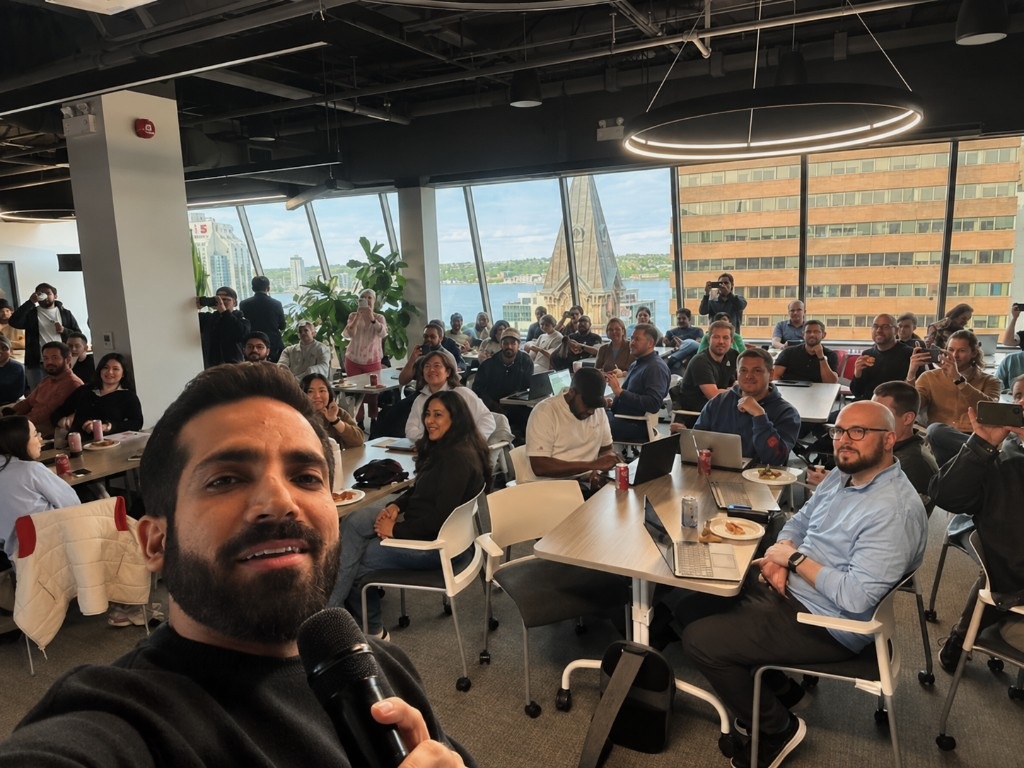
The office lost its old job
The pandemic disrupted that arrangement. Volta launched Virtual Residency in November 2021, extending support across Nova Scotia, New Brunswick, Prince Edward Island, and Newfoundland and Labrador. Its founders could increasingly build distributed teams without taking more desks in Halifax.
In an April 2023 explanation of the move, CEO Matt Cooper reported that research with startup teams put community first and hands-on support next. Dedicated offices still mattered, but fewer employees were working together on site. Resident companies had not necessarily become smaller; their need for shared physical space had.
The Armoyan Centre offered a different balance. Volta opened its new hub there on November 14, 2023, with 20 company offices, four partner offices, meeting rooms and space for coworking and events. It preserved somewhere to meet while reducing the footprint supporting those meetings.
About two-thirds less floor space. A change in the office model, not a measure of startup performance.
There was a second mismatch. Founders had learned startup theory and wanted help applying it. Cooper, who had joined as chief innovation officer in 2021 before becoming CEO in 2022, helped redesign support around that request. His account of the recurring question was disarmingly plain: “What do I do next?”
This is the useful failure in Volta’s story: the old combination of space and instruction no longer matched what enough founders needed. The response was to change the offer. Anyone running a membership business could copy the research habit: ask what people need help doing, then check whether the resources you sell actually help them do it.
AI gets a customer test
Volta made its AI direction explicit in August 2024, announcing an AI-First Startup Support Program with Dalhousie University’s Faculty of Computer Science. The partnership connected individualized support with technical workshops and access to student talent through ShiftKey Labs. It gave the hub a route to expertise beyond its own staff.
The current AI Residency focuses on regional founders building scalable AI products. Accepted residents receive community, coworking access, partner office hours, tools and other support. Teams showing early traction can apply for performance coaching. Acceptance into the community does not automatically unlock every level of help.
Its published benchmark is ambitious: C$1 million in annual recurring revenue within 18 months. That is a target for the support model, not a reported success rate or a promise to each applicant. Founders also face explicit boundaries: an Atlantic Canadian founder, a serious weekly commitment, and a product that is not primarily hardware-dependent or a regulated life-sciences product.
- 01Name the problemFind a need worth solving.
- 02Find a paying customerTest willingness to buy.
- 03Repeat, then expandLet evidence guide the next build.
An editorial distillation of Volta’s approach. A sequence of tests, not a forecast.
The small business gets a smaller first step
An established business has a different starting point. It may have customers already, alongside slow quoting, repetitive paperwork or information trapped in systems that do not communicate. Volta’s AI Productivity Lab works with Atlantic Canadian small and medium businesses, generally around 150 employees or fewer, to tackle a specific costly problem.
The first call is free and lasts 30 minutes. A suitable business needs an internal owner for the work, roughly two hours a week over four weeks, and a willingness to estimate the problem’s cost. When technical building is needed, the Lab connects the business with a local practitioner. Work proceeds in smaller steps, with possible funding explained before paid work begins.
Volta says it stops if the first step does not pay off. That makes the initial measurement important. Without a baseline, a faster-looking workflow can become another subscription nobody can justify. A business that cannot spare an internal owner, or only wants a cheque, falls outside the Lab’s stated fit.
Four weeks, with something to show for them
Sprint, announced on March 18, 2026, addresses the gap between learning about AI and building with it. Groups are capped at ten. Participants commit at least ten hours a week for four weeks, working on a real project with an experienced Lead Builder and weekly sessions for progress, questions and obstacles.
Cooper describes a model borrowed from athletics: structured practice with coaching. Volta positions it alongside regional education programs, including those from Digital Nova Scotia, Dal Innovates and NSCC. The expected output is a shipped project and experience doing the work.
The broader community offers other points of entry: events, mentoring, peer groups and a Builder Network connecting startup founders, people driving change inside organizations, and independent practitioners. That last group matters to the overall arrangement. A small business needing technical help and a builder looking for useful work have a reason to meet.
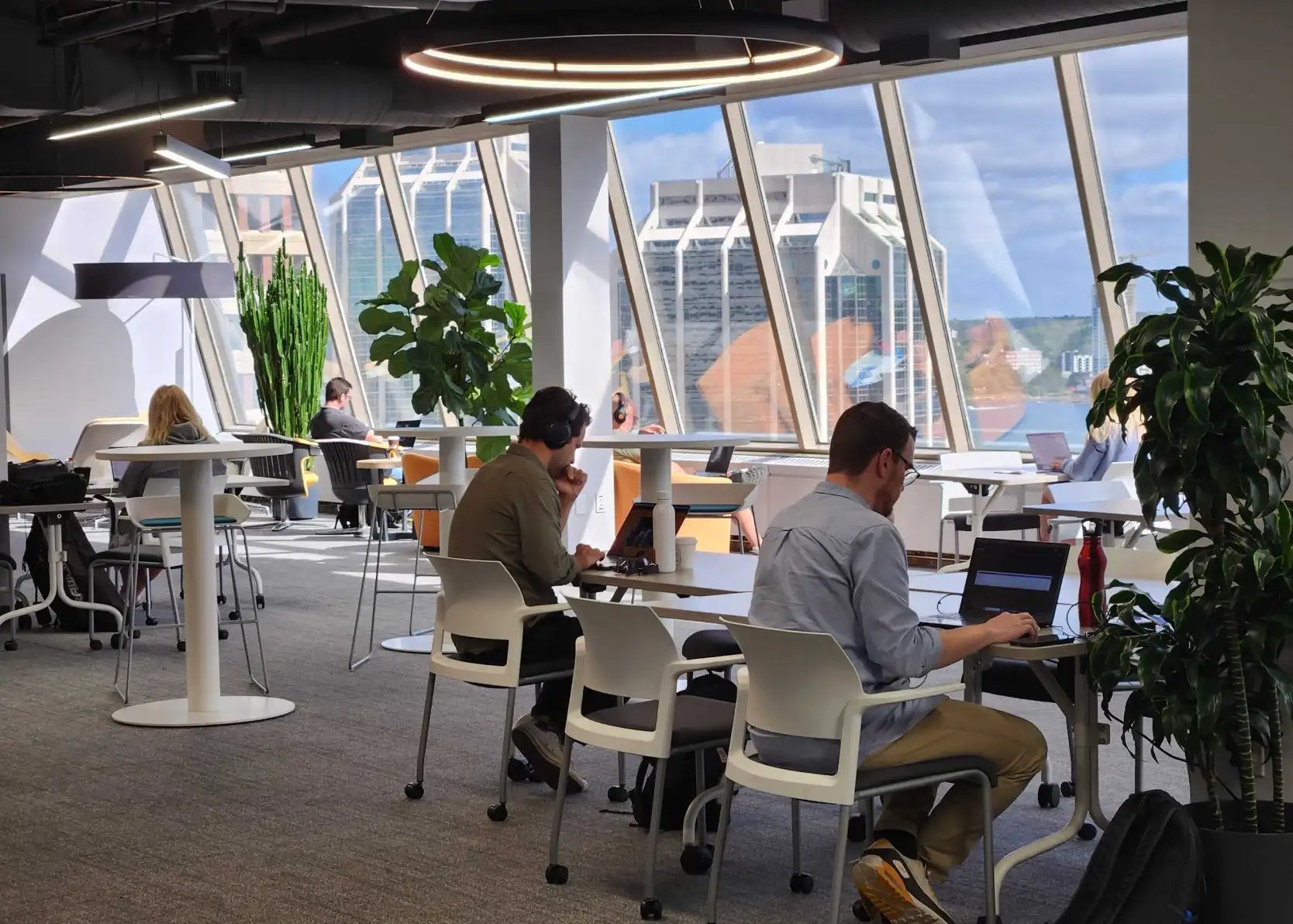
The expertise is also fairly specific. Volta’s July 2026 team roster includes Cooper, a Swept co-founder with product and marketing experience; AI Productivity Lab director Andy Farnsworth, whose work includes process design and prototyping; and Shri Subramanian, an adviser with applied AI and digital transformation experience. The mix is relevant to the work being sold: technical possibilities need to survive contact with customer acquisition, operations and the daily habits of an actual business.
A C$70 desk plan has backers
Volta remains a nonprofit, supported through public contributions, partnerships and paid offerings. Its current coworking menu starts at C$70 a month plus tax for Focus, with weekday daytime access. Build costs C$200 plus tax and includes a dedicated workspace and round-the-clock access, subject to its waitlist. Virtual Office costs C$100 plus tax for a business address and mail service.
| Plan | Price | Core offer |
|---|---|---|
| Focus | C$70 | Weekdays, 9-5 |
| Build | C$200 | Dedicated desk, 24/7; waitlist |
| Virtual Office | C$100 | Address and mail |
Published rates checked September 2026. Coffee and tea are a C$30 monthly add-on for Focus and Build.
Public money supports the wider operation. In November 2023, Nova Scotia committed C$750,000 annually for five years, an agreement running through March 2028. Volta also announced a C$3 million non-repayable ACOA contribution covering three years of operations and programming. These commitments support the organization and its services; they are not venture rounds.
Money for participating startups belongs in another column. In 2022, a SCALE AI-backed Volta cohort offered five supply-chain-focused startups up to C$14,000 each. That historical award program does not describe the current residency offer, whose website says Volta does not provide funding directly to founders.
Cooper’s published advice on fundraising makes the priority explicit. Chasing investment too early can absorb the time a founder needs for customer research and product refinement. The cost is partly attention: more hours preparing pitches can mean fewer hours finding out whether buyers care. Volta’s proposed remedy is to collect market evidence before treating a financing round as the next necessary achievement. That advice is available to readers even if they never apply to a program.
Useful neighbours, with different jobs
Volta’s competitive position rests on combining local relationships with applied support. A founder can seek structured acceleration through Propel, university entrepreneurship education, a specialist adviser or an ordinary coworking membership. Some of those options also work alongside Volta. Cooper has described its role as adding practical coaching to education available elsewhere.
The division of work is visible in Accelerate Black Tech, announced with Tribe Network in February 2024. Tribe brought education, community and non-dilutive funding; Volta brought coaching and advisory support. In January 2026, the province also announced a Cape Breton collaboration involving Volta, Ignite Atlantic and a shared business innovation centre in Sydney, with C$153,700 in ACOA support for Volta.
There is a record of businesses emerging from the community. Halifax Partnership reports more than 220 startups supported, over 4,000 jobs generated and more than C$400 million in venture funding raised by those companies. Those are cumulative figures for the supported businesses. They do not establish how much of each outcome Volta caused.
The practical lesson is smaller and easier to use. Put experienced people close to a real problem. Give the work an owner. Spend enough to learn whether the next step deserves funding. Volta has already applied a version of that discipline to its own office. Its AI programs now ask founders and business operators to bring the same willingness to change their minds.
Step into the community
Explore Volta, AI Residency, the AI Productivity Lab and Sprint. Browse news and founder playbooks, or read Cooper’s account of the move.