A customer runs out of mobile data. For most digital advertisers, that is the end of the conversation: the page will not load, the offer will not appear, the carefully purchased impression is somewhere else. Upstream has built part of its business around that awkward moment. Through participating mobile operators, its Zero-D portal creates a place to reach subscribers even after their data allowance has disappeared.
It is a useful introduction to a company whose work sits beneath the bright surface of mobile advertising. Upstream sells marketing software and campaign expertise to operators and brands. The objective is practical: get someone to subscribe, install an app, upgrade a plan or return to an unfinished purchase. Making the message attractive is one job. Getting it through, recognizing the customer and checking that the transaction is real are others.
That combination explains its position in the market. Upstream’s website reports a potential reach of 1.2 billion consumers and more than 370 advertisers. Those are distribution claims, not a billion people logging into an Upstream app. The company operates behind its customers’ brands, where a telecom relationship can become a route to another sale.
The operator already has the relationship
A mobile network has something an advertiser would like: an existing connection with the person holding the phone. Upstream works with those networks to use channels including messaging, operator websites and zero-rated portals. It names Vivo, TIM Brasil, MTN South Africa and dtac among its customer relationships. The commercial proposition extends beyond telecom into businesses such as Brazil’s vehicle-payment service Sem Parar.
Zero-D illustrates the operator-specific approach. Its advertising-funded portal offers a limited, zero-rated destination for subscribers who have exhausted their data. That requires a participating network and the relevant implementation; it is not a promise that every website becomes free. Upstream also offers data-reward campaigns and RCS, the richer messaging format that can carry images and interactive elements.
Read as a market position, the appeal is access plus execution. Braze provides customer engagement and journey orchestration; Infobip offers messaging and engagement products. Both overlap with parts of Upstream’s work. Upstream’s own emphasis is on combining campaign operations with mobile-network channels, subscriber identification and carrier-billing protection. The sensible comparison starts with which audience and channels a business actually needs.
A campaign builder with people attached
Grow is the main platform. Marketers can construct journeys through a drag-and-drop interface, define audiences, trigger messages from customer behavior and inspect results. The reporting covers measures such as engagement, churn and revenue. Secure-D, the integrated anti-fraud technology, adds checks intended to identify suspicious activity before bad traffic consumes the budget.
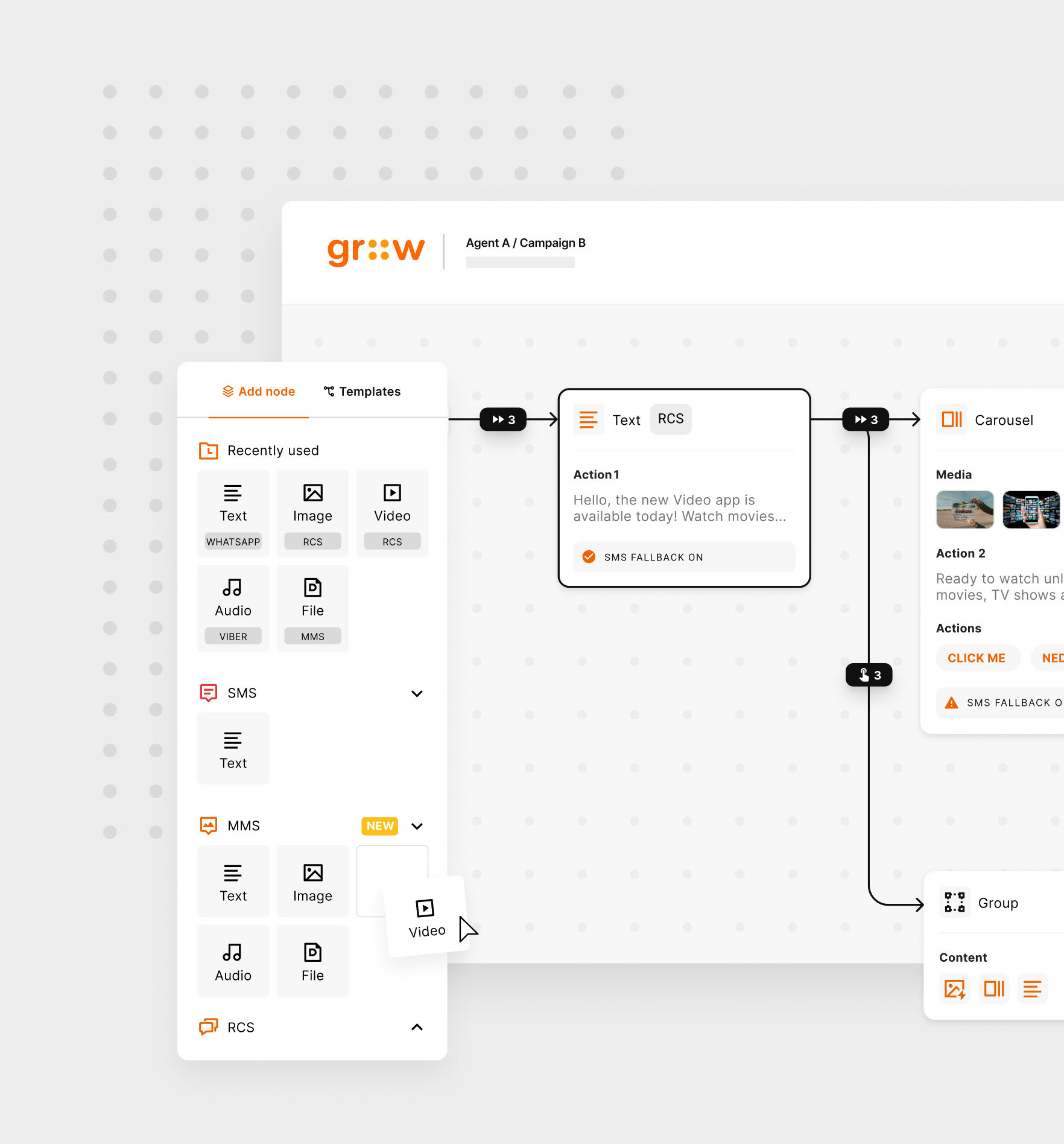
The software is accompanied by campaign work: creative development, media buying, testing and optimization. That makes the business a mixture of marketing technology and services, with a SaaS offering among its engagements. A buyer is assessing the people who will operate a campaign as well as the screen used to build it.
Vivo’s CRM manager Marcela Alvez de Souza supplies the human footnote in a public testimonial: “The support from the team has been amazing.” Support matters when one campaign spans several message formats, customer segments and approval steps. A dashboard can display a result; someone still has to decide what to change.
“The support from the team has been amazing.”Marcela Alvez de Souza · CRM Manager, Vivo
Thailand: more subscribers, fewer reasons to complain
The dtac case study makes the underlying problem unusually clear. The Thai operator wanted to expand digital value-added subscriptions without overwhelming its call centers with fraud complaints. The constraint was the quality of acquisition. More apparent customers would be a poor bargain if they arrived with disputed charges.
Upstream’s published account describes more than 33 service providers, over 80 services and more than 45 traffic sources. Campaigns covered categories including gaming and lifestyle. The team tested creative ideas, landing pages and steps in the user flow while applying its security technology. This was continuing operational work, rather than a single advertisement sent into the world.
The case study reports 3.7 million acquisitions and 174% year-over-year subscription growth. These are Upstream’s figures for a historical engagement, not a forecast for the next operator. The useful lesson is the method: broaden the offers and traffic sources, inspect the incoming transactions and keep testing the route from interest to subscription.
The abandoned cart gets a second appointment
Sem Parar offers a smaller, more copyable piece of the machinery. Upstream’s account says the Brazilian company built an opt-in audience through on-site campaigns tailored to three visitor segments. A welcome SMS carried the relevant offer. If a cart was abandoned, reminders followed after 20 minutes and three hours. An additional message 15 days after purchase supported upselling.
On sign-upWelcome SMS with the offer
20 minutesFirst abandoned-cart reminder
3 hoursSecond abandoned-cart reminder
15 days after purchaseSegment-specific upsell message
The published results include recovery of 9% of abandoned carts and 16.5 times as many of the company’s most comprehensive plans sold per month. That product qualification matters: the headline multiple is not a claim that every sale across Sem Parar increased sixteenfold.
For another marketer, the sequence is a hypothesis to test. A useful offer, permission to follow up and a relevant reminder are reproducible ideas. The particular delay is not a universal setting. Someone buying a low-cost subscription may decide differently from someone considering an expensive purchase. The campaign should learn from that difference.
From four people in Athens to a new owner
Upstream’s history begins in downtown Athens in 2001, with a four-person team and co-founders Marco Veremis and Alex Vratskides. The company describes its original business as a media-serving platform. It began working with European mobile operators in 2006, then opened in Rio and started African operations in 2008. Geography became part of its product education.
The official timeline records anti-fraud and zero-rated technology building blocks in 2018 and a relaunch of Grow in 2020. Those steps show the business widening from individual campaigns toward the systems that support them. They also help explain why the contemporary offering encompasses both an online retailer’s cart reminder and an operator’s subscriber-identification problem.
On July 11, 2025, Upstream announced its acquisition by Intersel, describing the buyer as a global investor with telecom expertise and emerging-market reach. Salim Khoury became executive chairman. The transaction ended Actis’s decade-long role as the principal investor. CEO Dimitris Maniatis remained the executive voice in the announcement, emphasizing the incoming chairman’s market knowledge and relationships.
The money went into the machinery
The financing record gives that evolution some scale. Upstream secured €25 million from the European Investment Bank in 2017. In 2021, an €8 million HSBC UK revolving credit facility backed expansion into additional industries and further technology development. These were company financing arrangements, separate from what an advertiser pays to run a campaign.
In December 2022, the company announced a five-year, €14 million loan from National Bank of Greece, partly to repay EIB borrowing. It also described an extension of the maturity on €11 million of EIB debt. Refinancing therefore accounts for part of the headline funding: adding the announcements together would overstate the fresh money available for growth.
Forbes Greece reported group turnover of €100 million for 2023 in its July 2025 acquisition coverage, with roughly 250 employees. It placed the corporate seat in Luxembourg and the principal operations in Greece. The company’s international office list includes London, Athens, Rio, Johannesburg, Lagos and Dubai. The business is better understood through that operating footprint than through a single address.
The browser can move the floor
Upstream’s latest technical announcement supplies a tangible example of what can go wrong upstream of a sale. On July 31, 2026, it reported a 23% decline in the enriched traffic used to identify subscribers following Chrome 147’s April release. The announcement links that change to the browser’s move toward encrypted connections.
The company says it adapted its Mobile ID technology for the HTTPS environment and had the solution operating with providers in Brazil, South Africa and Nigeria. This is Upstream’s account of its own deployments. Its significance is straightforward: an acquisition system can lose a useful identification signal even while the offer, creative and customer demand remain unchanged.
The inference for buyers is that network access is an operating dependency. Browser behavior, integration quality and available channels affect what a marketing platform can deliver. A business with little relevant operator access, weak customer data or no reason for people to return will have less to gain from this particular combination. Automation cannot supply the missing reason to buy.
Somebody still has to watch the campaign
Upstream’s recruitment material reflects the mix of work. Alongside engineering roles, it recruits commercial and marketing staff. Its advertised development programs include paid graduate training, professional certifications and opportunities to learn on live projects. The company says it encourages experimentation and ownership; those are employer claims, but the training programs give them a concrete expression.

The practical takeaway is to start with the point where a customer disappears. Is the message undelivered? Is the sign-up confusing? Has a cart been left behind? Does a transaction look suspicious? Those questions separate different problems that a single conversion rate can hide.
Upstream has built products and services around those gaps. Its case studies are most instructive when they show the work between the headline numbers: identifying a reachable audience, making a relevant offer, screening the response and trying again with better timing. The sale after the click is rarely automatic. That is why there is a business in looking after it.