The first job Tyler Calder took after university placed him near the beginning of marketing's measurement boom. It was 2007, and Eloqua was teaching businesses to see a customer journey as a sequence of signals. A page view could become a lead; a lead could become pipeline. For a young marketer, the appeal was almost architectural. The work took a fuzzy human activity and gave it beams, joints and numbers.
Calder carried that instinct into paid search, where every keyword arrived with a price and every click left a trace. At Search Engine People he rose from specialist to department manager, director and vice president of client strategy. He worked with large Canadian brands and startups, learned to speak in acquisition costs and conversion rates, and in 2012 landed on Marketing magazine's Canadian Top 30 Under 30 list.
But the career that followed kept pushing him toward the places where a neat attribution model breaks. At Precision Nutrition, Yulio Technologies, Enghouse Interactive, FlightNetwork.com and later Ingage, growth did not live inside one dashboard. It passed through creators, resellers, sales teams, customers and partners. The revenue was real. The route was untidy.
Two machines held together by hand
Before PartnerStack, Calder saw two versions of the same operational problem. In one role, he built an influencer program that generated more than $5 million in revenue within six months. The commercial result was persuasive; the machinery was homemade. The available tools did not understand a B2B subscription or give partners the experience the company wanted.
In another role, he inherited a co-sell and resell operation producing $200 million. It relied on spreadsheets and an 80-person finance team to move the money. Revenue at that scale usually looks like proof that the system works. Calder saw the cost hidden beneath the result. The process had scale, but not leverage.
The partner revenue loop
trust
transaction
growth
That distinction matters. Most companies already have a shadow partner program. An agency recommends the product. A consultant sends a buyer. A creator publishes a tutorial that keeps converting. A technology integration makes two tools easier to buy together. These motions look incidental until someone connects recruitment, enablement, deal registration, attribution, payment and reporting. The human trust should remain human. The friction around it can become software.
The fractional yes
In 2020, Calder was not shopping for another consuming startup job. He had come off an exit, his daughter had just turned one, and he wanted the ordinary pleasures that ambitious careers tend to bargain away: zoo trips, breakfast, daycare drop-offs and dinner. Then he met PartnerStack co-founders Bryn Jones and Luke Swanek. Their pitch touched the exact failures he had lived through.
He joined as a fractional vice president of marketing. It was a compromise with unusually long legs. Later that year he moved into a full-time senior marketing role, and in 2022 he became CMO. The daughter who was learning to walk when he joined grew up knowing him as a “Pancake,” PartnerStack's name for its employees, and as the dad who could still make the morning drop-off.
The anecdote is not sentimental garnish. It says something about Calder's operating style. A constraint can force clarity. If time is finite, activity must justify itself. If a relationship program deserves headcount, its assumptions should survive a conversation with finance. If a project matters, everyone should know where its decisions live.
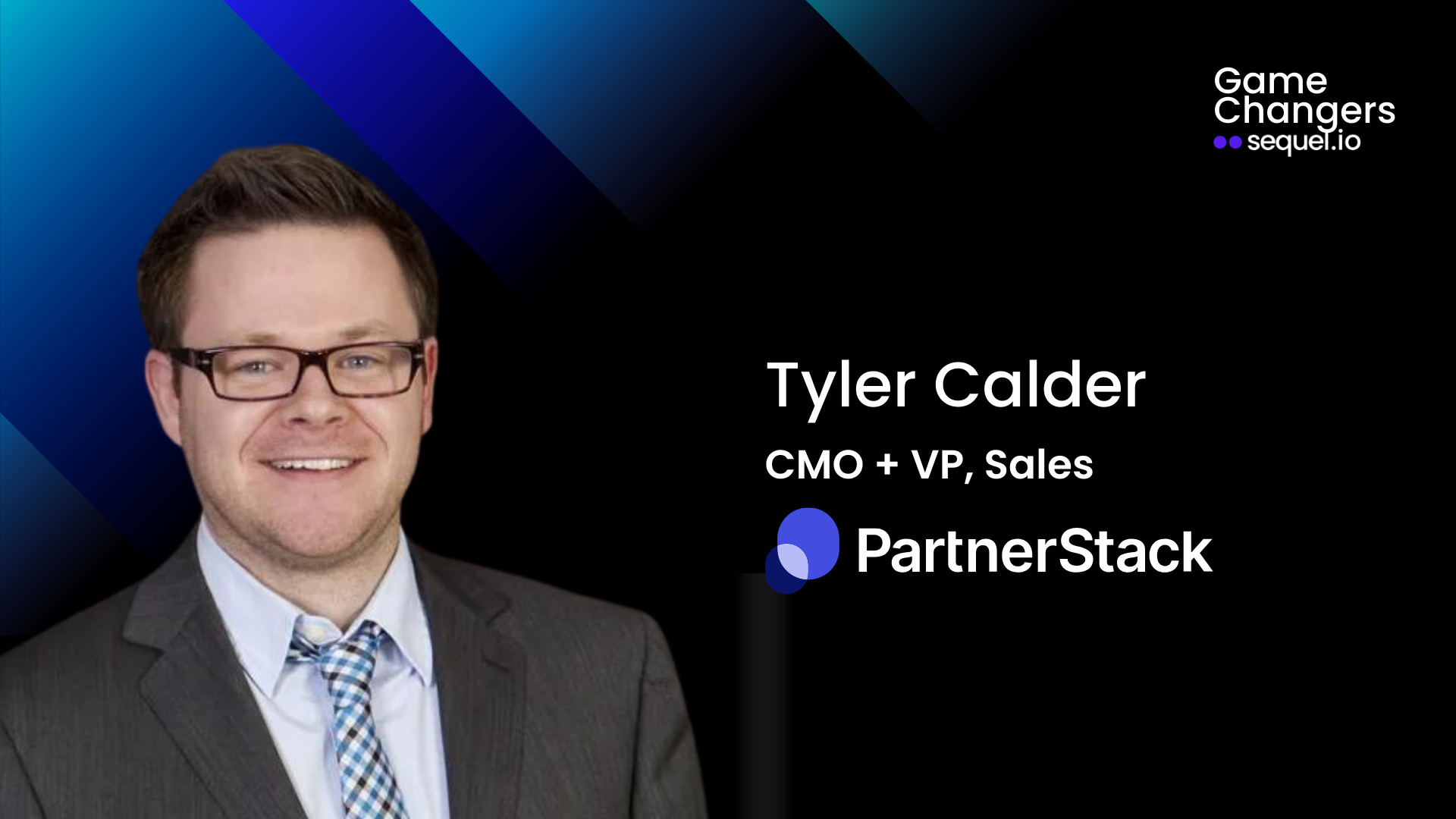
That last point became a company-wide project. PartnerStack consolidated scattered project workflows into Notion. Teams stopped spending the opening stretch of every initiative deciding how to collaborate. Calder said one shared page could explain what the company was doing, why it was doing it and why the work mattered. PartnerStack reported that individual product shipping rose 30 percent, while dozens of seats in other tools disappeared.
A CFO-proof version of trust
Calder's public language about partnerships is blunt because he has little patience for the word as a decorative abstraction. He has said that if “relationship building” becomes a place to hide from measurement, the CFO conversation will go badly. His alternative is not to drain relationships of warmth. It is to connect the warmth to an outcome.
At PartnerStack, that meant aligning marketing, sales, customer success and partnerships around a shared, data-backed view of the best accounts. Calder reported that the shift cut cost per dollar of pipeline by 34 percent and lifted pipeline value by 58 percent while the business pursued aggressive growth. No isolated campaign did the work. The advantage came from several functions looking at the same map.
His preferred method sounds almost old-fashioned beside the breathless vocabulary of growth: focus, fast experiments, evidence. Turn a channel off and see what changes. Score the market and compare the outcome. Separate the 80 percent that has earned investment from the 20 percent reserved for tests. The performance is in the feedback loop, not the hot take.
When the search box started answering back
This makes Calder's latest subject, AI visibility, feel less like a pivot than a return. Search shaped his early career. Now buyers ask ChatGPT, Claude, Gemini and Perplexity for a shortlist before they visit a vendor's site. The interface changed. The marketer's question did not: what influenced the decision?
PartnerStack's own numbers moved the topic from Calder's experimental budget into the core plan. He said referral traffic from large language models went from zero to roughly 10 percent of site visits in 18 months. It became the company's fastest-growing source, showed stronger engagement than any other channel and converted 1.7 times better than the next-best source.
The surprising implication sits outside the website. AI systems often cite publishers, reviewers, creators and communities. A vendor can describe itself perfectly and still disappear if no credible third party has a reason to mention it. Partner marketing, in this view, is no longer only a distribution channel after the buyer arrives. It helps shape the answer that sends the buyer somewhere in the first place.
There is a useful tension here for someone trained in paid search. Search advertising rewarded control: choose a term, write the message, set the bid. AI discovery rewards a wider field of independent voices. A company cannot simply purchase every mention or dictate every conclusion. It has to give partners something worth explaining, then make their success easier to see. Calder's old measurement discipline remains essential, but control gives way to coordination.
For Calder, this is a familiar collision of human behavior and technical infrastructure. Buyers want evidence from people they trust. Software can identify those people, help them participate, follow the resulting transactions and pay them. The mistake would be to automate the part that creates belief. The opportunity is to automate everything that makes belief difficult to act on.
The acquisition and the next layer
In April 2026, AppDirect acquired PartnerStack. The combination joined a network of more than 138,000 B2B partners with AppDirect's subscription commerce and marketplace infrastructure. Calder framed the fit in terms that could have been the final slide of his career to date: AppDirect built infrastructure for how businesses buy technology; PartnerStack built the ecosystem that shapes what they choose.
For him, the moment also closed a personal loop. The fractional experiment lasted six years. He got the zoo dates. He kept the drop-offs. The business kept growing. In a post announcing the deal, he wrote that the PartnerStack brand and team would continue building inside AppDirect, with more distribution available to the partners whose work the company already managed.
Calder is now a CMO, an instructor at the University of Toronto and the host of PartnerStack's Get It, Together podcast, where operators dissect the unglamorous mechanics behind good partner programs. His career has accumulated titles, but the central habit has stayed consistent: find the handoff that everyone tolerates, ask what it costs, and build a cleaner route through it.
There is a playful counterweight to all this systems thinking. Calder once opened a post by announcing that he had recently eaten his first tomato, mostly got over his fear of spiders and might attempt a mushroom next. It was a joke leading into a serious point about events and relationships. That rhythm suits him: a small confession, a number the finance team can inspect, then an argument about why people still matter.
Search taught Calder to follow the signal. Partnerships taught him that the strongest signal may begin as trust between two people. His work at PartnerStack is the attempt to preserve that beginning while making everything after it legible.