Marketing people enjoy decorating the future. David Cardiel prefers to bring a calculator. In a career stretching from semiconductor marketing to vendor-management software, he has made a habit of asking what happened after the campaign looked handsome, the content shipped and the applause subsided. Did a buyer move? Did sales have a better conversation? Did revenue arrive? It is a practical disposition, almost suspiciously so, and it has carried the Austin executive through two decades of B2B software, several acquisitions and enough changes of title to stock a small stationery shop.
Today Cardiel works as a fractional chief marketing officer at NetVendor, the company that helps property managers govern the vendors moving through their buildings and systems. The subject matter is compliance, credentials, contracts and work management. It is a long way from a perfume advertisement. That seems to suit him. His public writing is filled with systems, shared measures and the sturdy mechanics of turning attention into revenue. One recent formulation connects four things: what customers value, what sales can repeat, what product can deliver and what finance can believe.
value
repeat it
deliver it
believe it
The resource center that learned to sell
The cleanest demonstration came at Cision. Cardiel had arrived through Cision's 2019 acquisition of Austin media-intelligence company TrendKite, where he led global demand generation. The enlarged company possessed more than 300 blog posts plus a cupboard of ebooks, playbooks and webinars. It had plenty to say. The trouble was that prospects could not readily find the right thing, publishing moved slowly and the library was not organized around the industries and problems of the people using it.
Cardiel introduced a content-experience platform, connected it with Cision's marketing automation, and rebuilt the resource center around topic, industry and persona. Calls to action appeared where a visitor could sensibly use them. Sales could share material without conducting an archaeological dig. His description of the internal launch is delightfully physical: “When we rolled out the new resource center internally, jaws dropped.” The prettier interface was useful, but the numbers underneath it gave the story its backbone.
The episode explains Cardiel's taste for marketing infrastructure. A campaign ends. A system keeps making the next campaign easier. At Cision, the system did some of the distribution and organization so his team could spend more time assessing inbound leads and planning the sales follow-up. It also let employees become willing carriers of the company's material. The distinction is not romantic, but neither is a plumbing diagram. Both become fascinating when the water starts running.
“My biggest motto is be helpful.”David Cardiel
A marketer in work boots
Cardiel calls his leadership style “player-coach,” a phrase that can become corporate wallpaper if nobody ever leaves the dugout. His résumé gives it weight. Before TrendKite and Cision came Silicon Labs, Dun & Bradstreet, National Instruments and Blackbaud. He moved between field marketing, product marketing, customer marketing and demand generation. Later came Parse.ly and WordPress VIP, where he progressed from demand generation to growth leadership and interim CMO work. Omnipresent, Crayon and Quantified added more turns before NetVendor.
The formal training underneath that route is Texan. Cardiel studied marketing at Texas Tech University and later earned an MBA from Texas State University, then known as Southwest Texas State University. The degrees supplied the vocabulary; the jobs supplied the scar tissue. Product marketing taught him to translate. Customer marketing kept the installed base in view. Demand generation forced every promising noun to become a number. By the time he reached executive roles, he had already worked close to the handoffs where an elegant strategy is most likely to lose a wheel.
The sequence matters because Cardiel has repeatedly occupied the seams. Acquisitions join products faster than they join teams. Sales and marketing can share an office while keeping separate definitions of a good prospect. Brand and demand are often treated as squabbling heirs. Cardiel's advice is to give go-to-market work clear ownership, one dashboard and a narrow audience worth knowing properly. If every department owns the whole thing, nobody quite does. If each protects its own metric, the customer meets a company that appears to have several personalities.
Former colleagues remember the human counterpart to all that alignment. One direct report described the “air cover and autonomy” Cardiel offered after TrendKite became part of Cision. Another called out his communication, encouragement and support. His LinkedIn page carries dozens of recommendations, an unusual accumulation of professional testimony. They suggest that the systems-minded executive does not confuse a process with the people asked to live inside it.
Data with a pulse
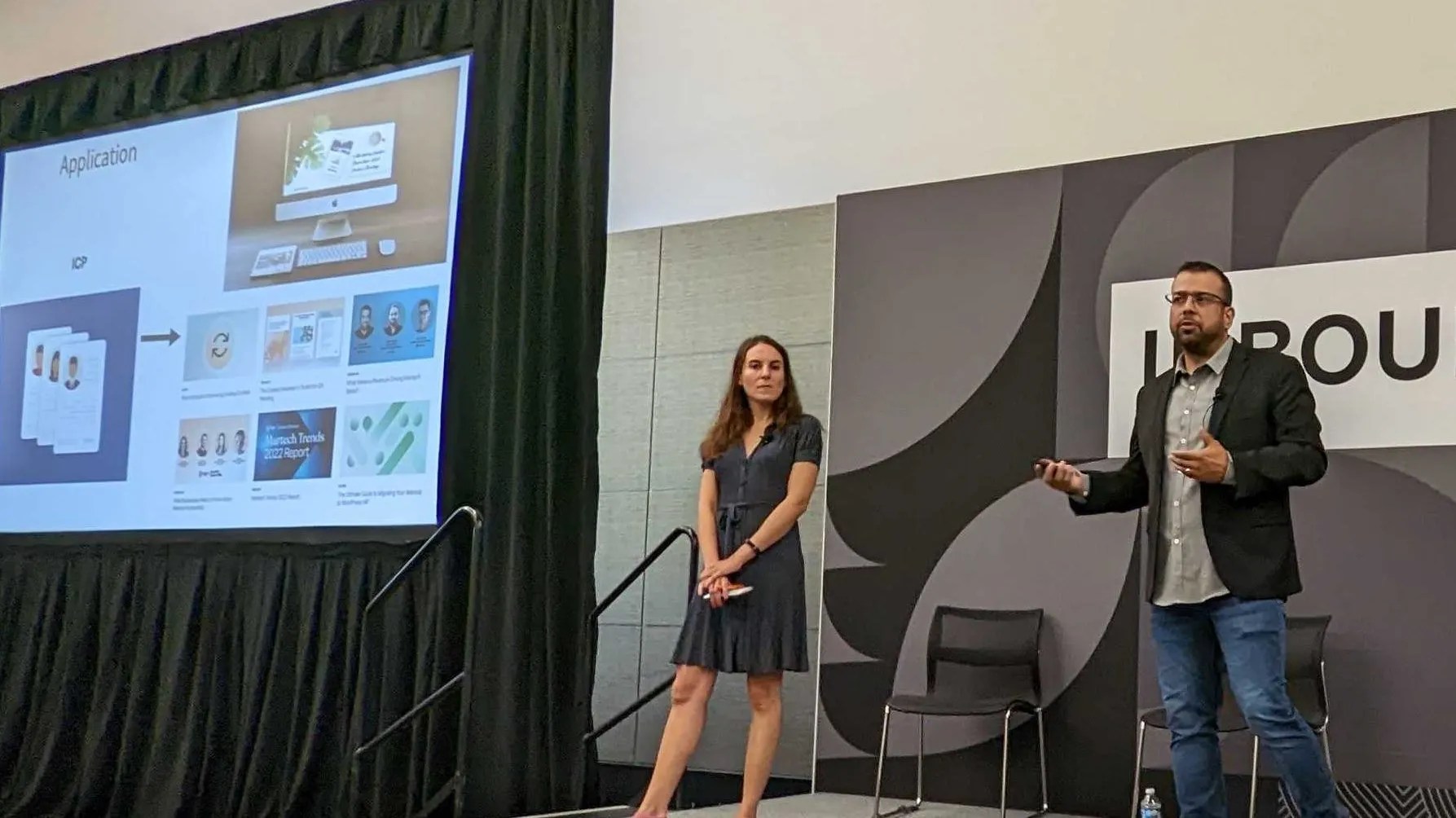
At INBOUND, presenting with Parse.ly's Stephanie Schwartz, Cardiel made the case for humanizing content analytics. The idea begins with a mild rebuke to dashboard worship. A page view is a person doing something. Useful analysis asks which topic, format, image or call to action helped that person make a decision. Then it experiments, tracks and changes course. At Parse.ly, an audience-centered overhaul was followed by a 21 percent rise in organic traffic and sharp growth in inbound leads and demo requests.
In a long-form conversation about B2B lead generation, Cardiel was equally specific. Separate the clear hand-raisers from everybody else. Put a marketing qualification team between inbound interest and a busy sales force. Respond quickly. Change the message for the industry, region and buying season. Watch who shares the material and whether they return. The advice lacks the intoxicating vagueness of “create buzz.” It can, however, be assigned to a person before lunch.
Minutes, not moods
Cardiel has advocated a five-minute service-level agreement for outreach to qualified inbound interest, backed by scoring that helps the team see who is most likely to convert.
This is why his boardroom writing sounds less like a plea for marketing and more like preparation for cross-examination. He recommends arriving with marketing-sourced revenue, pipeline quality, ARR contribution, customer acquisition cost, lifetime value, sales velocity, retention, expansion and profit-and-loss awareness. “The boardroom is no place for guesswork,” he writes. Creative judgment remains in the room. It simply has to bring identification.
When search stops sending the guest
The next strain on his system is AI. Cardiel argues that the familiar search bargain is changing: buyers can ask an assistant, consult a community, watch a video or get an answer directly on a search page without visiting the publisher. A traffic graph may therefore describe less of the buying journey than it once did. His proposed response is authority rather than volume. Brands need trusted information in the places where decisions form, formatted so machines can interpret it but credible enough that people want it recommended.
There is restraint in his version of AI adoption. Cardiel favors using the technology to personalize, distribute and measure credible voices from executives, employees and customers. “AI should multiply human credibility, not mask it,” he writes. That line belongs on the wall of any team presently asking a language model to produce 400 articles about adjacent keywords. Machines can widen the reach. They cannot retroactively provide a point worth making.
His fractional work follows the same logic. Companies bring him in to assess the existing motion, construct a plan and stay close enough to execution to see whether it survives. His consulting practice emphasizes acquisitions, business transformation, team building and practical leadership from the boardroom to entry-level marketing. The aspiration is sustainable, cost-efficient growth, not a brief sugar rush followed by an apologetic spreadsheet.
The rhythm beneath the spreadsheet
A strictly numerical portrait would miss the lively edges. Cardiel is a musician, a concert regular and a dachshund enthusiast. During a webinar about digital experiences, a guest used Doritos to explain value creation: inexpensive corn becomes something more desirable through processing, seasoning and presentation. The conversation briefly wandered into flavor allegiance. Cardiel chose Nacho Cheese. His co-host chose Cool Ranch. Marketing theory survived.
Music is an apt private vocabulary for the work. Marketing, sales, product and finance can each perform accurately and still fail to play the same song. Tempo matters. Listening matters. A good arrangement gives every part a purpose without asking every instrument to make the same sound. Cardiel's repeated insistence on shared KPIs, focused audiences and helpful content is an insistence on coherence.
His more personal writing has lately turned toward education. After college visits with his eldest son, he wrote about the distance between a business curriculum and the realities of beginning a career, then returned after the first semester with a practical playbook. The mentoring impulse, visible in colleague accounts and in his consulting pitch, had moved from the office into family life and back onto the page.
Cardiel's career offers no grand mystery. It offers something rarer in marketing: a chain of cause and effect. Organize the material around a buyer. Give sales a way to use it. Measure what changes. Learn when the result disappoints. Keep the human voice when the machines arrive. The result is marketing built less like scenery and more like a good touring rig - tested, portable and ready for the next room.