Doug Sechrist has spent much of his career trying to make marketing behave like a promise. Put in the right people, message, data and machinery; get out a result that sales can trust. In 2016, while leading demand marketing at Infusionsoft, he gave the idea an industrial name: a “demand generation factory” built for consistency and predictability. The phrase has a little steel in it. The work, however, has always depended on a softer material - human attention.
That tension has followed Sechrist across nearly 25 years in business software. He has helped build marketing teams and programs around three IPOs, at Taleo, Eloqua and Five9, and five acquisition exits, from Ascend and Zantaz through Taleo, Eloqua and Zenefits. He has accumulated three SiriusDecisions ROI Awards and two Eloqua Markies. The tally describes an operator fluent in the grammar of growth: pipeline, attribution, conversion, retention, operating plans. It also sets up his latest question. What happens when the buyer stops following the grammar?
The old machineA funnel you could put a wrench to
Sechrist arrived at the discipline when marketing automation was beginning to turn campaigns into an observable system. At Eloqua in 2012, he wrote about “digital body language,” the trail of behavior beyond a buyer’s basic demographics. Software applications were starting to speak to one another. Marketing could connect channels, see more of a prospect’s movement and tie its work to revenue. The marketer was no longer confined to counting brochures sent into the fog.
He carried that method to Five9, where he led demand marketing as the cloud contact-center company pushed into larger enterprise accounts. The team did not simply announce a new demand funnel and hope sales would admire the diagram. It ran the old and new systems in parallel, allowing lead scoring to prove its value. The broader data initiative improved prospect data quality by 23 percent. Evidence was given a job: settle the argument.
“As a B2B marketer, my mission is to drive revenue.”Doug Sechrist, 2016
At Infusionsoft, Sechrist found a funnel in need of rebuilding and a small-business market of daunting size. He was candid about the early predictive tools. Models could take months, costs multiplied, outbound data remained awkward and CRM quality suffered. He did not write like a tourist enchanted by new software. He wrote like the person expected to make it run on Monday. Technology was valuable only when it simplified a working process and helped the team decide where attention should go.
That instinct continued at Zenefits. A demand program overlaid ideal-customer data with intent signals, identified buying teams and used targeted calling to pursue qualified accounts. It generated $1.6 million in pipeline and two closed deals, including a company record at that time. The numbers are neat because the underlying work was not: false positives removed, mobile data checked, accounts sorted, sellers directed.
The pivotThe buyer left the flowchart
By the time Sechrist joined Consensus as chief marketing officer in June 2026, the classic funnel had acquired a behavioral problem. Buyers could research a product without entering the company’s preferred sequence. They could ask an AI agent a question, watch part of a video, click through a product tour, share a demo with colleagues and arrive at a sales conversation with opinions already formed. Marketing might see a campaign response. Sales might see a meeting. Presales might see a demo request. The buyer experienced one journey; the company kept three partial diaries.
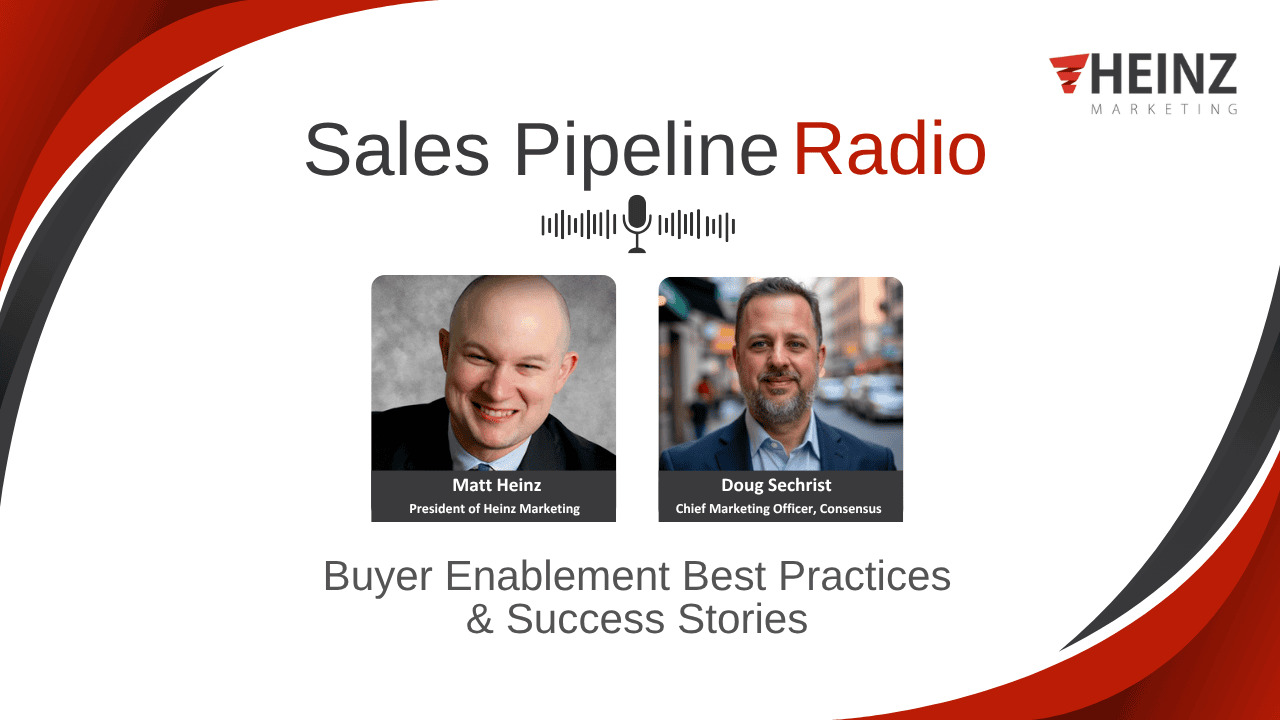
On Sales Pipeline Radio with Matt Heinz, Sechrist put the change bluntly: roughly 90 percent of the journey can happen before a seller is in the room. A buyer comparing four or five vendors leaves each seller a thin slice of time. “You get one shot,” he said. His conclusion is less theatrical than the line. The first human interaction matters more when the buyer has already completed so much private work. A seller who ignores that work forces the buyer to start over. A seller who understands it can begin somewhere useful.
“The buying journey has moved upstream, away from the sales conversation and into the buyer’s own hands.”Doug Sechrist, 2026
Buyer enablement sounds like a small rearrangement of words. It is a transfer of gravity. Sales enablement asks what a seller needs to move a deal. Buyer enablement asks what a buyer needs to make a sound decision, then equips the seller to help. The distinction reaches beyond new business. Sechrist says self-service product experiences increasingly matter during adoption, expansion and the rest of the customer lifecycle. Nobody wakes up eager to schedule a call merely to rediscover a button.
A practical signal stack / from activity to intent
The signal stack above is illustrative, but the hierarchy comes from Sechrist’s recent argument. Traffic, form fills and meetings describe activity. Questions, revisits, demo depth and internal sharing begin to describe progress. Consensus calls this buyer momentum. Its 2026 buyer-behavior analysis found that the average buying experience involved four stakeholders, and that people discovered after a demo was shared engaged at more than twice the rate of the original recipient. The buying committee was assembling in plain sight while the CRM remained devoted to one lead.
The through-lineArt, science and an allergy to decorative metrics
Sechrist describes his approach as both the art and science of marketing. Such phrases can float away if nobody ties them down. In his case, the science is visible: P&L planning, measurement, attribution, data quality, funnel efficiency. The art appears in category design, product positioning and the ability to give a technical shift a human consequence. A missed signal is not merely a reporting defect. It is a buyer repeating herself to a company that was not listening.
Colleagues have described him as thoughtful, metrics-focused, creative and analytical. Consensus CEO Doug Johnson added a bias for action and intellectual honesty about what the numbers show. The career record supports those descriptions without requiring us to bronze them. Sechrist likes operating problems: how teams work together, where the system leaks, which behavior predicts durable revenue, and how to turn strategy into shipped work.
Eloqua: demand marketing amid the rise of marketing automation, followed by IPO and Oracle acquisition.
Five9: an enterprise demand engine, measured data improvements and an IPO.
Infusionsoft and Zenefits: predictive marketing, funnel repair and growth programs built around sharper account signals.
Zenoti: marketing leadership and go-to-market work around the company’s core growth levers.
Consensus: CMO, with a mandate spanning brand, demand, product marketing and buyer engagement.
There is a nice continuity here. In 2012, Sechrist argued that the future of marketing automation lay not in what one platform did alone, but in the ecosystem created when channels could inform the larger strategy. In 2026, he is making a related case about buyer experience. A demo, an AI conversation and a seller meeting should not remain isolated episodes. Together, they can reveal what the buyer cares about and what ought to happen next.
The new assignmentMake the invisible journey legible
Consensus hired Sechrist after expanding through the acquisitions of Peel and Saleo. The company is moving from demo automation toward a broader product-experience platform, and his mandate includes defining that category. Category work is partly language, partly product and mostly patience. A company must explain a change buyers already feel but have not yet named. For Sechrist, the change is that the buying journey has moved upstream, into the buyer’s own hands.
His first published essay at Consensus framed the task around four moves: let buyers do discovery, give them immediate product access, use behavior as intelligence and keep testing the experience. The practical idea is modest. Every interaction should help the buyer make a decision and give the revenue team enough context to improve the next interaction. The organization stops treating self-service as a lobby outside the real sales process. It becomes part of the process.
This is where Sechrist’s old demand factory meets its next raw material. The factory once organized leads and campaigns into predictable stages. The newer system must recognize that buyers take side doors, invite colleagues and inspect only the rooms that interest them. Predictability no longer comes from forcing the route. It comes from paying close attention to the route actually taken.
A less experienced marketer might see the fading authority of the funnel as a loss of control. Sechrist sees another measurement problem. That is both his professional habit and the useful lesson in his career: when the model stops describing reality, keep the discipline and replace the model. Buyers were never tidy. The data has finally become impolite enough to admit it.