The first useful thing to know about Madeline O’Phelan is that she studied journalism and political science. The pairing sounds almost engineered for a career spent explaining complicated institutions to skeptical audiences. One discipline asks what happened and why it matters. The other asks who has power, how decisions get made, and what language persuades the room. O’Phelan has carried both questions from Minnesota public affairs into the executive suite of enterprise software.
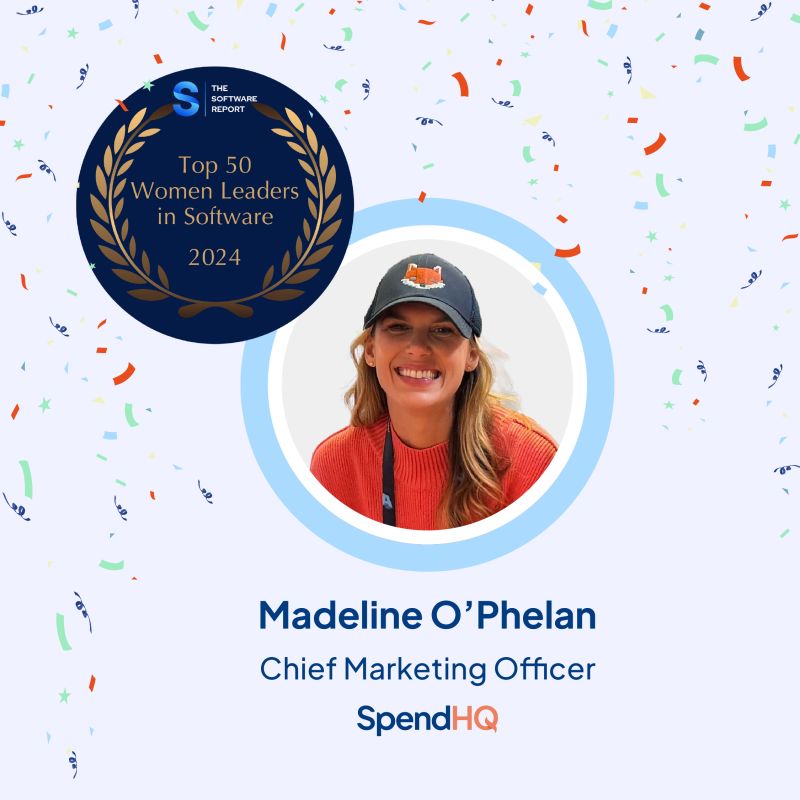
Today she is chief marketing officer at SpendHQ, an Atlanta-based procurement technology company. From Minneapolis, she leads brand, demand generation, and go-to-market strategy. Those three nouns can produce a formidable cloud of corporate weather. Her job is to make them rain: a clear market position, qualified interest, customers who understand the product, and growth the rest of the company can see.
The résumé tells a story of increasing commercial responsibility. The more revealing pattern is the continuity of the craft. O’Phelan keeps landing in fields with dense vocabularies and serious buyers - government, civic technology, fintech, procurement. In each, the marketer must make complexity legible without making it childish, and make a promise appealing without making it flimsy. It is a narrow bridge. She appears to enjoy the crossing.
Before the pipeline, the public record
After Loyola University Chicago, where she earned degrees in journalism and political science, O’Phelan worked in government affairs at Comcast. In 2013 she moved into the director of communications role at the Minnesota Department of Employment and Economic Development. The agency’s output included labor-market figures, grant announcements, and explanations of public programs. It was communication with consequences. A statistic about job vacancies was not decorative content; employers, workers, officials, and reporters could all read the same number for different reasons.
That setting rewards several habits rarely harmed by later success: verify the figure, understand the audience, anticipate the follow-up question, and do not bury the point. These are journalistic habits, but they are also excellent preparation for business-to-business marketing. Enterprise buyers are not short of adjectives. They are short of time and long on reasons to doubt.
In 2016, O’Phelan joined Granicus, which builds software for public-sector communications and civic engagement. It was a logical bridge from public communication to software marketing: she already understood one side of the market’s conversation. Over five years she held leadership roles spanning marketing communications and demand generation. During the early pandemic, she appeared in a Granicus webinar on building adaptable crisis-communications plans, bringing together the operational discipline of government messaging and the reach of software.
Government affairs at Comcast: institutions, policy, and public language.
Minnesota DEED: statewide economic information made clear and usable.
Granicus: communications became SaaS demand generation.
Verity: the operating tempo of private-equity-backed fintech.
SpendHQ: global brand, demand, and go-to-market leadership.
The operator who took the class
A former colleague’s account captures O’Phelan’s method better than a job description can. Asked to take on a website redesign and learn everything she could about search-engine optimization, she took classes. The resulting work, the colleague said, helped produce a 166 percent increase in inbound leads from the website. The number is handsome. The sequence is better: assignment, curiosity, study, execution, evidence.
The anecdote also explains why “creative” and “analytical” repeatedly appear together in descriptions of her work. A website is a story arranged in space. Search performance is a trail of behavior. A serious operator needs both forms of attention. O’Phelan went on to complete Vista Equity Partners’ Marketing Accelerate Program in 2019 and Pavilion’s CMO School in 2023, along with certifications in analytics and marketing technology. Professional curiosity became part of the operating system.
At Verity, where she was vice president of marketing from 2021 to 2024, that operating system met financial technology and the expectations of a private-equity-backed company. In a 2023 podcast, she joined a discussion on how marketing leaders can communicate with boards. The episode organized the challenge around three C’s: context, content, and confidence. Its central tension was familiar. Boards readily grasp customer profiles and account plans; brand can sound softer unless the marketer connects it to the commercial machine.
“We got more leads in the first month than we did in any month of the previous year.”Madeline O’Phelan, on SpendHQ’s website project
O’Phelan’s career suggests that she rejects the false choice. Brand gives demand a reason to exist; demand tells brand whether anybody cared enough to move. A marketer who understands only one side will either make attractive things nobody buys or efficient things nobody remembers. The better arrangement is reciprocal: narrative sharpens measurement, and measurement edits the narrative.
Selling clarity in an age of AI fog
SpendHQ appointed O’Phelan CMO in 2024, giving her responsibility for global marketing across North America and Europe, the Middle East, and Africa. The company’s subject is corporate spending: categorizing it, finding savings, tracking procurement projects, and helping teams explain their impact. In plainer English, SpendHQ tries to reveal where a large organization’s money goes and what procurement can do about it.
That mission has an appealing symmetry with O’Phelan’s own. Spend data is valuable only when somebody can trust it, understand it, and act. Marketing works the same way. A pile of impressions is not a strategy, just as a pile of invoices is not intelligence.
From message to measurable motion
The difficulty rose with the industry’s enthusiasm for artificial intelligence. Procurement AI is easy to describe grandly and hard to deploy responsibly. Enterprise data may be inconsistent; systems must meet security and governance requirements; a dazzling pilot may not survive ordinary work. SpendHQ first invested in Sligo AI in 2025, pairing structured procurement data with agents designed for enterprise workflows, then acquired the company in April 2026.
O’Phelan’s public language about the move focused on crossing from insight to execution. That is a specific claim, and therefore a useful one. It asks prospective customers to judge the product by work completed across category management, sourcing preparation, supplier evaluation, and contract analysis - not by the novelty of a chat window. In an AI market addicted to the future tense, the most persuasive verb may be “works.”
The work beyond the dashboard
There is a civic undertone to the career, too. O’Phelan served on the board of Project 515, a Minnesota organization devoted to equal rights for same-sex couples and their families. She later became board president of Hopewell Music Cooperative North, which works to make music education accessible in North Minneapolis. In a 2016 article recruiting board members, she wrote about the organization’s mission and the need for people who understood music’s power. The move from public affairs to software did not erase the public-minded chapter.
Her official biography supplies a few details from outside the conference room: cross-country skiing, gardening, and perfecting recipes. It is tempting to turn all three into business metaphors. Resist two of them. Gardening, however, deserves a small indulgence. Building a marketing function from “scrappy beginnings” into what she calls a strategic growth engine is less like flipping a switch than cultivating a plot. You choose what to plant, remove what competes for attention, and wait long enough to learn whether the conditions were right. The dashboard is simply the weather report with better typography.
Colleagues publicly describe O’Phelan as thoughtful, competitive, creative, empathetic, and analytical. Those qualities are not perfectly harmonious, which is why the list feels credible. Empathy listens. Competitiveness presses. Creativity proposes. Analysis objects. An executive earns her keep by keeping the argument productive.
That is also what makes her path more interesting than a clean march toward a C-suite title. It is a sequence of languages learned: policy, public information, civic technology, search, finance, procurement, and now agentic AI. The constant is not an industry. It is the discipline of discovering what a particular audience needs to understand next.
A story that answers to the number
O’Phelan has said she is proudest of building marketing teams from the ground up and guiding them from improvised beginnings to strategic growth. The phrase “growth engine” is common in software. The uncommon part is building one that colleagues, customers, sales leaders, and boards can all recognize as the same machine.
Her preparation for that work began before the first funnel diagram. Journalism gave her respect for a fact. Public affairs taught her to read the room around it. Demand generation made the response measurable. Executive leadership widened the audience to include a board asking how every part contributes to enterprise value.
At SpendHQ, she now markets software meant to turn unruly corporate data into decisions. It is difficult, rather unglamorous work, which may be why clarity matters so much. The grand claim has to survive the customer call. The campaign has to survive the revenue meeting. The clever line has to survive contact with the product.
A career can accumulate titles while losing its original plot. O’Phelan’s has done the opposite. The plot has become clearer: find the signal, give it language, and make sure somebody can act on it. Then look at the result. If the number disagrees with the story, the story is the thing that needs editing.