Laurie Miller's career begins with a useful inconvenience: a blank page. Before funnels, revenue targets and AI-ready knowledge bases, there were magazine layouts to assemble. A page is an unforgiving little kingdom. Space is finite. Hierarchy must be visible. A weak choice cannot hide behind a meeting. Miller spent ten years as creative director of the SD Jewish Journal, managing the publication's print and digital presence. It was a long apprenticeship in deciding what deserved attention and what did not.
That first chapter makes her later one at MadCap Software feel less like a sharp turn than a widening road. MadCap sells tools for people who create, manage and deliver complicated information. Its customers include technical communicators, knowledge managers, documentation teams and learning professionals. Miller now serves as chief marketing officer. Her job is larger than arranging a page, but the basic editorial problem remains familiar: make structure legible, make meaning travel and give every element a reason to be there.
Miller describes herself as a growth-oriented marketing leader who can move between strategy and execution. The public record supports the range. Over 23 years, she has worked in editorial design, membership travel, technology products, consulting and software. Her career did not discard one discipline each time it acquired another. It accumulated them. Design became brand. Brand met operations. Operations were asked to produce demand. Demand eventually became an executive brief.
The designer learns to carry a number
Miller studied visual arts and graphic design at the University of Louisiana at Lafayette, earning a Bachelor of Fine Arts after attending from 1996 to 2001. The degree explains the eye. Her subsequent jobs explain the appetite for systems. After the journal, she joined Travel To Go in 2013 as marketing manager, executing national membership campaigns and working with sales agents and department leaders to define what those campaigns needed to do.
In 2016, she moved to EdgeTech as marketing director. The role put her in charge of establishing and managing a full-service marketing and design department. Integrated plans, brand management, communications, promotions, market analysis and media relations gathered under one roof. The creative director was becoming an organizational designer.
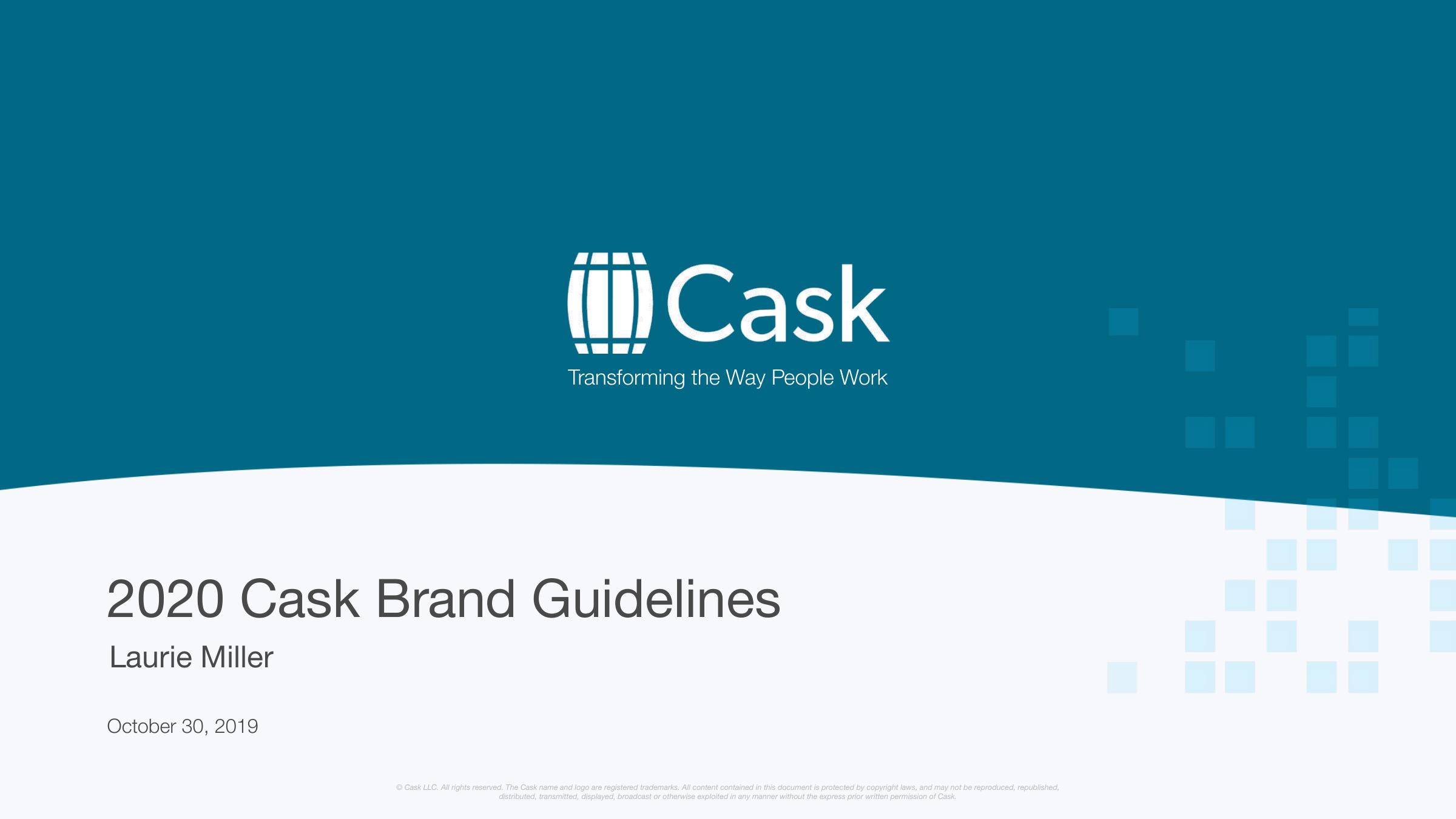
Then came Cask. Miller joined the technology consultancy in 2017 as a marketing associate, became a marketing manager and, by 2020, director of marketing. The progression is revealing because it runs through the work rather than around it. She coordinated campaigns, budgets, lead generation and the everyday traffic of a department. A 2020 brand guide carries her name on its cover. It is both artifact and clue: even as her title grew, the work remained close enough to touch.
“The company culture at Cask is incredible.”Laurie Miller, in a Cask recruiting document
Culture is an easy word to embroider on a pillow. Miller's former colleague Neil Anderson gave it operational meaning. He recalled five years working beside her and credited their marketing effort with 40 percent year-over-year growth. His portrait was of a leader who could build a brand, watch creative details and still roll up her sleeves. More tellingly, he described someone who gave credit to the team when things went well and accepted responsibility when they did not. This is management as an allocation of attention and blame. The first should be generous; the second should travel upward.
A year measured, not merely admired
Illustrative index of the 40% year-over-year growth credited to the Cask marketing effort Miller co-led. The bars show the reported rate, not company revenue.
A fast climb at a company built around content
Miller left Cask in June 2022 for Demostack, a platform for creating software product demos. As demand generation director, she worked on omnichannel campaigns, paid digital media and conversion. The stop lasted eight months, but it added a sharper performance instrument to her kit. In February 2023, she joined MadCap Software as vice president of marketing.
The timing placed her inside an expanding product story. MadCap had started in 2005 with developers from eHelp, the company behind RoboHelp and Captivate. It grew from authoring software into a broader content platform. In 2022, Battery Ventures made a majority growth investment. In 2023, MadCap acquired IXIASOFT and Xyleme, adding component content management and learning content management to its portfolio. Miller publicly greeted the Xyleme deal as a chance to change how organizations approach their content needs.
Her own remit expanded alongside the company. She became senior vice president of global marketing in April 2024, then chief marketing officer in April 2025. Three titles in twenty-six months can look like velocity for its own sake. In context, they mark an enlarged assignment: from running marketing programs to shaping how a growing portfolio explains itself across documentation, learning and enterprise knowledge.
- Make the page work. Creative direction for a print and digital publication.
- Make the campaign work. Travel marketing, then a technology marketing department.
- Make the system work. Three increasingly senior roles at Cask and Ondaro.
- Make demand measurable. Omnichannel programs and conversion at Demostack.
- Make the portfolio coherent. VP, SVP and CMO at MadCap Software.
The company says it serves more than 3,000 organizations and 20,000 licensed users. Those figures create a particular kind of marketing problem. The audience is specialized, the workflows are technical and the payoff can be hidden in fewer duplicate files, faster updates and less confusion. There is little room for perfume. The language must show how governed content affects real work.
When every business became a publisher
Miller's current chapter turns an old editorial concern into an AI-era business question. Organizations now publish procedures, training, help articles and product knowledge across portals, learning systems, support tools and assistants. When each channel keeps its own copy, information drifts. A small inconsistency can become a large credibility problem when an AI system retrieves it at speed.
In 2026, MadCap relaunched Syndicate AI as a governed content-delivery platform. The pitch is that information can move from an approved source into many human and machine experiences without losing control along the way. Miller has been blunt about the stakes. “Do you trust your AI?” she asked in a recent post, before pointing readers toward the role of governance and accountable authors. Earlier, she wrote that very few organizations possess the knowledge infrastructure required to make an AI strategy reliable.
“Do you trust your AI?”Laurie Miller, 2026
It is a neat reversal. For years, software companies told buyers that content was the soft layer on top of the product. Now the content determines whether the product can answer a question responsibly. The copy deck has become infrastructure. The editor's instinct - Which version is authoritative? Who owns this sentence? Where else does it appear? - has become an executive concern.
Miller's public professional activity is notably focused on that work. She shares guidance about content drift, single sources of truth, orchestration and the expensive accumulation of duplicate learning materials. There is no elaborate personal legend attached. The personality arrives indirectly, through what colleagues say: collaborative, exacting about creative work, willing to coach, quick to credit a team and prepared to remove an obstacle herself.
Her continuing education follows the same practical grain. Miller completed an accelerated management program through Yale School of Management Executive Education in 2021, operational marketing coursework in 2022 and Pavilion's CMO School certification in 2025. The sequence mirrors the career: add management to craft, operations to management and executive range to operations.
The page was never just a page
There is a temptation to tell careers like Miller's as tales of escape: the designer escapes design, the manager escapes execution, the executive escapes the details. Her record suggests the more interesting opposite. Each stage preserves something useful from the last. The visual artist notices hierarchy. The publication director respects deadlines. The campaign manager asks what the audience should do. The demand-generation leader checks whether they did it. The CMO decides how those habits serve the whole company.
That is why the blank page still matters. It teaches economy before a career acquires abundance: more channels, more data, more software, more content than anyone can sensibly read. Miller now markets products designed to impose order on that abundance. The scale has changed. The craft question has not. What belongs here, who is it for, and can they trust it?
In an era enchanted by production, Miller's trajectory makes a quieter case for stewardship. A useful piece of information is not finished when it is written. It must be structured, owned, delivered and kept true. The same can be said of a career. Hers has been built not by leaving the page behind, but by discovering how many systems live inside it.