PartnerStack exists because four founders were honest about a failure. Their first company, Pod, was collaboration software for nonprofits - essentially Slack with fewer features, fewer customers, and considerably less money. Bryn Jones and Luke Swanek had taken out loans. The founders worked from a small house in Toronto's Koreatown. At one point, even a subway pass felt expensive. Then something irritating happened: the bad product began making roughly $20,000 a month when outside agencies sold it for a commission.
The team had accidentally built a channel program. Customers were not asking how to use Pod; companies were asking how Pod had organized those outside sellers. That distinction became the business. The founders stopped polishing the collaboration app and turned the administrative mess behind referral selling into GrowSumo, later renamed PartnerStack.
The product was hiding in the workaround
Jones has described Pod with the efficiency of a founder who has processed the embarrassment: it was a bad version of Slack. The useful behavior was happening around it. Agencies in Toronto and London could reach nonprofit buyers the founders could not. Paying those agencies only when a sale happened turned fixed acquisition risk into variable cost. It also produced a swarm of new chores - attribution, agreements, commissions, updates, and proof that the right person deserved credit.
On a flight at the end of 2014, Jones compared the slow path in front of Pod with the opportunity cost of starting again. After the holiday, the group built a landing page around the one part that worked. The page barely did anything. It proposed that anyone could refer a business and earn a reward, and it displayed sample profiles to make the idea tangible. Jones and Swanek then called companies likely to run partner programs. Forty agreed in two weeks.
That was the mind-changing evidence. Not a brainstorm, not a market map, and not an enthusiastic accelerator mentor - customers committing to an unfinished solution. Three months after the idea, the team applied to Y Combinator as GrowSumo. The site still did not work. The founders could, however, describe the pain with the fluency of people who had lived inside it. YC accepted them into its Summer 2015 batch.
“We landed 40 companies in 2 weeks and that was the proof we all needed.”Bryn Jones, co-founder and CEO

A back office for other people's sales
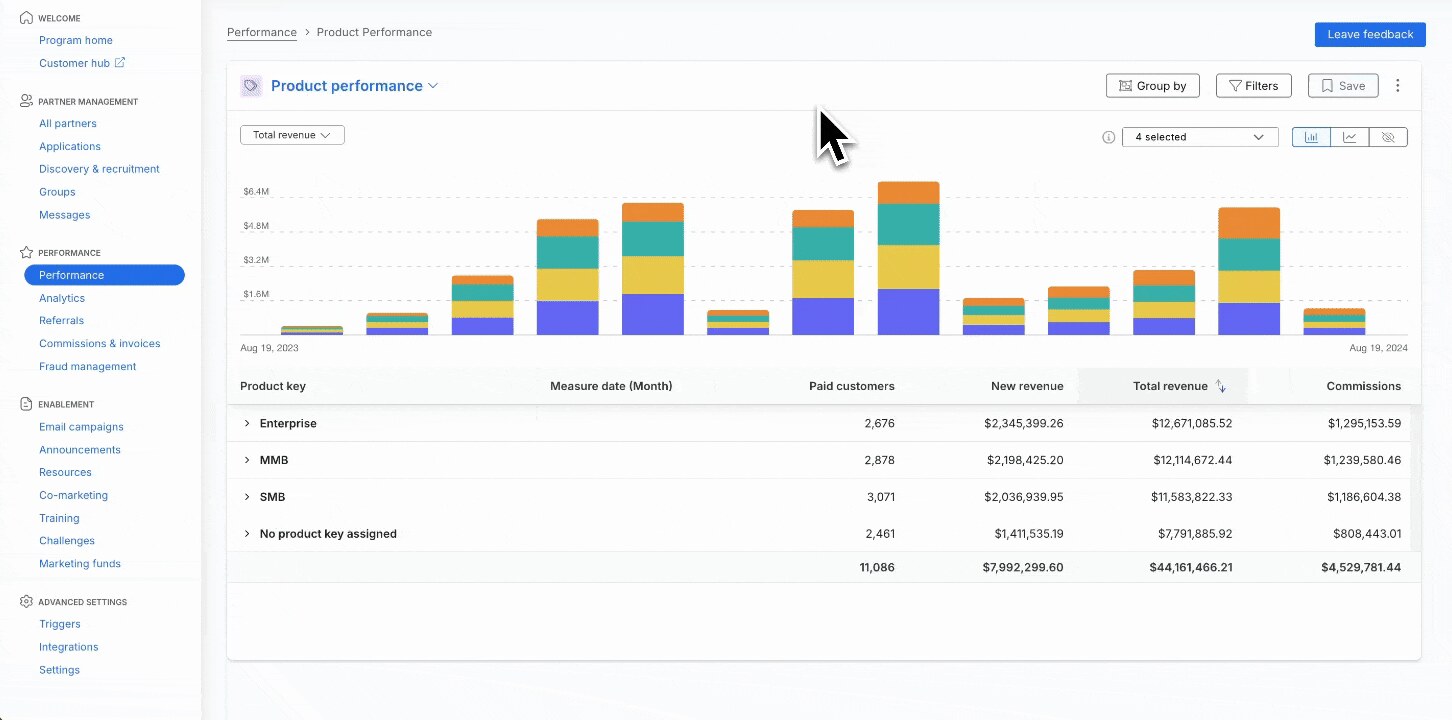
PartnerStack is partner relationship management software, or PRM, for B2B companies. Its customers create programs for affiliates, creators, customer referrers, agencies, resellers, and co-sell partners. The platform recruits applicants, segments them, delivers onboarding and training, issues tracking links, accepts leads and registered deals, synchronizes activity with a CRM, calculates commissions, pays partners, and reports which relationships produced revenue.
Two groups use it. A vendor such as monday.com, Webflow, Apollo, Freshworks, or PandaDoc operates a program. A publisher, consultant, influencer, agency, or reseller joins programs and earns commissions. The vendor buys the software. Partners can discover multiple programs through one account instead of learning a new portal for every product they recommend.
That shared network is the important difference. Traditional PRMs are often private portals: good at organizing partners a company already has, less useful when the company needs more. Simple affiliate tools can track a Stripe purchase cheaply, but they usually do not manage a reseller's deal registration, training, multi-step B2B conversion, and commission in the same system. PartnerStack's wager was that workflow software, distribution, and money movement belong together.
Automation is only useful when the program is alive
PartnerStack's case studies are most persuasive when they describe the pre-software indignities. CallRail spent more than 10 hours a month on payouts and worked through one-to-one contracts and fragmented communication. Genesys says automation saved teams more than 120 hours a month. Pipedrive needed to communicate with and pay thousands of affiliates. These are not branding problems. They are operations problems with a trust penalty: a partner who cannot see a deal or predict a payment stops sending the good leads.
Omnisend supplies the more revealing failure story. The email-marketing company briefly moved its agency program to another vendor. Internal teams and partners encountered enough friction that Omnisend returned to PartnerStack. After the broader realignment, it reported more than 200 percent year-over-year growth in partner-attributed revenue, with agency-sourced new business exceeding 40 percent in one quarter. The software alone did not create that growth, but the wrong operating layer was capable of slowing it.
This is where the marketplace pitch needs adult supervision. A large directory is not a sales force. Programs still require a credible offer, useful creative material, responsive managers, clean rules, and partners whose audiences match the product. PartnerStack can make applications and activity visible. It cannot make a forgettable product worth recommending.
04 / The economicsThe price of replacing a spreadsheet
per month, annual billing
PartnerStack's public marketing-channel Launch plan starts at $1,000 a month paid annually. A co-sell Launch plan starts at $1,250. Higher Growth tiers and Enterprise plans add flexibility and support; contract-specific fees can also apply to commission invoices.
The business model is conventional SaaS wrapped around transaction infrastructure. Vendors pay an annual subscription. PartnerStack also charges agreed fees connected to commissions, then collects the vendor's reward funding and remits it to partners through payment providers. The company benefits when programs grow, while vendors trade several finance and operations tasks for one system and one consolidated bill.
At $12,000 a year before related fees, the platform is not designed for the founder who has three friendly affiliates and twelve customers. It makes sense when labor, leakage, delayed payouts, poor attribution, and missed partner revenue cost more than the subscription. The break-even question is not “Can a spreadsheet track a link?” It can. The question is how many people must maintain the spreadsheet once customers upgrade, churn, buy through sales, register deals, change currencies, and dispute credit.
05 / What to stealCopy the sequence, not the software
PartnerStack's founding playbook is useful precisely because it starts before the platform. A small SaaS team can reproduce the logic without reproducing the company.
- Find the workaround already earning money. Pod's commission channel was not on the roadmap. It was the behavior customers and sellers pulled into existence.
- Describe the pain before building the cure. The GrowSumo landing page was a promise. Forty conversations tested whether the promise relieved something urgent.
- Run the channel by hand. Manual work exposes the actual objects - partner, link, lead, deal, contract, reward, payment - that software eventually needs to model.
- Measure activation, not enrollment. A thousand approved profiles are inventory. Track the smaller number that completes training, creates content, submits qualified pipeline, and earns a first commission.
- Automate trust points first. Attribution, deal status, commission rules, and payment timing are the moments where ambiguity damages a relationship.
When this will not work
A partner channel is a poor rescue plan for weak retention, fuzzy positioning, or a product no specific audience wants. PartnerStack is also excessive when program volume is low, margins cannot support commissions, the sale is simple enough for a lightweight tracker, or nobody owns recruitment and enablement. Automation scales a working motion. It also scales an empty one.

AppDirect bought distribution, not a prettier portal
The market around PartnerStack ranges from lightweight affiliate trackers such as Rewardful and FirstPromoter to enterprise PRMs such as Impartner, impact.com, Allbound, Channeltivity, and ZiftONE. Crossbeam and Reveal overlap in co-selling and ecosystem data, though they are frequently complements rather than complete substitutes. PartnerStack sits in the middle of these categories with a specific B2B SaaS emphasis and an unusually visible network.
AppDirect's April 2026 acquisition made that positioning explicit. PartnerStack arrived with more than 138,000 B2B partners. AppDirect brought subscription commerce, reseller infrastructure, and cloud-marketplace capabilities, reinforced by its earlier Tackle.io acquisition. The proposed whole is a distribution stack: discover a partner, coordinate a deal, transact software, attribute the result, and pay the people involved.
Pod stalls
The nonprofit collaboration app struggles; its commission channel works.
GrowSumo pivots
Forty cold-call yeses lead to Y Combinator and an early launch.
Network bet
A $29 million Series B funds matching, payments, product, and team growth.
AppDirect buys
The partner network joins a broader subscription-commerce platform.
PartnerStack has also begun adding AI for partner discovery, recruitment, conversation support, and program analysis, plus an MCP interface intended to let compatible assistants query performance and take approved actions. Those features may shorten research and administrative loops. They do not change the oldest lesson in the company: the good partner is not merely found. The good partner understands the product, trusts the rules, reaches the right customer, and sees enough mutual value to keep showing up.
The company's original insight remains more durable than any feature list. Selling through other people creates leverage, but it also creates a second customer: the partner. PartnerStack built the machinery for serving both sides. Its founders got there only after the first product failed loudly enough for the useful side effect to be heard.