The problem was arithmetic. At Pivot3, a technology company selling through partners, growth had outrun the possibility of giving everyone individual attention. A reseller needed help; another needed training; a third had an opportunity to register. Multiply those requests by hundreds of partners and a channel manager’s calendar becomes a very expensive waiting room.
Bruce Milne, then a Pivot3 executive, described the constraint plainly: “We didn’t have the resources to engage with every partner individually.” Impartner’s answer was to make more of those interactions repeatable. The intriguing part of this business is how much of selling happens before anybody gets to sell.
- Impartner runs the machinery of indirect sales: onboarding, training, deals and partner marketing.
- Its customers include enterprise channel programs and growing technology businesses.
- The product connects partner work with CRM data, marketing execution and cloud marketplaces.
- The useful lesson: find the administrative bottleneck before recruiting another hundred partners.
The arithmetic of one-to-many
A partner relationship sounds pleasantly social. In practice, it comes with permissions, contracts, training requirements and an argument about who found the customer. Businesses that sell through distributors, resellers or referral partners need to manage all of this across organizational boundaries. Their partners have other suppliers, other priorities and their own targets.
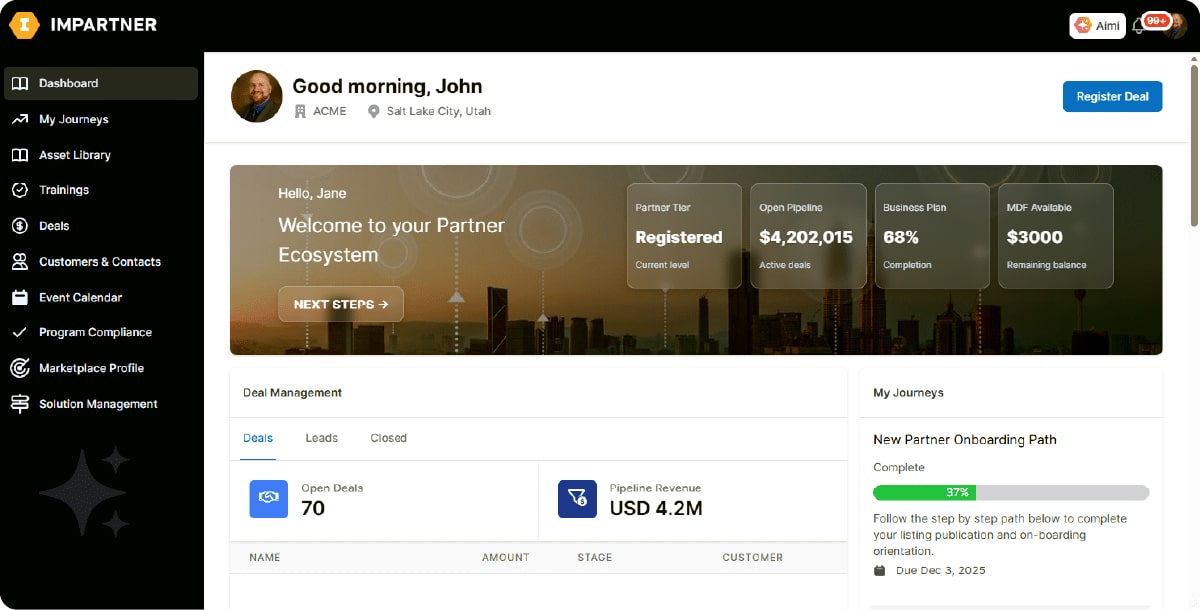
That is the market for partner relationship management, or PRM. A CRM organizes a company’s customer relationships. A PRM organizes the people outside the company who help create those relationships. Impartner supplies a branded portal and the workflows behind it: applications, onboarding, content, training, deal registration and performance reporting. The distinction matters because a partner is neither an employee nor simply another customer.
The company began in 1997 as TreeHouse Interactive, founded by Craig Flynn. In 2015, Joe Wang and Kennet Partners acquired majority ownership. Craig remained involved in engineering; Erich Flynn led sales. TreeHouse became Impartner. This was an established software business being repositioned for a bigger market, with a new name considerably easier to fit into a conversation.

The subsequent acquisitions reveal how the idea of a partner widened. Tremolo, acquired in June 2018, brought newsletter and social communication products. Amplifinity, acquired in August 2019, added referral management and incentives. A consultant who introduces a customer needs different machinery from a distributor moving inventory. Impartner was accumulating ways to serve both.
A portal has to earn its login
The easiest partner portal to build is a cupboard: put brochures inside, issue passwords and call it enablement. Impartner’s more interesting proposition is a workspace. A partner can register a deal, complete a course, find an approved asset and track the next step without making every action somebody else’s task.
AvePoint provides a concrete illustration. In a public customer testimonial, its channel executive Sam Valme reported that channel revenue’s share rose from 20% to 50% after two years. He also described plans to recruit another 700 partners without hiring another 50 account managers. Those figures describe AvePoint’s experience and ambitions; they do not establish that software alone produced the revenue shift.
Share of revenue through the channel. Customer-reported; not a controlled test of software impact.
In a separate customer session, AvePoint explained how it used custom objects to centralize atypical partner requests. That detail is more instructive than a triumphant growth slogan. Ordinary requests can follow ordinary workflows. Exceptions need somewhere to live, someone to own them and a visible status. Otherwise the portal merely redirects the confusion to email.
SoSafe identified another friction point: evaluating and processing deal registrations by hand. Its public testimonial describes hours saved by automation and a common reporting view between teams. Here the failure is specific. A partner has found an opportunity, but the vendor’s internal process makes recognizing it laborious. Speed matters even before the final sale.
The marketing department next door
Managing partners and helping them generate demand are related jobs. Impartner sells partner marketing automation, also called through-channel marketing automation, alongside its PRM. A vendor can provide campaigns and co-branded materials rather than expect every reseller to invent its own marketing department.
Xerox’s experience makes the point tangible. In a public testimonial, Isabelle Pampelune said Google Ads became the first source of partner leads across its geographies. She reported a 75% reduction in cost per lead without an increase in media budgets. This is a customer’s account of a particular program, rather than a discount every buyer can expect.
The attraction is division of labor. The vendor supplies brand knowledge and campaign infrastructure; local partners contribute market presence and customer relationships. Central execution can preserve consistency while allowing a campaign to arrive wearing the partner’s name. A badly organized version of the same arrangement gives everybody access to assets and nobody responsibility for the result.
Training closes another gap. Impartner supports SCORM-compatible courses and certification tracking. Its News on Demand product delivers segmented newsletters. These features share a modest ambition: put the right material in front of someone who can use it. A certificate that goes stale and a newsletter nobody reads are both administrative activity disguised as progress.
The invoice and the evidence
Impartner’s economics are those of business software: recurring subscriptions, packages, optional capabilities and services. Its PRM pricing page offers package comparisons and a request for pricing. A buying team therefore needs a proposal covering its actual configuration. HyperscalerGTM was announced with a base subscription fee and transaction-based pricing, so commerce volume introduces another cost variable.
The company has financed expansion through several different instruments. Emergence Capital invested $15 million in 2017. Brighton Park Capital led a $50 million growth round in October 2021, with existing investors participating. CIBC Innovation Banking announced $35 million of growth capital financing in May 2022. Lender financing and an equity investment belong in different columns, however tempting it is to add everything into one imposing number.
A 2023 Forrester Consulting study commissioned by Impartner modeled a composite organization based on customer interviews.
The commissioned study also reported $2.4 million in net value over three years and a payback period under six months for that composite. Its value is as a structured economic argument: less administration, better partner activity and more productive demand generation can justify investment. A composite organization is a model, with assumptions. Its return is a question to test against your own operation.
Impartner competes with Salesforce partner management, PartnerStack, Allbound and other specialist tools. Its proposition is breadth across the partner lifecycle, paired with connections into existing systems. The buyer’s choice depends on which tasks need joining up, the CRM already in place and the type of partners being served. A long feature list earns its keep only when those features remove actual work.
The next bottleneck is the quote
The recent product direction moves closer to the transaction. HyperscalerGTM connects deal registration with co-selling and cloud marketplace execution across AWS, Microsoft Azure and Google Cloud. Its workflow includes private offers and revenue data returning to analytics. This targets the awkward handoff between a partner finding business and the systems through which a customer purchases it.
- 01Register
the deal - 02Coordinate
co-selling - 03Create
the offer - 04Track
the revenue
Conceptual workflow for HyperscalerGTM. Eligibility, approvals and configuration still govern transactions.
Aimi, released in December 2025, puts AI into everyday partner tasks: creating and translating content, creating records from text or voice, and locating knowledge through an assistant connected to the asset library. The practical detail is configuration awareness. Impartner says Aimi recognizes required fields and asks for missing information. A conversational interface becomes useful when it understands the form it is replacing.
In June 2026, Impartner expanded native HubSpot CRM Sync, including reciprocal data synchronization and duplicate-record management. In August it launched Impartner CPQ. Partners can configure offerings from a vendor-controlled catalog, use established pricing rules and submit proposals for approval inside the PRM. Quoting becomes part of the partner’s workspace, with vendor controls intact.
“Quoting should not be the point where a partner opportunity slows down.”Robert Harris, VP of Product Management, Impartner · August 2026
Copy the sequence, then choose the software
The transferable idea is to follow one partner through one sale. Count the requests for help. Note where a record gets entered twice. Find the approval that requires a private email. Then decide which step should become self-service, which should be automated and which needs a human with clear responsibility. This is an operational inference from the customer examples, not a promise attached to a license.
The conditions matter. A business with few partners and little administrative complexity may have less to gain from a broad platform. Dirty CRM records, unclear deal ownership or unappealing partner economics can survive a software purchase quite comfortably. Automation accelerates the process you have defined; it cannot decide whether the partner has a reason to participate.
Impartner’s story is compelling because the ambition sits inside small actions: finding a document, submitting a request, finishing a certification, getting a quote. Each looks trivial until hundreds of people need to do it. Selling through someone else requires making it reasonably easy to be that someone else.
Open the workspace
Explore Impartner’s website, its interactive product tours, customer stories and latest product news.
Watch the AvePoint partner operations session or browse Impartner’s YouTube videos. Follow on LinkedIn, X and Facebook.