Tom Furr's first useful advantage arrived disguised as a missing credential. He left school at 16. In Britain, that could be stated as a fact; in America, where he now lives, it became a conversational trapdoor. New acquaintances traded university initials. Furr had work. By the time some peers were collecting degrees and searching for entry-level roles, he was collecting years inside the job. He became a vice president at 26.
The tidy version would make this a parable about ignoring education and charging ahead. Furr refuses the tidiness. He says there is no single correct route. What mattered in his own case was the way he traveled it: energy, ambition and humility. The first two accelerated him. The third kept acceleration from hardening into certainty.
The label he tried to outrun
His career moved through digital marketing, strategy and an advertising agency before reaching NewVoiceMedia, the cloud contact-center company later bought by Vonage. The résumé became increasingly senior, but one word clung to it: brand. Furr worried that the tag placed him on the decorative side of B2B marketing while demand generation and product marketing occupied the serious, measurable center.
So he translated. A brand campaign contained product positioning. Media buying resembled demand generation. Measurement showed fluency in performance. Each explanation was accurate, yet the cumulative effect was odd: the marketer whose job was to identify and amplify difference was sanding down his own.
A conversation with Anthony Kennada, formerly the CMO of Gainsight, changed the pitch. Brand was not evidence that Furr lacked breadth. It was the unusual capability in a field full of candidates with similar demand, product and field experience. The advice was bracingly practical: own the difference. If a company wanted a demand-generation specialist in the CMO chair, Furr could politely reject the fit. The right company would be hiring the distinction rather than tolerating it.
“Principles endure and formulas don't.”Tom Furr on carrying lessons between companies
This was career advice and brand strategy folded into one sentence. A company that attempts to resemble every safe competitor becomes harder to choose. So does a person. Once Furr stopped presenting his specialty as an apology, his path grew more coherent.
Nine acquisitions, one familiar sound
At Vonage, coherence was the assignment. Americans knew the name from residential phone service and its obstinately memorable “WooHoo” jingle. The business underneath that memory had changed. Through organic growth and nine acquisitions, Vonage had assembled cloud communications, contact-center software and programmable APIs. A collection of capabilities needed to become one company in a buyer's mind.
Furr, then head of brand, helped retire a set of acquired identities and reintroduce Vonage as a B2B cloud communications platform. The work respected the old recognition without pretending the old proposition still fit. It is difficult brand surgery: keep the part people remember, replace what they think it means.
He moved next to MongoDB as vice president of brand marketing, content and creative. There, he worked on a rebrand and repositioning and watched leadership habits at close range. He admired CMO Peder Ulander, including a culture that favored written memos over slide decks. When Furr later arrived at DISCO, he carried the visible method with him. It did not fit.
The companies had different cultures, characters and problems. Copying MongoDB's ritual preserved the surface while losing the reason. Furr stepped back. The transferable principle was disciplined thinking, not the memo itself. To learn DISCO on its own terms, he held more than 100 one-to-one meetings in his first two months. People supplied what a template could not: context.
An office larger than the living room
DISCO appointed Furr chief marketing officer in June 2022. It was his first CMO role. He took responsibility for brand, communications, demand generation, sales enablement, field marketing, digital and performance, creative and communities. The title came with an office larger than the living room in his apartment. The joke landed because the scale felt real.
Executive leadership also altered his place in a meeting. As a functional leader, he had been one marketer among marketers. In the senior room, he was often the only one, expected to represent the entire discipline while contributing to conversations that were not about campaigns at all. His formulation is crisp: a CMO is a business leader who needs an opinion on the business.
His way through unfamiliar decisions was social rather than theatrical. Consult the network. Find people better at the problem. Invite the contrarian view. Ask what becomes true if the objection is right. Then decide and own the result. Humility, in this version, is not endless hesitation. It is the removal of ego before commitment.
Legal tech discovers a sense of humor
DISCO sells software for litigation, including e-discovery and AI-assisted legal work. The stakes are serious, and the category's visual habits tend to advertise that seriousness with restraint. Furr's response was Lady J, a bronze-painted reimagining of Lady Justice who speaks plainly, mocks antique technology and tells lawyers to “Law Better.”
Lady J was Furr's first character. She gave DISCO a recurring voice and the category an interruption. In a field where competitors can borrow the same product vocabulary and respectable styling, the campaign made a strategic bet on memory. A creative idea still had to express real product differences, but it did not have to dress like a procurement document.
When every team can access similar targeting, scoring and optimization, the scarcer advantage is being recognized before the sales conversation begins.
His argument does not demote performance. Short-term results earn permission for long-term investment. Sales teams care about leads, and they also know how much harder a meeting becomes when the prospect has never heard of the seller. Brand and demand work as a pair: one helps create recognition; the other converts active interest. Furr's complaint is aimed at the false choice.
The same pairing helps explain why he was hired. In 2022, brand awareness was becoming a more explicit B2B problem. The standard performance machinery had spread: comparable advertising systems, comparable lead scoring, comparable habits of optimizing every available inch of a campaign. Those systems remained useful, but access to them no longer made a company unusual. Furr had spent his career working on the less standardized layer - how an enterprise brand appears, sounds and organizes a jumble of products into a thought a buyer can retain.
At DISCO, that layer stretches beyond advertising. His remit joins communications and creative with demand, sales enablement, field activity, digital work and communities. The organization chart quietly rebuts the old fear that brand sits apart from commercial work. The specialist did not abandon his craft on the way to the C-suite. He placed it in conversation with the rest of the revenue system.
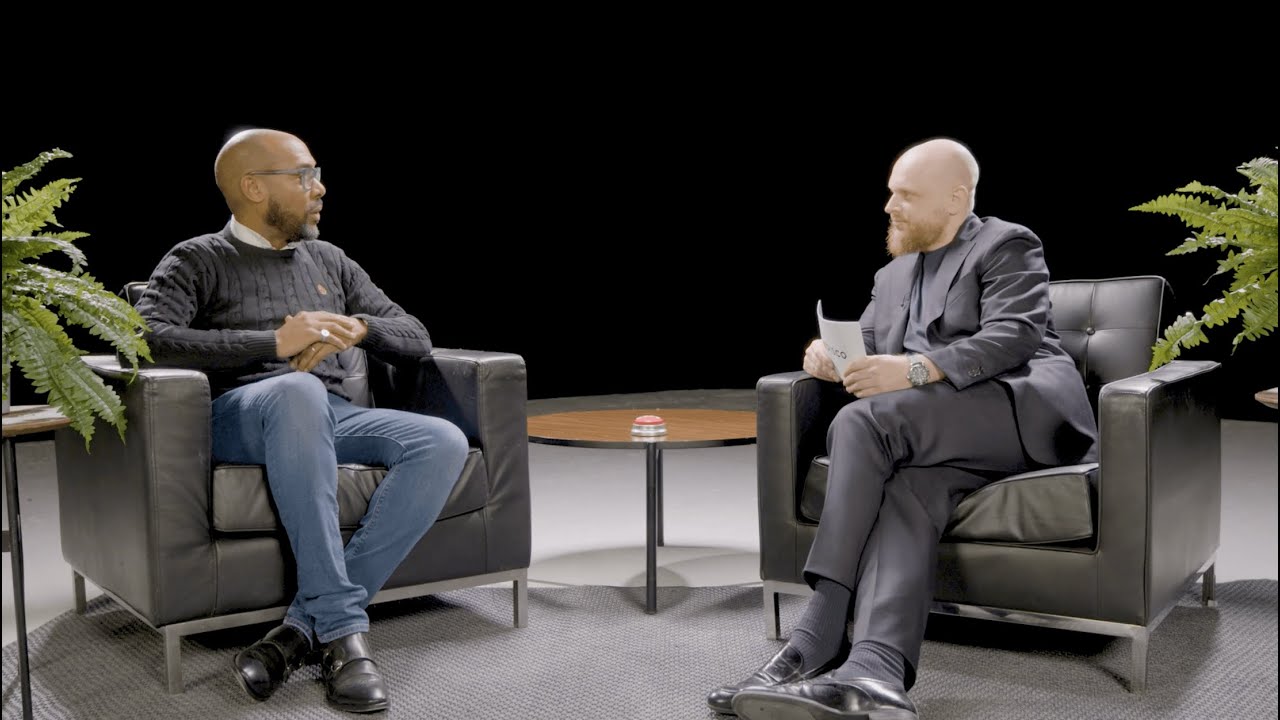
He also practices the tone he preaches. A LinkedIn essay promising lessons from the Michael Jordan documentary answered its own question with one word: “Nothing.” When the DISCO team wore temporary tattoos of his face for his birthday, he posted a request for help. Two bobblehead versions of Tom later joined the collection. His video series, “Between Two Firms,” placed lawyers between ferns and prompted him to ask publicly whether anyone knew Zach Galifianakis.
The jokes are not random garnish. They reveal a consistent suspicion of corporate solemnity. Furr's public personality - bald, bearded, British, cheerfully self-mocking - becomes evidence for his professional claim. People notice a voice with edges.
There is a civic ambition beneath the comic delivery. When Furr joined DISCO, he said legal technology was only beginning to reveal its capacity to transform legal practice. The company's stated purpose gave him a category larger than software features: tools that could help lawyers work more efficiently and strengthen the rule of law. He wanted to widen both awareness and demand while the company expanded its products and reach. Lady J could crack the joke because the work behind her still had to matter.
Boldness after the novelty wears off
By 2025, Furr was speaking at Demandbase's GO NYC about a future-ready go-to-market organization: better alignment, sharper fundamentals, personalization and the new problem of discoverability when buyers use reviews and large language models to research vendors. The channels changed. His underlying concern did not. A company still has to enter the consideration set.
That makes Furr's own career unusually symmetrical. He advanced after learning to enter the right consideration set as himself. The candidate trying to demonstrate every possible marketing strength was competent but blurry. The brand operator willing to say “I am not your person” to a mismatched role was easier to understand.
Leaving school early gave him time. Brand gave him a craft. Leadership taught him to separate a durable principle from a fashionable formula. At Vonage, MongoDB and DISCO, the products became more technical and the categories more crowded. His assignment remained stubbornly human: make the complicated clear, give it a recognizable character, and listen long enough to know which parts should never be copied.