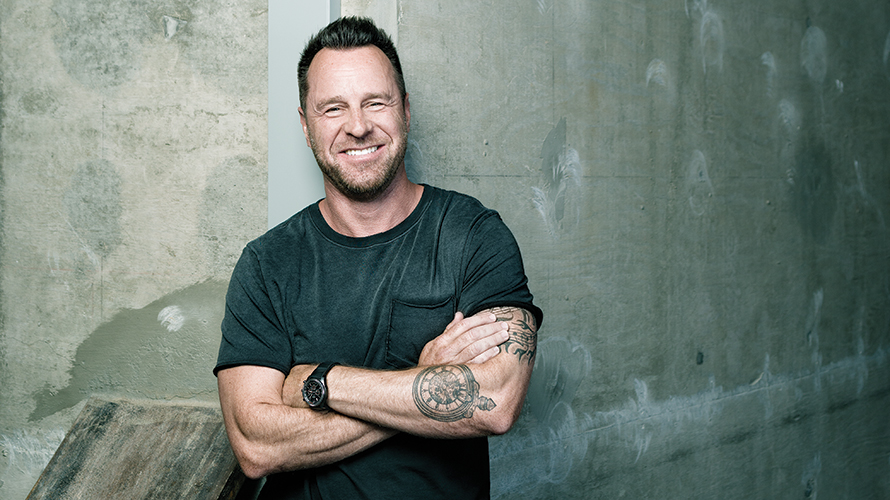
There's a phoenix tattooed on Toby Gabriner's body. Not as decoration. As documentation. The man has been to the mat - two failed startups, a dot-com bust that gutted his company overnight, a marriage that didn't survive the journey - and each time, he's rebuilt. Not from scratch, exactly. From muscle memory. From the particular resilience of someone who knows what collapse feels like and has decided to stay anyway.
In early 2025, Help Scout - the Boston-based customer support platform trusted by over 12,000 businesses - named Gabriner its new Chief Executive Officer. He was the choice at a pivotal moment: AI is rewriting what "customer support" means, and Help Scout's founder Nick Francis was handing the wheel to someone with a track record of platform transformations. Gabriner's hire wasn't a caretaker move. It was a signal.
"I care deeply about customers, about the people who build great products for them, and about the kind of company culture that makes both possible," Gabriner said on joining. He wasn't pitching investors. He was telling the team who he is - and the market has spent 25 years verifying the claim.
Remain maniacally focused on the customer problem you are trying to solve.
- Toby Gabriner
The career arc started improbably. Gabriner grew up working-class in San Francisco's Mission District, was kicked out of his family home at 18, and took an entry-level job at Parenting Magazine. He put himself through community college on straight A's, transferred, eventually earned an MBA from Boston University's School of Management and a BA in Political Science from Occidental College. The trajectory sounds orderly in retrospect. It was anything but.
Phoenix Tattoo - Rising From Failures, Every Time
His first real company, Freestyle Interactive, a digital agency he founded in the late 1990s, was acquired by Carat in 2003 - making him President of Carat Interactive, one of the industry's earliest large digital shops. Then came the dot-com collapse. He was running a 60-person bootstrapped agency when he lost 40% of revenue in a single night. Forty employees. He laid them all off - and personally met with each one to explain the decision with dignity. It's the anecdote he returns to when people ask about resilience. Not the exit. The layoffs.
"Resilient people are those that have a combination of determination and grit," he has said. The emphasis on both matters: determination without grit is just stubbornness; grit without direction is just pain. Gabriner tends to combine them productively.
The story people in ad tech tell about Toby Gabriner is the Adap.tv story. He joined the video advertising platform as President and CEO around 2009, when it was a small, pre-revenue operation finding its footing in a market that barely existed yet. Four years later, revenue had gone from $200,000 to over $200 million. That's not a growth rate. That's a rounding error becoming a company. AOL acquired Adap.tv in 2013 for $465 million.
Adap.tv Revenue Growth Under Gabriner (Approximate)
Before Adap.tv, there was [x+1], one of the earliest demand-side platforms in programmatic advertising. Gabriner was CEO there too. The pattern was already forming: take an early-stage platform at the edge of a market shift, build the team and the customer base, push hard on revenue, and exit or evolve. Repeat.
In 2016, Gabriner joined AdRoll as a strategic adviser - which, for him, was apparently a transition state, not a destination. Within months he was President. Within a year he was CEO, succeeding co-founder Aaron Bell. AdRoll had built a business on retargeting, and Gabriner thought that description undersold it. "We have, for the longest time, been pigeonholed as a retargeting company," he said in 2019, "but the reality is that we have really been evolving."
In September 2019, AdRoll Group became NextRoll. New name. New structure. Two business units - AdRoll for e-commerce brands, RollWorks for B2B account-based marketing - plus a platform services layer for developers. The company had reached $300M+ in annual revenue run rate. The rebrand wasn't cosmetic; it was Gabriner signaling that the company's self-definition had outgrown its founding product.
The pattern repeated at Bitly. He joined as CEO in 2020, during a pandemic that was - inadvertently - making digital engagement tools more relevant than ever. Bitly was known for one thing: making long URLs short. Gabriner made it into a multi-product platform covering traffic analytics, campaign management, and QR code solutions. The QR code bet, in particular, proved shrewd: pandemic-era menus and contactless everything brought QR codes back from near-obsolescence, and Bitly was positioned to capture that wave.
Help Scout is different from anything Gabriner has run before. It's not an ad tech stack or a link management tool. It's where customer relationships live - the shared inbox, the knowledge base, the live chat, the metrics that tell a support team whether they're doing their job. Over 12,000 businesses use it. Many of them are the kind of companies that care deeply about not feeling like they're talking to a robot.
The timing is deliberate. AI is arriving in customer support at speed, and Help Scout - built on the premise that design should serve end-users, not just decision-makers - is navigating a moment where "AI-powered support" can mean either "better for customers" or "cheaper to run, worse for customers." Gabriner has been clear about which direction he's heading. He noted that Help Scout's approach to designing for end-users represents "the right foundation for where customer support is headed."
His first stated priority was direct engagement: talk to customers, understand what they need, before anything else. That's not a communications strategy. That's a worldview. Twenty-five years of scaling companies, and his opening move at the newest one is still the same: listen first.
An English teacher once told Toby Gabriner he would never amount to anything. That teacher is unnamed in the anecdote. Gabriner says the doubt still motivates him. He has the phoenix on his skin as a reminder. He has four CEO tenures, a near-half-billion-dollar exit, and a fifth act beginning in Boston as evidence.
The reinvention has not stopped. It's just moved to a different building.