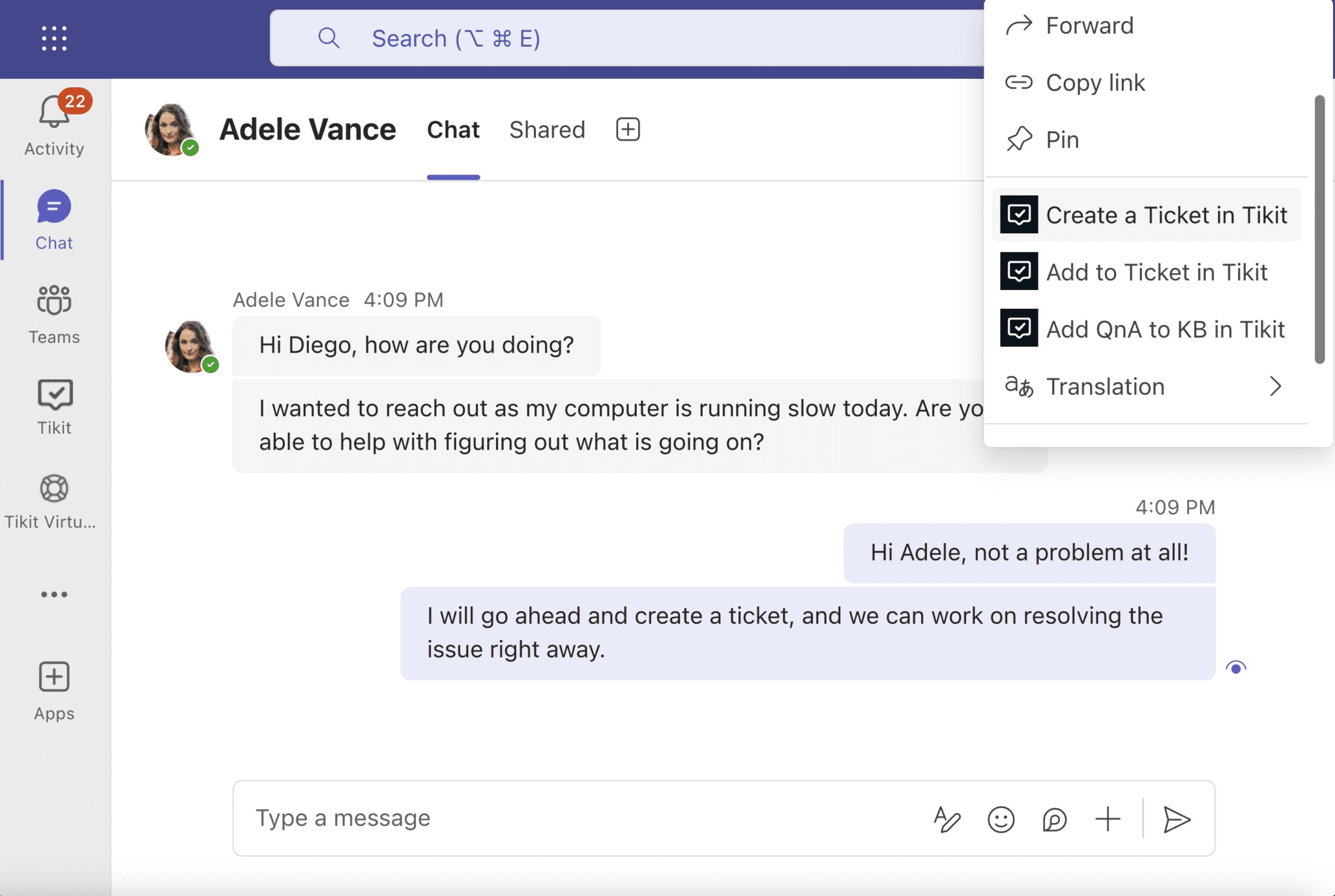
The dangerous words are “just a quick question.” In an office chat, they sound harmless. For a support team, they can mark the beginning of a job with no ticket number, no clear owner and no dependable way to follow up. Tikit’s proposition starts at that awkward handoff: turn the conversation into work somebody can track.
Built by Cireson, Tikit brings service management into Microsoft Teams. An agent can convert a message into a ticket; an employee can ask a virtual agent for help. The appeal is practical. If the request is already in the conversation, capturing it there saves an extra submission. Behind that small gesture sits a larger business selling subscriptions, workflow tools and implementation expertise to organizations invested in Microsoft 365.
The expertise walked out the door
At British automotive retailer Harwoods Group, the case for changing software became clear when people left. Its previous ticketing system had been designed for managed service providers serving multiple clients. Maintaining it internally depended on specialist knowledge. Paul Smith, Harwoods’ business support director, described the consequence in Cireson’s customer account: “the expertise went with them”.
That was the weak point. Harwoods wanted something easier to sustain inside its Microsoft environment, and Teams integration helped sell the switch. Its staff could turn informal messages into tickets instead of losing those requests outside the usual support channels.
The company also gave its support experience a character: Sir Helps A Lot, a knight on horseback carrying the Harwoods identity. A little heraldry in the help desk. The mascot supplied a recognizable face for a system intended to feel approachable. The useful lesson is less about medieval branding than about designing a service colleagues will remember when something goes wrong.
A Microsoft habit becomes a business
Cireson’s founders, Shaun Ericson and Paul Sutton, had worked across IT service management before building applications around Microsoft Service Manager. Their earlier business grew by extending software customers already used. Tikit carries that approach into the cloud: sell useful additions to an established Microsoft environment.
Cireson dates its founding to 2011. Tikit arrived in early 2021 as a Teams ticketing system, followed by the Microsoft 365 Service Desk plan in May 2022. The July 2023 ITSM release widened its ambitions with ticket lifecycles, a service catalog and orchestration through Power Automate. Each step gave customers more ways to organize the work after a request arrived.
The distinction between the two Cireson products matters. Service Manager Portal serves Microsoft’s on-premise System Center Service Manager. Tikit is the cloud service desk. For a buyer, choosing between them involves infrastructure and operating habits as well as the appearance of the interface.
The university that kept its vendor
Southern Illinois University Carbondale illustrates that choice. Its team had used Cireson’s Service Manager Portal, but maintaining the on-premise environment increasingly consumed attention. According to the university’s published customer story, it examined more than a dozen ITSM platforms, including ServiceNow and Freshworks. It wanted cloud delivery, Microsoft integration and room to configure specialized campus processes.
Tikit allowed SIU to keep a vendor relationship it valued while changing platforms. The team used Microsoft Forms and automation to put submitted answers into tickets and route them to the appropriate support groups. APIs offered another way to connect campus systems and examine demand for IT resources.
The transition also required patience. Some desired capabilities, including Lifecycles, were still in development when SIU moved. Its team participated in discussions about how those features should work. This was a configured implementation with active customer involvement. The software did not arrive knowing how a university operates.
Nor did everyone suddenly prefer chat. SIU’s story describes users who liked email and phone contact. A service desk can adopt Teams without insisting that every employee adopt the same support habit.
Sometimes the winning interface is a menu
A2 Global, an electronics components and supply-chain business, started from a different position. Its operations and laboratory services group lacked a structured system for requests and quotes. Cireson’s case study lists more than 500 employees and 40 agents, and describes engineers working onsite with the customer to build workflows and automations.
The revealing change came with the Service Catalog. Employees could use a visual web page to find the form they needed, reducing reliance on informal requests. That suited people with different levels of technical confidence. It also gave the organization more consistent submissions.
For Jake Cook, A2 Global’s director of business support, the implementation included learning to maintain the result: “helped educate me so I could self-serve” The commercial advantage here includes the people behind the software. A configurable product becomes more useful when the customer can change it without reopening a consulting engagement for every adjustment.
“helped educate me so I could self-serve”
Jake Cook · A2 Global
In Cireson’s customer interview
Ask the next useful question
The everyday product has several entrances. Teams provides conversational requests and updates. Browser portals give agents queues and administrative controls, while requesters can submit and review their own work. Eligible plans also accept email. The common objective is to put scattered conversations into a record that can be assigned, updated and resolved.
AI-assisted knowledge and a service catalog can direct people toward an answer or an appropriate request. The practical test is whether the employee gets useful help. A plausible reply that leaves someone stuck should not count as a successful resolution. For a buyer running a trial, checking that outcome is more revealing than admiring the bot’s fluency.
The April 2026 release of Custom Properties and Multi-Turn Cards addresses another familiar problem: incomplete information. Administrators can add ticket fields and make forms depend on earlier answers. In Cireson’s onboarding example, a hardware choice determines whether the employee sees a subsequent laptop form. Questions can appear when they become relevant.
NO → Skip that formReview & submit
Based on the conditional onboarding example in Tikit’s April 2026 release.
That is a useful design principle to copy: ask for what the next person actually needs, and avoid making everybody complete every possible question. It takes process knowledge to do this well. Someone still has to decide which requests need approval and which information determines the route.
The laptop has a history, too
On April 29, 2026, Cireson introduced Asset Management for Tikit, a managed Power App, alongside custom navigation. It connects asset records with tickets and can hold purchase orders, invoices and warranties. An Intune integration can synchronize asset data on a 24-hour cycle.
This gives a support request more context. A malfunctioning machine is also something the organization bought, assigned and may need to replace. Putting that history beside the complaint can help an agent investigate without hunting through a separate inventory. The release also supplied a Power BI reporting template and ways to place relevant tools inside the agent experience.
Intune remains a device-management tool in this arrangement. Tikit’s asset features add service and financial context around the device. The fit is clearest when an organization already uses Microsoft tools and wants the connections between them to do more work.
The monthly price has an annual commitment
Tikit licenses support agents and allows unlimited requesters. Its advertised monthly equivalents, billed annually upfront in US dollars, are $26 for Teams Ticketing, $39 for Microsoft 365 Service Desk and $49 for Microsoft 365 ITSM. Volume discounts can change the calculation. The pricing comparison also lists ITSM Pro, so buyers should check the current allocation of features before choosing.
USD / agent / month equivalent · annual upfront billing · advertised rates checked September 8, 2026 · volume discounts may apply
At those headline rates, five ITSM agents would represent $2,940 a year before discounts or other costs. That is illustrative arithmetic, not a customer invoice. Cireson offers a 14-day trial and complimentary setup, while more extensive implementation consulting is paid work.
Microsoft licensing deserves its own line in the budget. Microsoft classifies the Tikit connector as Premium for Power Automate and Power Apps, and lists an active Tikit ITSM subscription as a prerequisite. Connecting services is not proof that all the required licenses are already included. The connector also has regional exclusions, including GCC High for Power Automate. Buyers in specialized environments need to check the actual deployment path.
A service desk still needs a service owner
Tikit’s position is specific: internal service management for organizations centered on Microsoft. SIU’s shortlist shows it competing for decisions that also involve larger ITSM vendors. Its advantage rests on the usefulness of that Microsoft fit, the effort required to configure it and the support relationship. An organization that barely uses Teams has less reason to prize the same integration.
Cireson backs the software with training, community support and a public feature roadmap. Its stated culture emphasizes user-centered design and customer service, with enough levity to list an IT Monkey as Director of Culture. In May 2026, it reported a third consecutive annual SOC 2 Type II audit for Tikit with zero exceptions. That is a vendor-reported assurance milestone, separate from whether a customer’s own workflows are sensible.
The most transferable idea is to begin with a real request. Follow it from the employee’s first message through missing details, assignment, approval and closure. Watch where people improvise. Tikit supplies ways to capture and coordinate that work. The organization supplies the decisions about who should do it. Even Sir Helps A Lot needs somebody behind the shield.