The first thing to fail is rarely the equipment. It is the story about the equipment. A laptop leaves with an employee, a camera kit moves to another floor, a loader goes to a job site, or a laboratory instrument returns with a problem nobody logs. The spreadsheet still shows a neat row. Reality has taken the afternoon off.
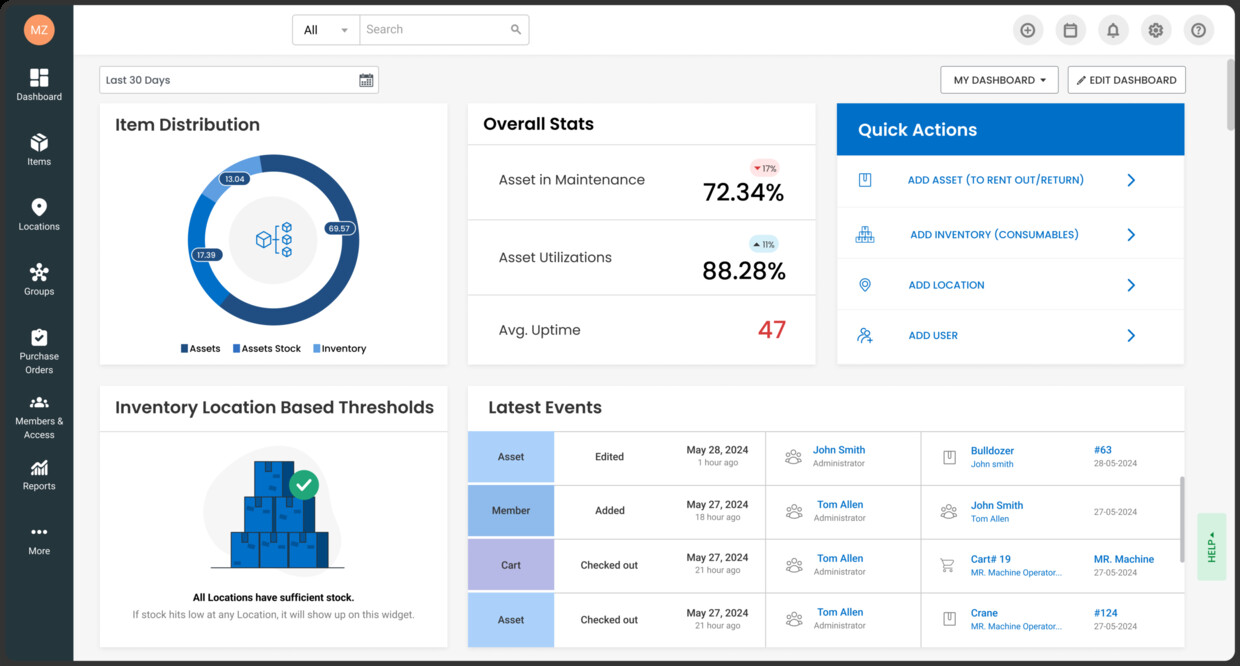
EZO lives in that gap. The privately held software company, founded by Syed Ali in 2011, makes cloud systems that record an asset’s location, custodian, availability, maintenance history, and next required action. Its portfolio now reaches four related operating rooms: EZO EAM for enterprise equipment, AssetSonar for IT assets and service, EZO CMMS for maintenance, and EZRentOut for rental businesses. An AI copilot named Zoe is being threaded through the products, but the raw material is still decidedly practical - clean records of who has what.
01 / The useful objectFollow the thing, then follow the work
EZO’s clever move was to treat the asset as a plotline rather than a noun. A barcode is only a label. It becomes valuable when a scan checks a tool out to a foreman, blocks a damaged machine from dispatch, tells finance what can be retired, or reminds a technician that preventive maintenance is due. The record is the hinge between inventory and action.
That is also how the company expanded. The original EZOfficeInventory product managed general business assets. Rental customers needed bookings, quotes, customers, invoices, and a webstore, so EZRentOut followed the same item into commercial circulation. IT teams needed hardware discovery, software licenses, employee offboarding, tickets, and patches, which became AssetSonar. Maintenance departments needed work requests, parts, labor, vendors, and reliability analytics, which became EZO CMMS. The products are not identical, but they orbit the same stubborn question: what is happening to this thing?
One scan, four consequences
02 / The customer evidenceThe spreadsheet did not crash. It quietly became fiction.
EZO’s customer stories repeat with almost comic precision. The first failure is usually Excel, paper, or a homegrown database - not because those tools stop opening, but because the data stops matching the world. At Wildstone Construction Group, equipment information had become inaccurate and siloed as excavators, trucks, loaders, trailers, and drills moved between job sites. Vice president Mike Melissen tested several systems and chose EZO for access controls, custom fields, roles, and reports. The company now tracks more than 1,000 assets with a five-digit numbering scheme: excavators start with 101; skid steers with 102. Before automating, it invented a language everyone could use.
A large broadcaster had a sharper pain. Static spreadsheets took five to six labor hours to update and offered no reliable audit history. Equipment could vanish during employee offboarding. After moving to EZO in 2017, the organization used custody records, approvals, custom fields, and dashboards; EZO says the customer recovered more than 100 assets in one effort and improved data accuracy by 50 percent. This is the category’s least glamorous magic trick: make ownership visible and missing gear starts volunteering clues.
“EZO was hitting the mark on everything we were looking for, so we decided to give it a go.”Mike Melissen, Wildstone Construction Group
Foster Display Group offers the cleanest before-and-after clock. Its warehouse manages trade-show booths, branded displays, and event materials - circular inventory that returns, changes, and leaves again. A ten-item fulfillment order once took 1.5 to two hours. With EZO’s customer-facing request portal, carts, labels, mobile records, and visual item data, the same job fell to about 20 minutes. Back-and-forth communication dropped by roughly half. The software did not make the warehouse faster by adding a dashboard; it stopped sales, accounts, and warehouse staff from repeatedly reconstructing the same context.
The two-hour order shrinks
03 / The businessSaaS priced by the thing being managed
EZO sells subscriptions, with a different meter for different operational jobs. AssetSonar’s public 2026 list pricing starts at $0.75 per asset per month for IT asset management and $1.08 per asset per month for IT service management, with a 100-asset minimum and volume discounts. Advanced software asset management is another $0.42 per asset per month. EZO CMMS lists annual-billing tiers of $12, $22, and $39 per paid user per month. EZO EAM scales with tracked inventory across Essential, Advanced, Premium, and custom Enterprise plans. Enterprise implementation, integrations, private-cloud requirements, and specialized support are quoted separately.
That model creates an honest buying question: what grows faster, your people or your inventory? Asset-based pricing can suit a large workforce sharing a manageable equipment pool; it can become costly when item counts explode. User-based CMMS pricing does the reverse. The buyer has to model the denominator, not admire the feature table. Very small teams with static inventory and few handoffs may be better served by a simpler tracker. A global operator with audits, repairs, and custody changes is paying for the history as much as the current location.

04 / The marketA crowded category, divided by which headache wins
EZO competes on several maps at once. IBM Maximo, SAP EAM, and ServiceNow occupy the broad enterprise end. MaintainX, UpKeep, and Fiix press on maintenance. Asset Panda and Snipe-IT cover general or IT tracking. Lansweeper specializes in discovery. Booqable and rental-specific systems chase commercial fleets. EZO’s difference is portfolio breadth with a comparatively approachable interface: one vendor can meet operations, IT, maintenance, and rental teams without pretending their workflows are interchangeable.
The integrations acknowledge that EZO will never be the only system in the building. Jira and Zendesk connect service issues to asset context. Google Workspace and identity tools help provision users. Dropbox and OneDrive back up data. Zapier moves events between apps. QuickBooks synchronization connects purchase orders to accounting. The product is strongest as an operational hub, not a replacement for every neighboring system.
Zoe, the AI layer, is the current bet. Inside AssetSonar, it summarizes tickets, drafts replies, suggests fields, diagnoses problems, and answers questions using the company’s IT graph. Inside EZO EAM, it creates records and helps interpret reports. The distinction is important: a generic chatbot knows what a warranty is; a grounded copilot can know which MacBook has one, who holds it, what software is installed, and which incident came first. In June 2026, EZO added explicit labels and field highlights to show what Zoe generated - a small transparency feature with outsized value when an AI is editing the operational record.
The real product is not the scan. It is the moment a scan changes responsibility.
05 / The copyable playbookStart with accountability, not automation
What can another operator steal? First, define the object before installing the software. Wildstone’s category codes worked because a foreman could recognize them. Second, map the handoff: who gives the item, who receives it, what proves the transfer, and what state makes it unavailable? Third, pick one costly loop - offboarding, warehouse fulfillment, preventive maintenance, or rental returns - and measure its current time and loss. Foster could prove improvement because it knew an order took up to two hours.
Then expand only after the record earns trust. Consolidated Safety Services began with one client in 2018 and broadened EZO across its portfolio after seeing the system work. That sequence matters. Automating several departments against messy naming, duplicate items, and unclear ownership merely produces wrong answers faster.
The rollout worth copying
- Name assets and locations in a language field teams already understand.
- Give every handoff an owner, a scan, and an exception path.
- Import one clean slice of inventory, not the whole archaeological dig.
- Measure recovery, fulfillment time, downtime, or audit effort before expanding.
- Connect adjacent systems only after the core record stays accurate.
And when would it not work? When staff see scanning as clerical punishment, managers permit off-system exceptions, nobody owns data quality, or leadership buys “visibility” without deciding what action a record should trigger. RFID cannot resolve an argument about responsibility. AI cannot rescue a duplicate-ridden inventory. EZO can preserve a disciplined operating model, make it searchable, and expose where it breaks. It cannot supply the discipline on its own.
That constraint is also why the company’s market remains durable. Equipment keeps moving. Employees leave. Software renews. Machines wear out. Rental orders return late. Every physical operation produces a stream of tiny custody decisions, and most organizations still store too many of them in memory. EZO has spent 15 years turning those decisions into software. The pitch is not futuristic. It is almost aggressively present tense: the thing exists, someone has it, and the company should know who.