A ceiling drip in store 184 does not look like strategy. Neither does a sticky freezer door, a flickering sign or a toilet that picked Saturday afternoon to revolt. But across hundreds of locations, those small failures become a capital-allocation system with boots. Someone describes the problem. Someone decides whether to send help. A contractor drives. An invoice arrives. Finance asks why the number moved. By then, the money is usually gone.
Fexa sells software for the people caught in that sequence. The New Jersey company began in 2011 as Facilities Exchange, a computerized maintenance management system, or CMMS. Its original job was recognizable: accept work orders, find the right provider, follow the repair and preserve the record. In 2019 it shortened its name and pushed “Fexability,” an earnest pun that also states the product thesis. Large operators should bend software around their workflows rather than flatten their operations to fit a vendor's template.
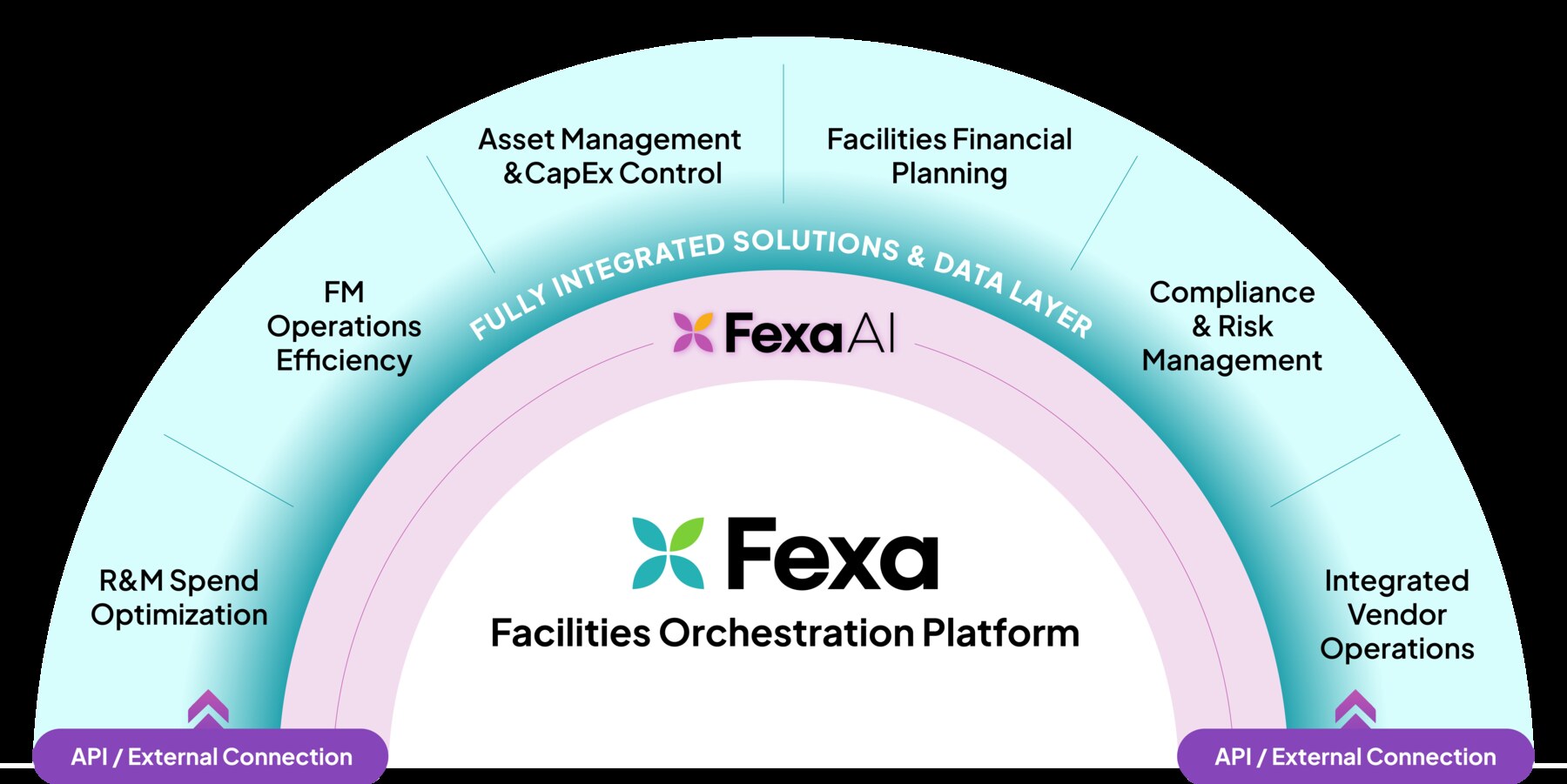
Now Fexa is trying to become something broader. In 2026 it recast itself as a Facilities Orchestration Platform - six connected areas for operations, assets, financial planning, repair-and-maintenance spend, vendors, and compliance, with AI moving across the same data. The rebrand is corporate language, yes. But the underlying observation is sharp: the hard part of facilities was never creating a ticket. It was making a defensible decision before that ticket became a truck roll.
The work order that never deserved a van
The cleanest demonstration comes from an anonymous casual-apparel retailer in Fexa's customer files. The chain had more than 450 sites, two legacy systems split between work orders and accounting, aging infrastructure and nearly 7,000 work orders in 2023. More than 5,100 invoices averaged $1,098 apiece. Facilities and finance were looking at different versions of the same operation.
What failed first was not a boiler. It was coordination. Redundant requests became dispatches; manual steps created errors; separate departments lacked a shared record. Leadership turnover changed the company's appetite for the status quo. New executives had seen other retailers manage the work differently, and a construction director saw an opening to put construction and facilities on one platform.
Fexa inserted multi-step troubleshooting before dispatch. The questions changed by work category, priority and class. Store employees received guidance for simple fixes. Rules made clear which problems justified a provider visit, while status changes recorded avoided calls and their value. The retailer reported $393,084 in savings from call avoidance, or 7 percent of break/fix invoice spend. That is not proof every buyer will get the same return. It is proof that a work-order form can be designed as a spending control rather than a complaint box.
“The work order was never the hard part. The hard part is the impossible math of the job - the budgets that won't stretch, the aging assets, the vendor puzzles.”Kim Goei, president of Fexa
Its real product is operational memory
Fexa CMMS is the hub: work-order intake, preventive maintenance, provider selection, asset history, project templates, invoice controls, lease responsibilities, dashboards, access rules and integrations. The company targets operators with roughly 50 to more than 5,000 locations. At that scale, “Did we repair this rooftop unit last year?” is no longer a question for whoever remembers. It is a query across thousands of assets, contracts, invoices and visits.
The platform also refuses a common facilities-market bargain. Operators can retain their own providers, or use Fexa Link, a curated sourcing network. Fexa says it charges providers no access or invoice fees. That distinction mattered to gorjana, the jewelry retailer. Its previous intermediary platform charged vendors, delayed payments and obscured direct relationships. Local cleaners and specialists raised prices or walked away. Vendors themselves recommended Fexa.
After the switch, gorjana centralized ticketing and used flat-file integrations to speed payments. Its public case study says one team member managed repair, maintenance and recurring services across roughly 120 locations while ticket volume grew 400 percent. The lesson is pleasantly unfashionable: software can scale a relationship only when its economics do not irritate everyone asked to participate.
The refrigerator changed the roadmap
In 2023 Fexa acquired Trakref, a refrigerant-management specialist. This was not a random sustainability ornament. Grocery, restaurant and retail operators already dispatch HVAC/R work through facilities. The same visit can create refrigerant records, leak histories, asset costs and regulatory obligations. Keeping compliance in another database guarantees duplicate entry and invites gaps.
Trakref brought a rules engine built around audit-ready tracking. Fexa later created a native integration so a maintenance event and its refrigerant consequences travel together. A national grocery chain, fragmented by acquisitions and facing state-level deadlines, reportedly became audit-ready across more than 2,000 locations in under 30 days. The acquisition moved Fexa from documenting that a contractor visited to documenting what happened to a regulated substance while the contractor was there.
The company now reports 400,000 HVAC/R assets under management. That gives its climate story a practical center. Fexa is not selling carbon accounting in the abstract. It is trying to catch the leak, record the gas, attach the service event, apply the correct rule and keep the evidence ready for an auditor.
AI enters through the least glamorous door
FexaAI launched in 2025 with a Work Order Agent. A store employee can describe a problem in ordinary language; the agent asks for missing details, adds location-specific context and routes the ticket. Bath & Body Works was among the first enterprise users. Fexa has since expanded the pitch toward multiple agents that answer questions, summarize activity and advance routine work.
The guardrails are more interesting than the chatbot. Customers define approval limits, safety thresholds, site rules and vendor preferences. Actions are logged. Work involving judgment, signatures, safety or meaningful spend can route to a person, who can override the machine. Fexa's AI claim is not that a language model understands a chiller better than a technician. It is that the model can collect a cleaner story before the technician arrives.
The old loop
- Vague request lands
- Coordinator chases details
- Vendor gets a thin brief
- Repeat visit or surprise invoice
The Fexa bet
- Issue arrives in plain language
- Rules fill the missing context
- Human keeps the consequential call
- Decision joins the asset history
Where the pitch earns its keep - and where it does not
Fexa competes in a crowded band that includes ServiceChannel, Corrigo, IBM Maximo, Planon and newer CMMS products such as MaintainX, UpKeep and Limble. Its wedge is not simplicity for every maintenance team. It is flexibility for a distributed operator whose approval chain, vendor mix, accounting export, lease logic and regulatory exposure are too particular for an off-the-shelf workflow.
Pricing is private and quote-based. That makes a sober buying process important. A prospect should price implementation, configuration, integration, training and migration - then compare that total with avoidable dispatches, vendor fees, invoice labor, downtime and compliance risk. Fexa's strongest case studies pair the software with operational change: new troubleshooting rules, cleaner ownership, connected finance data and ongoing training. Merely digitizing a bad process would preserve the bad process at greater speed.
A single building with a trusted handyman, a small asset list and straightforward approvals may find this much platform unnecessary. The model also weakens when an organization will not define its rules, clean its data or give facilities and finance a shared operating rhythm. Configurability is useful only when the buyer knows what deserves configuring.
The playbook worth stealing
Facilities leaders can copy the operating logic without copying every product. Put troubleshooting before dispatch. Make approval thresholds explicit. Tie invoices to the work and assets that created them. Measure repeat visits and avoided calls. Let providers communicate through the system without taxing the relationship. Preserve exceptions so the next workflow is smarter. Keep compliance evidence attached to the maintenance event, not in a quarterly scavenger hunt.
Fexa's corporate arc follows the same logic. It grew as a bootstrapped business, accepted a $40 million Mainsail Partners investment in 2022, acquired Trakref in 2023, installed Kurt Smith as CEO that year and added AI after the operational data was already in place. Founder Marc Balzamo remains a strategic adviser and board member. The sequence matters: workflow first, adjacent records next, intelligence last.
The company says its systems support 1.8 million locations, 750,000 service providers, 3 million processed invoices and $5.6 billion in facilities budgets. Those are Fexa's figures, not audited disclosures. Still, they show the scale of the category's hidden machinery. Every open store depends on decisions that customers never see. Fexa wants to make those decisions earlier, cheaper and easier to defend - ideally before a van leaves the lot.