The modern school day can be derailed by an object worth less than a pair of sneakers. A Chromebook refuses to join Wi-Fi. A teacher submits a ticket. A technician needs to know which student has the device, where it lives, whether its warranty is active, how often that model has failed and whether a spare is waiting. In plenty of districts, each answer once lived in a different tab, spreadsheet or colleague’s memory. Incident IQ built a company around making those answers appear together.
That sounds like a help desk, but the useful distinction is context. Generic ticketing software is good at moving a complaint through a queue. Incident IQ links the complaint to the physical and administrative world of a school district: a person, asset, classroom, campus, repair history, funding source and set of permissions. The same connective tissue now supports work orders, gym reservations, textbook distribution and employee questions. What began with IT became an argument for a district operating layer.
The spreadsheet cracked before the laptop did
Founder Travis Collins knew the machinery around schools from both sides. Before Incident IQ, he built technology businesses and served 12 years on Georgia’s Rockdale County Board of Education. The company was founded in August 2016, then spent 18 months piloting with partner districts before showing the platform at the ISTE education-technology exhibition in 2017. That long rehearsal mattered. Schools have their own seasons, vocabulary and awkward edge cases. Thousands of devices go out in a rush, come back in another rush, change hands, break, disappear and occasionally return wearing somebody else’s asset tag.
The first thing to fail at growing one-to-one programs was often not hardware. It was the improvised system around the hardware. Moreno Valley Unified School District, with more than 31,000 students, described a slow asset product sitting beside a homegrown ticketing system. Union School District near San Jose had inventory separated by campus, leaving the district office unable to see the whole fleet. Coweta Public Schools in Oklahoma had spreadsheets and email ticketing, a particularly brittle combination for an IT staff of six.
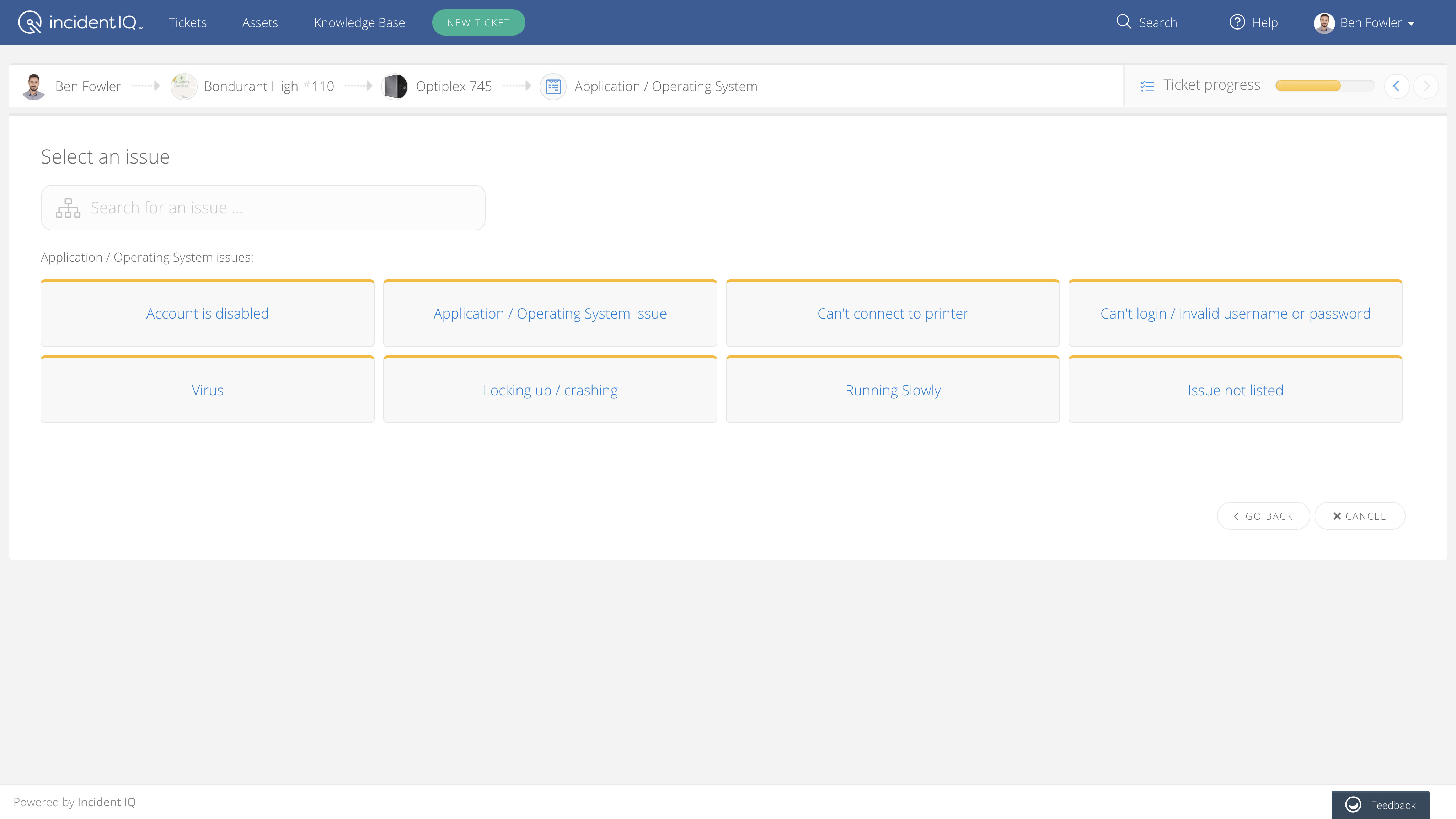
Incident IQ’s early answer was to combine iiQ Ticketing and iiQ Assets. Teachers and students get guided intake instead of a blank complaint box. Technicians get routing rules, device history and a knowledge base. District leaders get reports across schools instead of a monthly archaeological dig. Assets can be deployed and collected in batches, audited, repaired, assigned to users and followed through retirement. The product fits the annual choreography of K-12 rather than asking K-12 to impersonate a corporate office.
“Everything was isolated within each school.”Jenny Torres, Union School District
One record, then another department
The company’s growth makes more sense as a sequence than as a feature list. In August 2021, when JMI Equity made a strategic growth investment, Incident IQ served more than 650 districts in 48 states. It had added over 350 districts in a year. By the time R.T. Collins succeeded Travis Collins as chief executive in 2023, the count had passed 1,200 and the team had reached 150 people. Cove Hill Partners joined JMI, management and the founders as an investor in early 2024, when Incident IQ reported more than 1,500 districts and 10 million students and teachers. The company’s site now says more than 2,000 districts in all 50 states.
The money helped fund a wider platform. iiQ Facilities handles work orders, preventive maintenance, labor, parts and inspections. iiQ Events coordinates requests, approvals, room setup, fees and payments. iiQ Resources, launched in November 2024 after district feedback, tracks textbooks and other instructional materials through approval, distribution and collection. iiQ HR Service Delivery corrals benefits questions, leave requests, forms, onboarding and offboarding. More than 130 apps and integrations connect the system to student information, identity, device-management, payment, warranty and remote-support tools.
This is the company’s clearest advantage over a general-purpose service desk. Freshservice, Jira Service Management, SolarWinds and Zendesk can all run a queue. K-12 specialists such as One to One Plus, Manage1to1, Frontline, FMX and Brightly compete more directly. Incident IQ’s pitch is that the queue becomes more valuable when it shares a native map of students, staff, devices, campuses and district processes. A ticket is no longer an isolated chore. It is evidence about a device model, a room, a recurring failure or a future purchase.
The bill is based on the school, not the queue
Incident IQ sells annual SaaS agreements priced by student enrollment and selected modules. There are no stated limits on users, requests or assets. Districts can begin with one product and add others; onboarding, district configuration, training, support and product updates are included. Some premium applications and partner integrations can add cost. Multi-year terms are available. There is no public rate card, so procurement happens by tailored quote.
Public school-board records make the economics less abstract. In April 2024, Wentzville School District in Missouri recommended a $95,715.99 Incident IQ purchase covering work orders, event management and asset management. That figure is one district’s scope, not a sticker price. A supplied company-data estimate puts annual revenue near $21.3 million and total funding near $40 million, but the company has not publicly confirmed revenue, valuation or the amounts in its two announced investment rounds.
The pricing logic is clever. Per-seat software discourages broad participation, yet a district platform improves when teachers, custodians, technicians and administrators all use it. Enrollment is a rough proxy for operational scale. Unlimited requests remove the perverse incentive to keep problems out of the system. Modular packaging, meanwhile, lets Incident IQ expand revenue as a customer moves from IT into facilities, events, resources or HR.
The product is not the ticket. The product is the memory attached to it.YesPress analysis
AI joins the front of the line
In March 2026, Incident IQ introduced an AI Ticket Assistant. A teacher can describe an issue in plain language; the system pulls out details, classifies the request, estimates urgency and sends it to the appropriate team. Incident IQ says early users cut average resolution time from five days to one and that districts can resolve tickets up to 30 percent faster. Those are company-reported early results, not a controlled benchmark, but the use case is sensible. Ticket triage is repetitive, text-heavy and constrained by a district’s own categories.
The useful part is not a chatbot performing confidence. It is cleaner intake. A vague ticket called “computer broken” creates a second job: finding the device, asking what happened and locating the right technician. If AI reliably gathers those missing fields and draws on connected asset data, it reduces the least interesting work without pretending to repair a Chromebook. The feature also shows why Incident IQ spent years assembling context before adding AI. A model with access to the right district record can do more than one staring at a sentence.
What another operator can steal
The copyable lesson is not “build for education.” It is to find a workflow where context is scattered, then make the surrounding objects first-class parts of the product. Incident IQ did not merely digitize a form. It connected the form to the asset, owner, location, service history and downstream action. That creates switching costs, but it also creates legitimate usefulness: every completed task improves the district’s operational memory.
Second, pilot through the customer’s real calendar. An 18-month test catches two device-deployment seasons, an end-of-year collection, summer repairs and enough budget cycles to expose fantasy workflows. Third, let one department prove the data model before expanding. IT created records that could inform facilities, events and finance. Finally, charge on a unit aligned with customer scale while removing tolls on participation. A system meant to reveal problems should not punish people for reporting them.
A small school with a modest device fleet may not need a district operating layer. A team without clean roster or inventory data will import its confusion. And software cannot manufacture process ownership: somebody still has to decide categories, permissions, routing rules and what “done” means. Budget-sensitive districts also compare Incident IQ with cheaper K-12 tools and open-source asset trackers. Specialization earns a premium only when the connected workflows are used.
Incident IQ’s biggest risk is the same as its ambition. A unified platform is attractive because it replaces silos; it becomes cumbersome if each new module is merely another silo behind one login. Facilities managers and HR teams will judge the product on their own work, not on how much the IT director likes its asset records. The company has to keep the shared data useful without forcing every department into IT-shaped habits.
So far, the expansion has followed a coherent object map. Students and staff use devices in rooms. Rooms require maintenance and host events. Classes consume instructional materials. Employees need service from HR. The company found a business in the connective tissue, the uncelebrated work that determines whether a teacher begins class or begins troubleshooting. Education may happen at the front of the room. Incident IQ is betting that the market is behind the door, holding a repair ticket and looking for the right key.