The problem arrived wearing cleats and carrying a contract. Cameron Oliver was 25 when he became general manager of Bobcat Sports Properties at Montana State University. Football season was 45 days away. More than 3,000 sponsorship assets - radio spots, signs, tickets, hospitality, promotions and the little contractual promises that only become noticeable when missed - were scattered across emails, files and conversations. A staff of roughly two and a half people was expected to remember the lot.
Some sponsors did not receive what they had bought. That was the first failure: not sales, but fulfillment. Oliver built a spreadsheet system to impose order. It was inelegant and laborious, yet the operation could finally see what had been sold, who owned the next action and what remained undone. Trak says sponsorship revenue grew 278 percent in three years during that period. The spreadsheet worked well enough to expose its own ceiling.

The unglamorous moment when the spreadsheet wins
This is the part of Trak's origin worth copying. Oliver did not declare war on Excel. He used it until the job was understood. The spreadsheet made every sold promise legible, and that operating knowledge became the specification for a product. With co-founders including Brandon O'Hara and Ben Fjare, he turned the improvised system into software. The early name, Sponsorship Buddy, had the air of a helpful sidekick. In 2018 it became Trak, a name closer to the job.
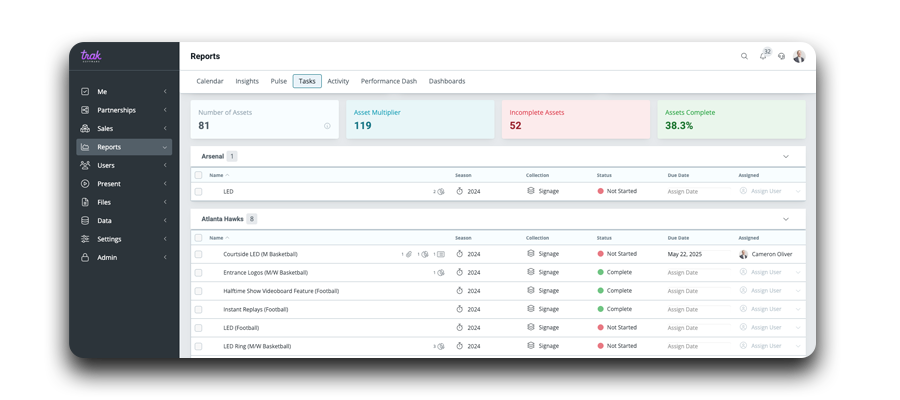
Today the software follows a sponsorship from request to renewal. A team can log an opportunity, store contracts, inventory every asset, assign approvals, schedule activations, upload artwork, capture proof photos, track performance and generate a recap. The point is less “all-in-one” than “all in sequence.” Generic tools can hold a task or a contact. Trak knows why a car display at a Saturday game, a logo in an email and four hospitality passes belong to the same commercial promise.
One promise, five places it can go missing
What customers are actually buying
They are buying fewer scavenger hunts. The Colorado PGA case is almost painfully ordinary: a nine-person organization, more than 50 sponsors and important obligations living in Excel. Email blasts and event exposure could be missed. By renewal season, confidence depended on whether somebody could reconstruct the year. In Trak, the team could see completion percentages, keep files beside the obligation and build reports from work already recorded.
Carolina Core FC gives the same story a number. Its executives estimate that Trak saves 300 to 500 hours per year, especially in activation tracking and recaps. The club's staff tags game-day photos as it works instead of searching hundreds of images later. A young soccer organization reports a 95 percent renewal rate and says the system helps it operate with major-league discipline. Those are customer-reported outcomes, not a controlled experiment, but the mechanism is easy to understand.
“Get me out of spreadsheet hell.”Sabrina Higdon, 88 Marketing
The agency example sharpens the economics. 88 Marketing used Trak while supporting Alaska Airlines through the pandemic, when games, travel and physical activations were disrupted. Its old process involved six or seven “monster spreadsheets,” a clogged inbox and recap data that was difficult to compare. Trak let the team model affected assets, show delivered value and handle reconciliation conversations with a shared record. The customer says that work helped save millions of dollars. The software did not make canceled events return; it made the consequences negotiable.
The price of knowing
Trak now publishes a refreshingly plain annual ladder. Standard starts at $5,000 for three licensed users, unlimited collaborators and 5,000 AI credits. Professional starts at $12,500 for 15 licensed users, standard integrations, a dedicated customer-success manager and 50,000 credits. Enterprise starts at $25,000, adding unlimited licensed users, custom integrations, single sign-on, governance and 250,000 credits. Every tier includes the full feature set.
| Plan | Starts at | Best clue about buyer |
|---|---|---|
| Standard | $5,000/year | A small core team with many outside collaborators |
| Professional | $12,500/year | A growing program that needs integrations and hands-on support |
| Enterprise | $25,000/year | A large organization with governance, SSO and custom data flows |
The comparison is not simply subscription versus free spreadsheet. It is subscription versus labor, missed inventory, make-goods, anxious renewals and the cost of asking a sponsor to resend evidence. If the system saves even 300 hours, Carolina Core's low-end estimate, the entry price implies about $16.67 per recovered hour before counting revenue or risk. That math becomes attractive only when the work is genuinely complex.
Why a focused tool can beat a famous one
Trak sits between customer relationship management, project management, digital asset management and business intelligence. A determined team could reproduce pieces of it in Salesforce, Monday.com, Asana, a shared drive and a reporting tool. Many do. The trouble is the seams. A contract amendment changes inventory; inventory changes tasks; tasks produce proof; proof informs a recap; the recap influences renewal. Each handoff is a chance for context to evaporate.
The product competes with specialist sponsorship platforms such as KORE Software and SponsorCX, but its most persistent rival is the stack a team already tolerates. Trak's differentiation is not that it can store a file. It is that its data model understands buyers, rights holders, agencies, assets, make-goods, fulfillment and proof as parts of one partnership. The mobile app extends that model to the concourse, where staff can complete tasks and upload photos while the sign is still hanging.
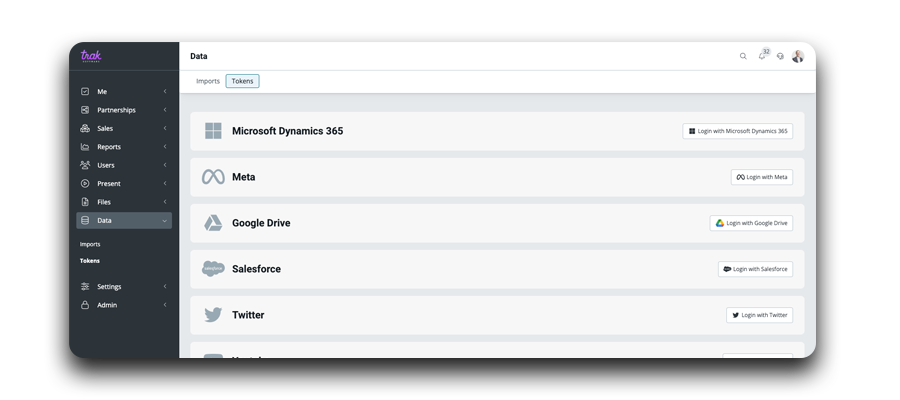
Scale changes the plumbing, not the job. The Las Vegas Raiders send daily CSV files with thousands of deal and inventory rows so Trak stays current without a human rekeying everything. Their case study reports more than 5,000 completed tasks and 100,000 partner notifications. Coca-Cola selected the platform in 2024 to consolidate Tier 1 sponsorship workflows across North American rights holders, agencies and bottlers. In both cases, the valuable feature is a shared version of reality.
What changed their minds
Buyers seem to move when inconvenience becomes exposure. The Colorado PGA had missed obligations. 88 Marketing faced pandemic reconciliation. Carolina Core wanted to scale without adding equal administrative weight. The Raiders had inherited a system and were not actively shopping until the team saw Trak at an activation summit. The demonstration revealed a tool external partners might actually use, with integrations that could remain current in the background.
That pattern matters. “Fewer spreadsheets” is a weak buying event because spreadsheets are familiar and already paid for. A missed asset, a disputed value, an audit, a renewal scramble or a portfolio expanding beyond one person's memory is a buying event. Trak wins when disorder acquires a price tag.
Five things another vertical SaaS founder can steal
- Work the problem manually until every ugly edge case has a name.
- Model the whole revenue-bearing sequence, not one isolated task.
- Invite outside collaborators freely so the workflow spreads across organizations.
- Capture evidence during execution so reporting becomes an output, not a project.
- Sell against the moment failure becomes costly: audit, renewal, scale or dispute.
Where the playbook breaks
Vertical software is not magic. A tiny organization with five simple sponsors, one meticulous owner and no serious reporting requirement may never earn back a $5,000 subscription plus migration effort. A team that refuses to record work will merely produce a cleaner empty database. If contract data cannot be imported reliably, or leadership keeps parallel spreadsheets as the “real” record, the promised single source of truth becomes another source.
Likely fit
Many partners, recurring assets, several internal owners, outside agencies, proof requirements and renewal pressure.
Probably overkill
A handful of simple deals, one accountable operator, little collaboration and no costly fulfillment or reporting risk.
Nor does organized fulfillment guarantee a good sponsorship. Trak can show that every promised asset ran and that proof was collected. It cannot make a weak audience fit, a dull activation or a bad commercial idea suddenly valuable. The company itself argues that objectives, strategy and support must exist first. Software is an amplifier; it is most useful when the underlying partnership deserves to be amplified.
A small category with large consequences
Trak has spent a decade widening a narrow wedge. It began with asset tracking, then added activation, approvals, financials, recaps, mobile work, integrations, enterprise controls and AI credits. It announced SOC compliance in 2024 and refreshed its identity in 2025. Its 2026 customer survey reported an 8.4 out of 10 average rating and a Net Promoter Score of 43.9, while also identifying room to improve onboarding, adoption and reporting visibility.
The amusing truth is that the product exists because a spreadsheet succeeded. It made a chaotic business visible, taught its creator the actual workflow and proved that disciplined delivery could support growth. Trak's business is the grown-up version of that file: every promise given an owner, every owner given a deadline, every deadline attached to proof. In sponsorships, memory is charming right up until the invoice arrives.