Cameron Oliver arrived in Bozeman with the timing of a substitute teacher handed the keys during a fire drill. He was 25, newly appointed general manager of Bobcat Sports Properties at Montana State University, and football season was 45 days away. He had driven roughly 1,800 miles from Bowling Green over two days around the Fourth of July. At the end of the road sat a small staff, a strong run of sales and more than 3,000 sponsorship assets that had to appear in the right place, for the right partner, at the right time.
The previous 18 months had been successful. More deals had been signed. That summer, sold assets jumped 35 percent. On paper, this was excellent news. In practice, it meant radio spots, signage, tickets, hospitality, promotions and other contractual details were distributed across emails, files and conversations. Oliver's team could not see the whole promise, much less prove it had been kept.
By season's end, the operation had fulfilled only 80 percent of what it sold. Oliver did not varnish the memory when he later told the story. He described apologizing to every client and called the experience the worst walk of shame of his career. The founder story starts here, in the distinctly unfashionable interval between selling a thing and delivering it.
“I screwed up a ton of things in my first few months, which is actually where the idea for Trak.io was born.”Cameron Oliver, on his first season in Bozeman
A promotion with bigger boots
Oliver had already learned the geography of collegiate sports marketing. His official biography traces his Learfield Sports career through Logan, Utah; Bowling Green, Ohio; and Bozeman, Montana. Before the Montana promotion, he worked at Falcon Sports Properties while finishing an MBA at Bowling Green State University. His portfolio there was a manageable list of about 25 partners. He also holds a bachelor's degree from Utah State University.
Bozeman multiplied the scale and compressed the clock. Oliver says he was told he was the youngest general manager in Learfield history. The promotion offered authority, but authority is a poor substitute for an inventory. If nobody can answer what was sold, who owns it and whether it ran, the impressive title becomes a very fine nameplate on a very untidy desk.
His response was wonderfully ordinary. He assembled PDFs and Excel files into a system. He brought in more interns and gave them jobs beyond being spare hands on game day. Obligations gained owners. Work became visible. The system was useful enough that Oliver began presenting it at Learfield events to other general managers. A private workaround had crossed an important line: other operators recognized their own headache in it.
When the spreadsheet earns a sequel
Over the next three seasons, Bobcat Sports Properties reported a 278 percent rise in revenue, passing $2 million in annual sponsorship revenue. Attrition fell from 27 percent to 8 percent. Oliver also helped four part-time staff members move into full-time Learfield jobs. Those figures belong to the operation he led, not to the spreadsheet alone. Better sales, staffing and relationships mattered. But the spreadsheet supplied a shared memory, and shared memory is underrated infrastructure.
The method laid the groundwork for the business that was first known as Sponsorship Buddy and later became Trak Software. With co-founders including Brandon O'Hara and Ben Fjare, Oliver translated the manual workflow into a focused software product. The useful sequence was failure, method, teaching, product. By the time code entered the picture, the team already knew the nouns and handoffs the product had to respect.
The product hiding inside the apology
Sponsorship operations sit awkwardly between customer relationships, project work, file storage and reporting. A generic tool can hold a contact. Another can hold a task. A shared drive can hold a photograph. The commercial meaning lives in the connection among them: this photograph proves that this sign appeared at this game because this contract promised it to this partner, and that proof will matter when the agreement is renewed.
Trak follows that chain. The platform organizes sponsorship contracts, inventory, activations, approvals, evidence, recaps and renewal decisions. It serves brands, agencies, sports properties and entertainment organizations. Its specificity is the point. A car display on a concourse and a logo in an email may look unrelated to ordinary project software; inside a sponsorship agreement, they are siblings.
The company found public validation in its own industry. Sponsorship Buddy won the National Sports Forum Tech Tank in 2017. Trak won again in 2022, making it a two-time winner under two names. That year Oliver also joined colleagues at the NFL Club-Led Activation Summit in New Orleans. The gathering included sponsorship marketers from 29 of the league's 32 clubs, and Trak led a session on what chief marketing officers want from activation and delivery.
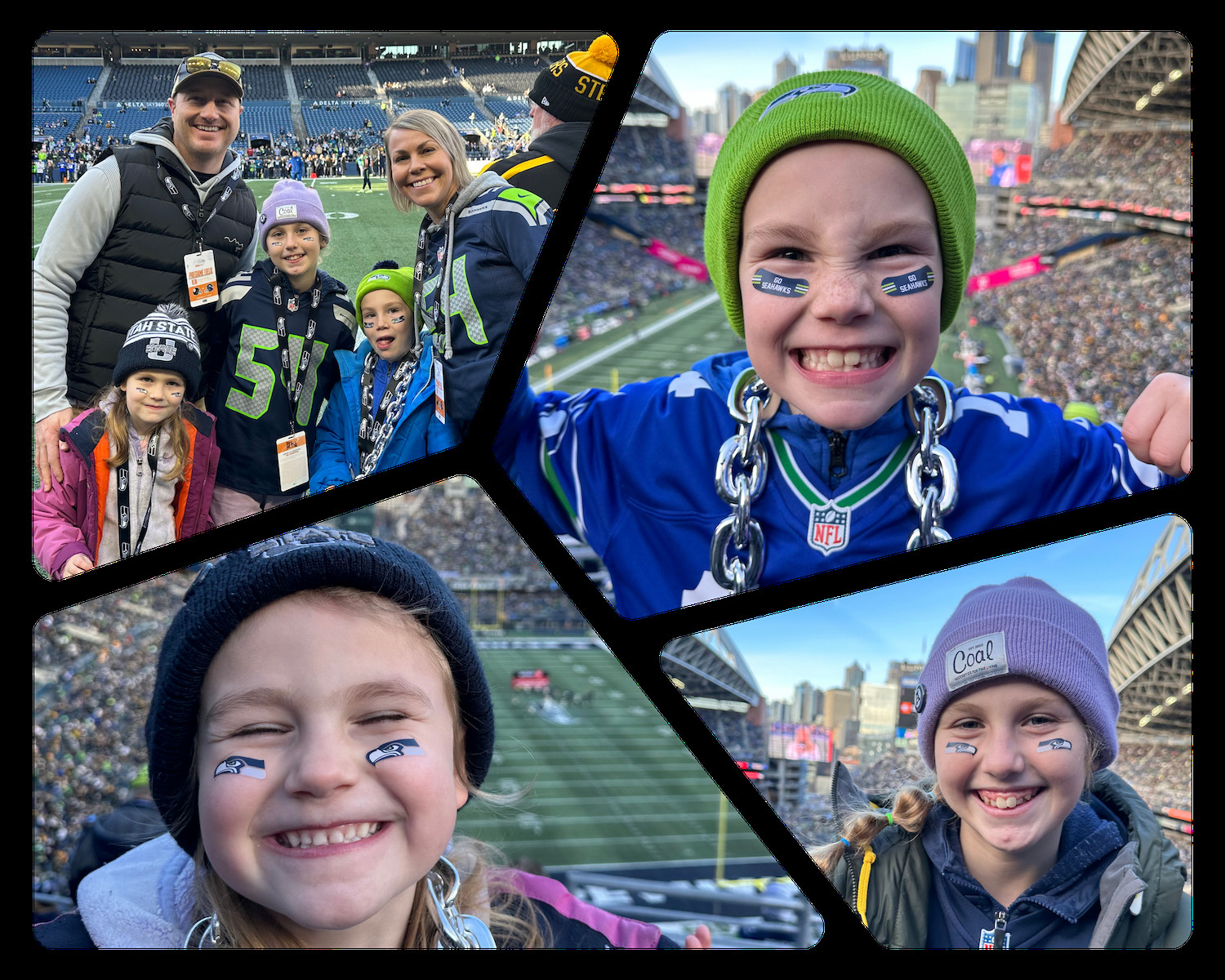
There is a pleasing circularity in the family photograph. Oliver began his working life selling the commercial apparatus around college games, then built software to make that apparatus less intrusive and more accountable. In the picture he is back on the field as a fan and parent, not a general manager hunting for a missing sign. The lanyards, logos and sponsor marks are still everywhere. Most spectators correctly ignore the operational choreography. That invisibility is the work's peculiar reward: a well-run activation belongs to the day instead of interrupting it.
Oliver's official biography says he has spent 15 years moving from sponsorships to software. The phrase makes the transition sound like a change of industries. His career suggests something subtler. He stayed with the same problem while changing the instrument. First came sales and service, then spreadsheets and presentations, then a cloud platform and mobile tools. Now comes machine-assisted organization. The constant is an operator's interest in what happens after the handshake, when a bright idea turns into several hundred ordinary tasks.
In October 2024, Trak announced that Coca-Cola had selected its platform to streamline sponsorship management. The distance from one collegiate operation to a global brand looks enormous. The job underneath remains recognizable: translate agreements into work, keep the work visible and preserve enough evidence to have an honest conversation later.
“Been there, felt it, hate it and love it all at the same time.”Cameron Oliver, on sponsorship management
Now the spreadsheet can read
In August 2026, Oliver announced Trak AI after more than a year of building and testing. The product applies sponsorship-specific intelligence to contracts, intake, proof files, social posts, broadcasts, fulfillment and portfolio reporting. It can scaffold deliverables from an agreement, organize photos, identify sponsor appearances and surface what has been delivered or remains outstanding.
Oliver's argument for the new layer is more interesting than the fashionable label. He wrote that the model itself is no longer the competitive advantage. Context is. A general model can read an uploaded contract. It does not automatically know what happened at the moment of fan impact, what a team delivered last season, who owns the next task or what the partner values. Trak is betting that a decade of structured sponsorship work gives automation something coherent to act upon.
Work the problem manually until every costly handoff has a name. Then build around the entire sequence, not the most photogenic feature.
That is a practical vertical-software lesson. Domain expertise is not merely knowing the customer's vocabulary. It is knowing why one missing field becomes a frantic call on Friday, why a photo on an employee's phone can affect a renewal months later, and why flexible language in a contract creates rigid work on the ground. Oliver learned those dependencies while carrying the consequences personally.
The discipline of keeping promises
There is a temptation to retell Oliver's first season as a neat prelude, embarrassment redeemed by software. The more useful reading leaves a little grit in the gears. He did not solve the crisis at once. He apologized. He created a manual system. He added people. He taught the method. Only then did the method become a company. Each step forced him to understand the work more precisely.
His public manner retains some of that candor. He writes conversationally about mistakes, calls the original situation a hot mess and makes room for affection alongside frustration. The personality fits the product category. Sponsorship is commercial, but it is also theatrical: brands borrow the emotion of games, concerts and gatherings. Behind the spectacle is a ledger of promises that somebody must quietly keep.
Oliver still lives in Boise and leads Trak as CEO and co-founder. The company has widened from asset tracking into an operating platform, but its purpose remains close to that first bruising season: help teams stay organized, demonstrate what happened and build stronger partnerships. The software may now scan video and interpret contracts. Its moral technology is older. Write down what you said you would do. Give it an owner. Keep the evidence. Return before renewal day with fewer apologies.