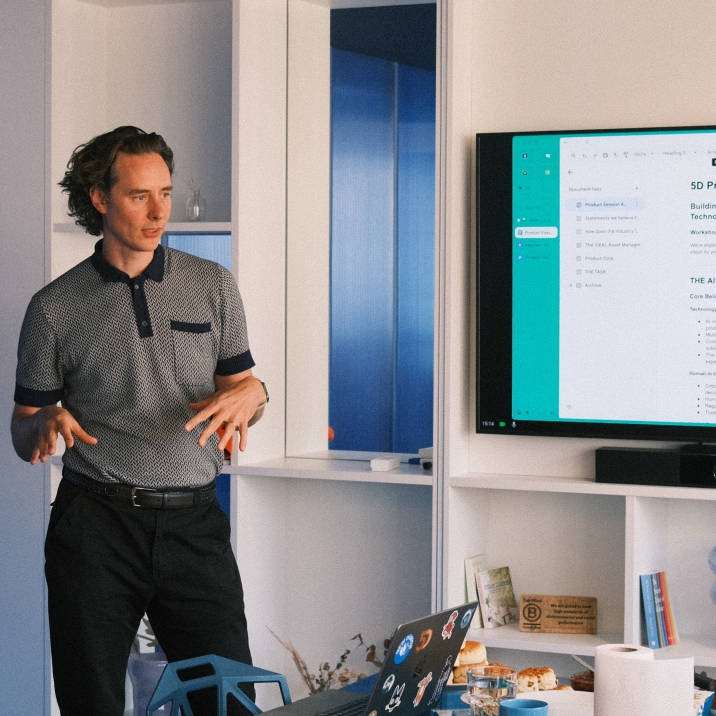
The Scene
It is Tuesday. Somewhere in a tower above Oxford Street, a 200-page lease is being read by a machine.
Not skimmed. Read. The clauses, the rent reviews, the break options buried on page 147 that a tired analyst would have missed at 9pm. By the time the human pours a second coffee, the document is structured, summarized, and sitting in a template ready to defend in front of an investment committee.
This is Fifth Dimension on an ordinary day. The company sells something the real estate industry has wanted for decades and rarely admits: software that understands the difference between a number and a decision. Its AI assistant has a name - Ellie - and a single, unglamorous job. Read the things nobody wants to read, so the people who get paid to think can actually think.
We power investment decisions for the physical world.
- Fifth Dimension, company tagline
The Problem They Saw
Real estate is a $3.88 trillion market that still runs on PDFs and the goodwill of overworked associates.
The asset is physical - a building, a portfolio, a piece of land. The intelligence about it is anything but. It lives in leases, surveys, valuation reports, rent rolls, data rooms, and a spreadsheet someone named "FINAL_v7_USE_THIS." Every deal means re-keying the same facts, in the same firm, for the third time that month.
The cost is not a rounding error. It is the most expensive people in the building spending their week assembling information instead of judging it. The founders had watched it up close - one of them put it bluntly: brilliant professionals spending 40-plus hours building a board deck instead of making the call the deck was meant to support.
The industry's response, for years, was to hire more associates. Which is one way to solve a reading problem - the expensive way.
The deeper issue is that real estate data does not behave. It arrives as scans, as appendices, as a clause that contradicts the one three pages earlier. It is not a tidy database waiting to be queried; it is a filing cabinet that argues with itself. Most software gave up at the cabinet door and asked a human to type the contents in by hand. That handoff, repeated across thousands of firms, is the quiet tax the whole sector has been paying without ever naming it.
The Founders' Bet
A Stanford linguist and a real estate data veteran decided the fix was not more people. It was better reading.
Fifth Dimension was founded in 2023 by Dr. Kate Jarvis and Johnny Morris - a pairing that sounds like the setup to a joke and turns out to be the whole strategy. Jarvis brings a PhD in Linguistics from Stanford and more than a decade building machine-learning products. Morris brings 16-plus years of real estate data, research, and analytics. One understands how language models actually work. The other understands what a rent review clause actually means.
Fifth Dimension AI is not just following a trend, we are leading the way.
- Dr. Kate Jarvis, Co-Founder & CEO
Their bet was specific. Generic AI is a confident guesser - useful for a poem, alarming for a covenant. Real assets need a model that has been pre-trained on real-assets transactions, that knows the documents, the formats, and the stakes. So they built for the vertical first and the hype second. The result is less "chatbot in the corner" and more "the analyst who never forgets where the data lives."
$10B+
Transactions underwritten by team
30%
Targeted productivity lift
The Product
Ellie does the reading. The platform does the remembering.
Ellie pulls unstructured data from leases, surveys, and risk reports, then drops it into formatted templates - the kind of work that used to eat an afternoon and a junior analyst's enthusiasm. It writes on-brand content, runs market research, and handles the regulatory checks that nobody enjoys but everyone needs.
Around Ellie sits the larger ambition: a decision-intelligence platform that connects the structured and the unstructured - ERPs, spreadsheets, PDFs, data rooms, deal platforms - into one place that actually talks to itself. Crucially, it does not demand the industry throw out what it owns. It plays alongside Argus, Yardi, and CoStar, which is the polite way of saying it solves the problem without starting a turf war.
Ellie
The AI co-pilot built for real estate pros - extracting data, generating on-brand content, and automating the document grind.
Decision Intelligence Platform
One system unifying structured and unstructured data across the investment lifecycle, from deal screening to portfolio management.
RealAgent
An AI offering aimed squarely at real estate financial analysis and underwriting workflows.
Integrations & Security
Works with Argus, Yardi and CoStar via API, with SOC 2 Type I and GDPR-aligned data handling.
From leases and surveys to risk reports, Ellie pulls unstructured data and organizes it into perfectly formatted templates in record time.
- Fifth Dimension, product overview
The Mission
Decision intelligence for the physical world - not another chatbot in the corner.
The framing matters. Plenty of companies bolt a generic AI layer onto an old workflow and call it transformation. Fifth Dimension argues the opposite: that real assets deserve a system built natively for their data, their documents, and their decisions. The goal is not to replace the investor. It is to hand the investor back the hours that paperwork quietly stole.
I watched brilliant investment professionals spend 40+ hours building board decks instead of making decisions.
- Fifth Dimension, on the problem it exists to solve
Why It Matters Tomorrow
The giants are building their own AI. Fifth Dimension is betting most firms would rather buy reading than build it.
Wall Street's largest owners are wiring up custom AI in-house, and that pressure could squeeze the proptech layer that defined the last decade. The firms that move now - that connect their data before a competitor does - get the compounding advantage. The ones that wait keep hiring associates to re-key leases.
So picture that Tuesday again. The 200-page lease, the tower above Oxford Street, the second coffee. The difference is no longer that the machine read the document. The difference is that the analyst trusted it enough to spend the afternoon on the decision instead of the data entry. That is the change Fifth Dimension is selling - quietly, one read at a time.