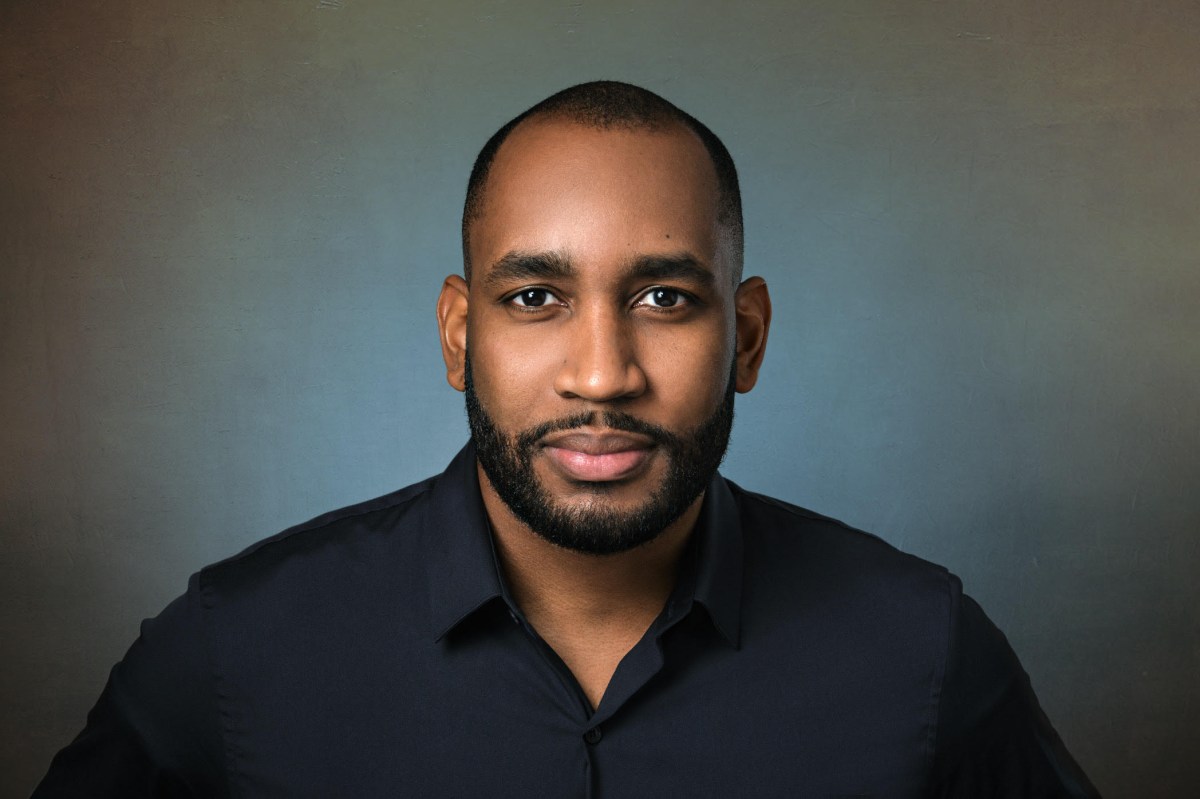
 PHOTO / GEOLAVA
Founder Dispatch · Spatial Intelligence
Hantz Févry
He wants every building on Earth to answer a question - and he's training the machine that will reply.
PHOTO / GEOLAVA
He wants every building on Earth to answer a question - and he's training the machine that will reply.
Type a question about a building - the state of its roof, whether it breaks a zoning rule, how much its block has changed since last spring - and get a real answer. That is the product Hantz Févry is building at Geolava, the San Francisco company he runs from the 37th floor of 415 Mission Street.
Geolava is a spatial-intelligence platform that fuses satellite imagery, LiDAR, aerial scans, street-level photography and government records into a single model you can interrogate in plain language. The pitch is blunt: "We bring AI to the physical world," and it "turns ground truth into financial advantage." For property owners, asset managers and investors weighing decisions across hundreds of buildings, that is the difference between a hunch and a number.
In July 2025 the company stepped out of stealth with a $4.3 million seed round led by Luge Capital, with Suffolk Technologies, E2MC, Moderne Ventures and NVIDIA Inception alongside. Luge sized the opportunity at more than $20 trillion - the fragmented, under-digitized world of real estate and infrastructure. Févry's line on it is shorter: spatial intelligence will reshape real estate in the next few years.
The platform doesn't stop at description. It is built to analyze, underwrite, monitor and forecast - reading a property across structural condition, neighborhood activity, the regulatory environment, and development pressure, then translating those spatial features into a financial read on the asset. The promise is that exposure and opportunity stop being qualitative gut calls and start being things you can query across an entire portfolio. Early-stage conversations with a name as large as JLL signal where Févry thinks this lands: inside the workflows of the people who already move the built world.
Most maps tell you where something is. Geolava is built to tell you what it's worth, what's wrong with it, and what's coming next - by reasoning over the same satellite and sensor data everyone else just looks at.
Same Haiti high school. Same university. Once roommates. Later, colleagues at Google. Now they're building Geolava together - a partnership two decades in the making.
Spatial intelligence will reshape real estate and infrastructure in the next few years.- Hantz Févry, Commercial Observer, 2026
In 2010, a 7.0 earthquake leveled much of Haiti. Févry was 20. His response was not a donation drive - it was a company. He founded I. Trade International and started building an earthquake early-warning system. The work was good enough that Google noticed, and Google hired him.
Mountain View came next. He led the AI research team behind Google Assistant's hotword - the "Hey Google" trigger - sharpening speech recognition for launches in more than 120 countries. His team eventually folded into DeepMind. Somewhere in there he picked up a specialization in quantum computing from MIT, on top of a finance and operations education from Stony Brook.
Then he left to build Stoovo. As an immigrant on a work visa, he first had to secure his green card - and he had none of the Silicon Valley scaffolding people assume. "I did not have that famous garage where I can just sleep," he has said. No family connections, no safety net. Just a plan.
That distance from the standard founder script shows up in how he talks about the work. He's careful to separate the person from the resume - "I am Hantz, I'm not a Googler" - and he's spent real time thinking about how founders without networks should approach fundraising, even building a framework for sizing up founder-investor fit. His read on location is just as unsentimental: being outside Silicon Valley, he insists, doesn't stop a company from working. Geolava puts that conviction into practice, running a San Francisco headquarters while building the bulk of its engineering in Toronto and Montreal to reach Canada's AI talent pool.
Stoovo started as a tool to help gig workers earn more. It boosted delivery efficiency by 40% and lifted driver earnings by 32%. But the real discovery was smaller and stranger: the thing that wrecked a driver's day wasn't traffic or distance. It was the last 100 meters - not knowing where to park, which door to use, how to actually reach the address.
Solving that meant understanding buildings, not roads. So Stoovo started mapping them. One hundred and thirty million of them. That map is the seed of everything Geolava is now - the realization that the physical world is full of questions nobody had bothered to make answerable.
He refuses to call any of this a pivot. "I like to say that Stoovo evolved." Adapting your direction, in his telling, is a sign of resilience, not failure.
Most founders chase a big market. Févry chased a 100-meter gap between a driver and a door - and found a $20-trillion one waiting on the other side.
Geolava is built as a foundation model for the built world - sitting at the intersection of language, vision and location. You ask; it reasons over everything it can see.
Luge spelled out why the bet made sense to them: AI applied at the intersection of language, vision and location; a multi-vertical platform flexible enough to expose its intelligence through an API; a market measured in tens of trillions and starved of digitization; and a founding team with a track record of executing fast. Stoovo had already proven the last point - 130 million buildings mapped, and clients of the caliber of Apple, GM, FedEx and TomTom paying attention. Geolava is the same instinct pointed at a bigger target.
The questions Geolava is built to field aren't abstract. They're the ones that move money and risk:
"I am Hantz, I'm not a Googler."
On keeping his identity separate from his employer"You might get there. You might not, but at least you were courageous enough to try."
On taking the entrepreneurial leap"I did not have that famous garage where I can just sleep."
On building without Silicon Valley's safety nets"Ageism goes both ways. You just can't let it affect you."
On being a twenty-something founderFévry has been a founder long enough to have collected opinions, and he's unusually willing to state them. He started his first venture in high school. He started his second, I. Trade International, at 20. By the time he was running Stoovo through the chaos of a pandemic that reshuffled the entire gig economy, he had a working theory of how young founders get treated - and it wasn't bitter. "Ageism goes both ways," he says. People will wonder how someone so young can be doing this; the trick is simply not letting it land.
He's equally direct about the leap itself. The downside of trying, in his framing, is bounded: "You might get there. You might not, but at least you were courageous enough to try." It's the kind of line that sounds like a motivational poster until you remember the person saying it arrived in the U.S. in 2009, waited on a green card, and built two companies without the network most founders take for granted.
The throughline across all of it is execution. Luge backed Geolava in part because the team moves fast, and speed is the trait Févry keeps returning to - rapid execution, tight teams that survive a change in direction, a refusal to confuse a hard pivot with a failure. Stoovo didn't pivot, after all. It evolved. So, in his telling, has he.
Before buildings, Févry's frontier was voice. He led AI research on the hotword that wakes up Google Assistant - tuning speech recognition for products that shipped in more than 120 countries. The team carried into DeepMind. The lesson carried into Geolava: build a model that understands the messy real world, then let everyone talk to it.
His first company sold promotional branding items - while he was still in high school.
Geolava is staffed in San Francisco but builds much of its engineering in Toronto and Montreal, mining Canada's AI talent.
He and his co-founder met as teenagers in Haiti and have been roommates, classmates and colleagues - long before they were partners.
His Google AI team didn't just work near DeepMind. It became part of it.
The endgame isn't prettier maps. It's a world where the built environment is queryable - where a building's condition, risk and future are a question away, and the answer is one a machine can defend. Févry has spent fifteen years closing the gap between the digital and the physical. Geolava is the closing argument.