A company that sells the boring part of finance, on purpose.
Here is a fact about finance that nobody puts on a billboard: the expensive part of running money is not the trading. It is the plumbing. It is the analyst re-keying a trade into a second system at 11pm because the first system doesn't talk to the second one. It is the compliance officer manually checking whether a portfolio just breached a limit, and the operations team assembling the same risk report on Monday that they assembled last Monday. Everysk, a New York financial technology company founded in 2016, has built a business out of the belief that all of this can be handed to software - and that a lot of firms will pay to make it go away.
The Everysk pitch, stripped to its shortest form, is a slogan the company puts on its own site: "Grow AUM without growing headcount." This is a very finance sentence. It says: you would like to manage more money, but managing more money currently requires hiring more people to do reconciliation and reporting and risk checks, and people are expensive and make mistakes and go home at night. What if the reports and the checks and the reconciliation ran themselves? Then you could manage more money with roughly the same number of humans. That is operating leverage, and operating leverage is the thing every asset manager secretly wants.
"Everysk was born from the firm belief that, regardless of the size of your firm and the complexity of your portfolios, having proper infrastructure is paramount for enduring business growth."
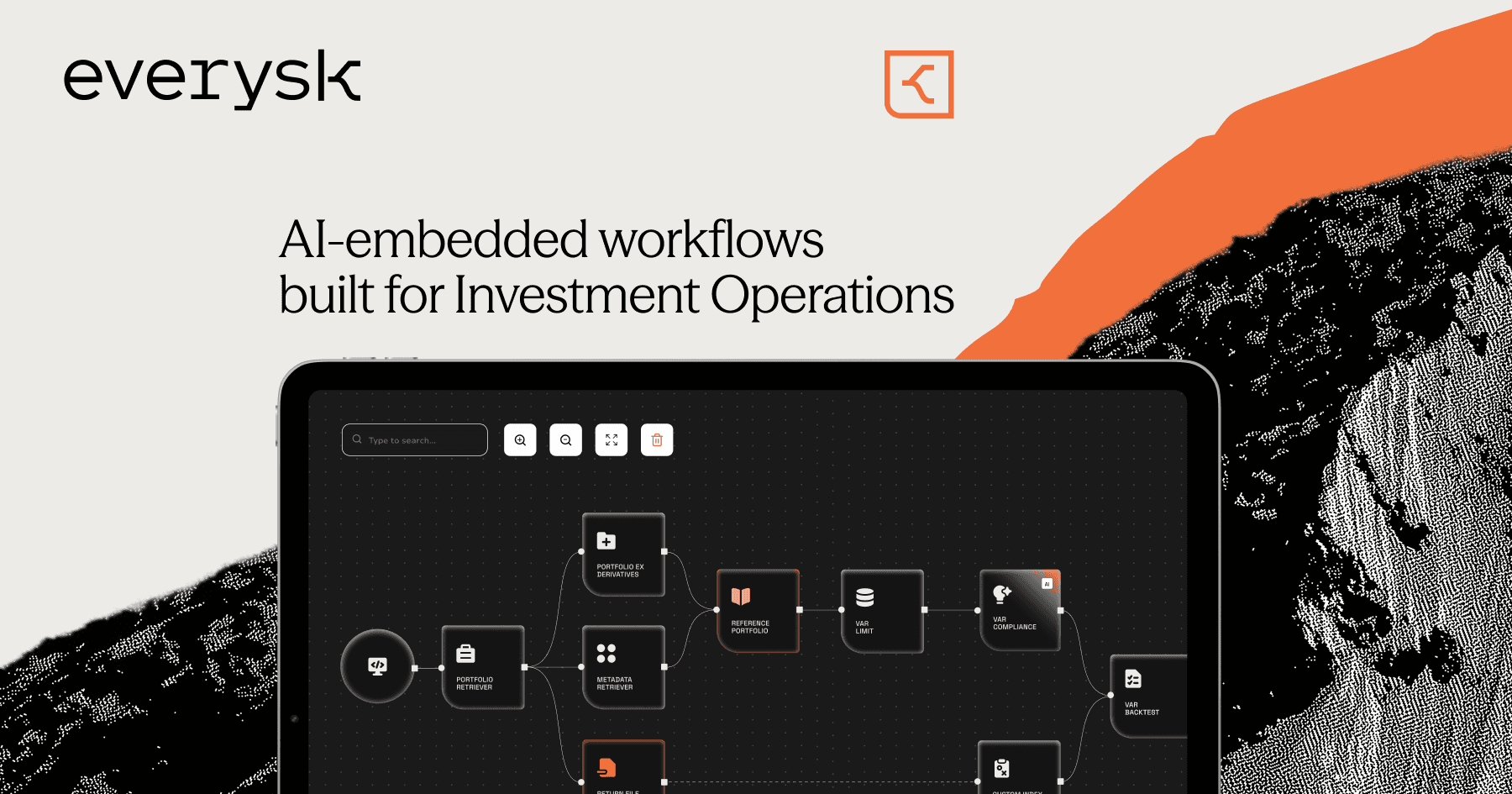
The way Everysk does this is genuinely clever, and it has a slightly delightful vocabulary. The core of the platform is a library of what the company calls "digital robots" - small, modular automations, each of which does one specific capital-markets task. One robot connects to a broker and pulls positions. Another runs a portfolio calculation. Another checks a value-at-risk limit and flags a compliance breach. Another assembles a dashboard and emails it to the right people on a schedule. The robots have names that read like a very literal-minded org chart: Portfolio Retriever, Metadata Retriever, VaR Compliance, VaR Backtest.
Snap-together workflows, no code required
What makes the whole thing usable by non-engineers is the second layer: a no-code design canvas. Instead of writing software, an operations person drags the robots onto a canvas and draws lines between them. Pull the positions, run the calculation, check the limit, build the report, send it. The workflow you just wired together now runs on its own, every day, forever, without anyone touching it. If you have ever used a flowchart tool, you already understand the interface. The difference is that at the end of this flowchart, a real risk report goes to a real portfolio manager.
On top of the robots and the canvas, Everysk has layered agentic AI - and here the company has been notably disciplined about sequence. Plenty of firms bolted a chatbot onto their product in the last two years and called it an AI strategy. Everysk built the deterministic, auditable automation infrastructure first, and then let AI agents reason on top of it. The agents can work through a messy, open-ended task, call outside tools like a news scraper or an SEC-filing API, and then trigger a full automation. The reasoning is fuzzy; the execution underneath it is structured and traceable. In a regulated industry, that ordering matters a great deal.
Who is behind it
Everysk was co-founded by Allan Brik, its CEO, and Denison Linus, its CTO. This is not a couple of twenty-somethings who read about hedge funds on the internet. Brik holds a PhD in computer-aided engineering from MIT and a master's in structural engineering from Brazil - which is to say he modeled buildings before he modeled portfolios, and both jobs are ultimately about understanding how much stress a system can take before something bad happens. The founding team's resume is the pitch: its executives previously designed institutional portfolio systems that monitored roughly $14 billion invested in hedge funds, and traded and managed risk in fixed income, currency and commodity portfolios at Goldman Sachs and Merrill Lynch.
This matters because Everysk is selling to skeptical, technical buyers - risk officers and operations heads who have seen a lot of vendors promise a lot of things. A team that has personally sat on the other side of the desk, building the exact systems it is now trying to automate, is a credibility shortcut. The company's culture reflects this: it describes itself as built from people out of market-leading hedge funds and analytics providers, with a US-Brazil engineering core and a distributed, remote-friendly footprint. Its headquarters sits on West 14th Street, in Manhattan's Meatpacking District, a few blocks from the High Line.
Roughly 34 people move more than $60 billion in portfolios through the platform every day. That ratio is the entire point.
Does anyone actually use it?
Yes, and the customers are the kind that make other customers comfortable. Everysk was selected by XP Inc. - one of Brazil's largest financial platforms - to provide automated portfolio risk monitoring technology for its institutional asset management business. Genial, another Brazilian financial group, picked Everysk to automate its liquidity risk workflows. The company says more than 100 investment teams use the platform, spanning hedge funds, asset managers, family offices, private equity, venture capital, wealth managers and retail brokerages. The platform, it says, monitors more than 10,000 multi-asset portfolios and processes north of $60 billion daily.
The thing to notice about that customer list is how little of it is consumer-facing glamour. Everysk is infrastructure. It sits underneath other financial firms and makes their operations run, which means most people will never knowingly interact with it - the same way most people never think about the payment rails behind a card swipe. That invisibility is arguably a feature. The best infrastructure companies are the ones nobody outside the industry can name.
The money, and the market
Everysk is not, by the standards of splashy fintech, heavily capitalized. Public records point to a seed round of about $1.3 million around April 2020, and the company has stayed relatively lean since. In an era where "agentic AI" startups raise enormous rounds on a slide deck, there is something almost contrarian about a company that built real revenue-generating infrastructure and a $60-billion-a-day processing footprint on a modest seed check. Whether that reflects capital discipline, a deliberately narrow focus, or simply a founder who preferred to own more of his company is not something the public record settles - so we won't pretend to know.
The competitive neighborhood is crowded and heavy-hitting. On one side are the incumbents of portfolio risk and analytics: MSCI's RiskMetrics, BlackRock's Aladdin, Bloomberg's portfolio tools, FactSet. On the other are newer investment-management and workflow platforms like Enfusion. Everysk's wedge is the combination - a no-code automation canvas plus agentic AI plus genuine multi-asset, multicurrency risk math - aimed squarely at the operational middle of investment firms rather than at any single function. It is trying to be the connective tissue, not another point solution.
What can you actually do with it? If you run an investment firm, quite a lot of the day-to-day: automate the full trade lifecycle from request-for-quote to reconciliation; monitor risk across a multi-asset, multicurrency book in real time; run stress tests and VaR backtests; catch compliance breaches the moment they happen and keep an audit-ready record of everything; aggregate holdings and market data scattered across systems into one place; and ship interactive portfolio apps, scheduled reports and alerts to clients and colleagues without an engineer in the loop. The promise is not that Everysk does anything a large team couldn't do by hand. It's that it does those things without the large team, and without the midnight re-keying.