Four hours is a long time to spend telling people their flight has gone wrong. At Swoop, the Canadian airline later folded into WestJet, staff once extracted passenger manifests from Navitaire’s reservation system and assembled Outlook mail merges. A disruption response typically took four hours. After adopting 15below, the airline reported getting that job done in under 15 minutes.
The aircraft did not become easier to repair. The weather did not become more agreeable. What changed was the work between an operational decision and a passenger hearing about it. That interval is where 15below has built its business: connecting airline information to messages people can understand and actions they can take.
The Brighton company’s proposition sounds modest beside the grander promises of travel technology. Keep people informed. Yet the Swoop example makes the stakes unusually legible. A manual process consumed staff attention precisely when staff had the least attention to spare. Automation gave them time back while giving passengers an earlier answer.
A booking record with something to say
Founded in 2000 by Nicholas Key and John Clynes, 15below grew out of travel-industry experience. Key had worked at SITA and American Express. Ryanair became its first customer in 2002. Today, its customer roster includes British Airways, Cathay Pacific, Etihad and JetBlue, and its remit reaches beyond airlines to other travel businesses.
The core product connects reservation systems to passenger communications. Its Disruption module identifies affected bookings, sends branded messages and lets travellers respond through hosted pages. Accepting an itinerary change or choosing another available option can feed information back into the reservation system, so an agent can see what happened. The message has an operational consequence.
Workflow Manager tackles the queue behind those messages. It sorts and processes passenger name records - the booking records usually shortened to PNRs - according to an airline’s rules. It can distinguish routine cases from those needing attention, suppress duplicate processing and schedule reminders. The practical attraction is consistency across thousands of bookings, with difficult cases returning to people.
- 01Flight changesOperational or reservation data
- 02Rules check the bookingWho needs what, and when?
- 03Passenger gets a choicePersonalised message and self-service
- 04The record catches upResponse returned to airline systems
The plumbing is part of the product
That puts 15below in a particular corner of enterprise software: passenger communication tied to travel operations. An airline could assemble its own messaging workflow, use capabilities already inside its reservation system, or connect a general messaging service to custom software. Those alternatives still need to identify the right booking, interpret the change and record the response.
15below’s differentiation rests on those connections and the travel-specific rules around them. Amadeus and Navitaire are strategic partners. Cirium supplies flight-status data and trip monitoring; Cirium’s own explanation of the partnership notes that extracting the necessary data from airlines can be difficult. Access to reliable information is part of the work being sold.
The business model is hosted B2B software with configuration, integration and ongoing support. Buyers enter through a consultative sales process. For an airline evaluating it, the useful cost comparison includes the existing staff workload, maintenance burden and repeat contacts, alongside the software contract. Faster notifications matter commercially when they remove work or let passengers finish a task themselves.
When the paperwork reached the departure queue
JetBlue’s pandemic experience shows how quickly an information problem can become an airport problem. Changing US health-attestation requirements forced the airline to collect and validate paperwork. In 15below’s account, queues exceeded four hours, online check-in was paused to ensure forms were collected, and paper records created a storage burden.
The response was to collect information digitally, validate passengers using booking and flight details, and update the booking when the process was complete. One week after launch, 70% of attestations were completed through the microsite alone. Three months in, 90% were completed digitally. These are historical pandemic results, but the operational lesson travels well: collect information before the passenger reaches the bottleneck.
Aegean took a more gradual route. It approached 15below in 2012 after relying on four full-time agents for manual schedule-change work. Delivery came in three phases, allowing the airline to coordinate operational changes and judge results before moving further. By 2019, nearly 80% of schedule-change communications were automated, and the case study reported that extra seasonal staff were no longer required.
The sequence is worth copying. Pick a repeatable task, establish what consumes time, introduce automation in a manageable scope, then measure the remaining manual work. A high automation rate is useful only if the exceptions still reach someone equipped to resolve them.
Your boarding pass would like to buy you coffee
Some of the clearest product value fits into a small airport purchase. Working with iCoupon and Ryanair, 15below connected delay-triggered voucher issuance to passenger notifications. Travellers receive the value available, instructions on where to redeem it and the news that their boarding pass now serves as their voucher.
During a period of disruption beginning in June 2024, the partners reported issuing 175,196 refreshment vouchers automatically, with a peak daily send of 36,528. Ryanair helped develop and test the integration. Here, the communication finishes a practical job: it tells someone how to obtain assistance without joining another queue to ask.
A separate Ryanair case study published in June 2026 reports more than 50 million personalised notifications annually. That figure describes the scale of messaging. The voucher example explains why a particular message might deserve to exist.
Even a good airline has awkward handoffs
Hawaiian Airlines supplied a different kind of evidence. Despite a strong record of punctuality, feedback from guests and colleagues revealed opportunities to improve disrupted journeys. In a three-day workshop described in October 2024, 15below and customer-experience consultancy Empathyce brought together almost 30 people at the airline’s Honolulu offices.
They walked through the terminal, mapped experiences for different passenger personas and examined how departments, systems and rules interacted. The exercise exposed gaps, overlaps and unintended consequences. Proposed improvements included more contextual notifications and better coordination. The account describes a programme of work, rather than attaching a convenient revenue number to a workshop.
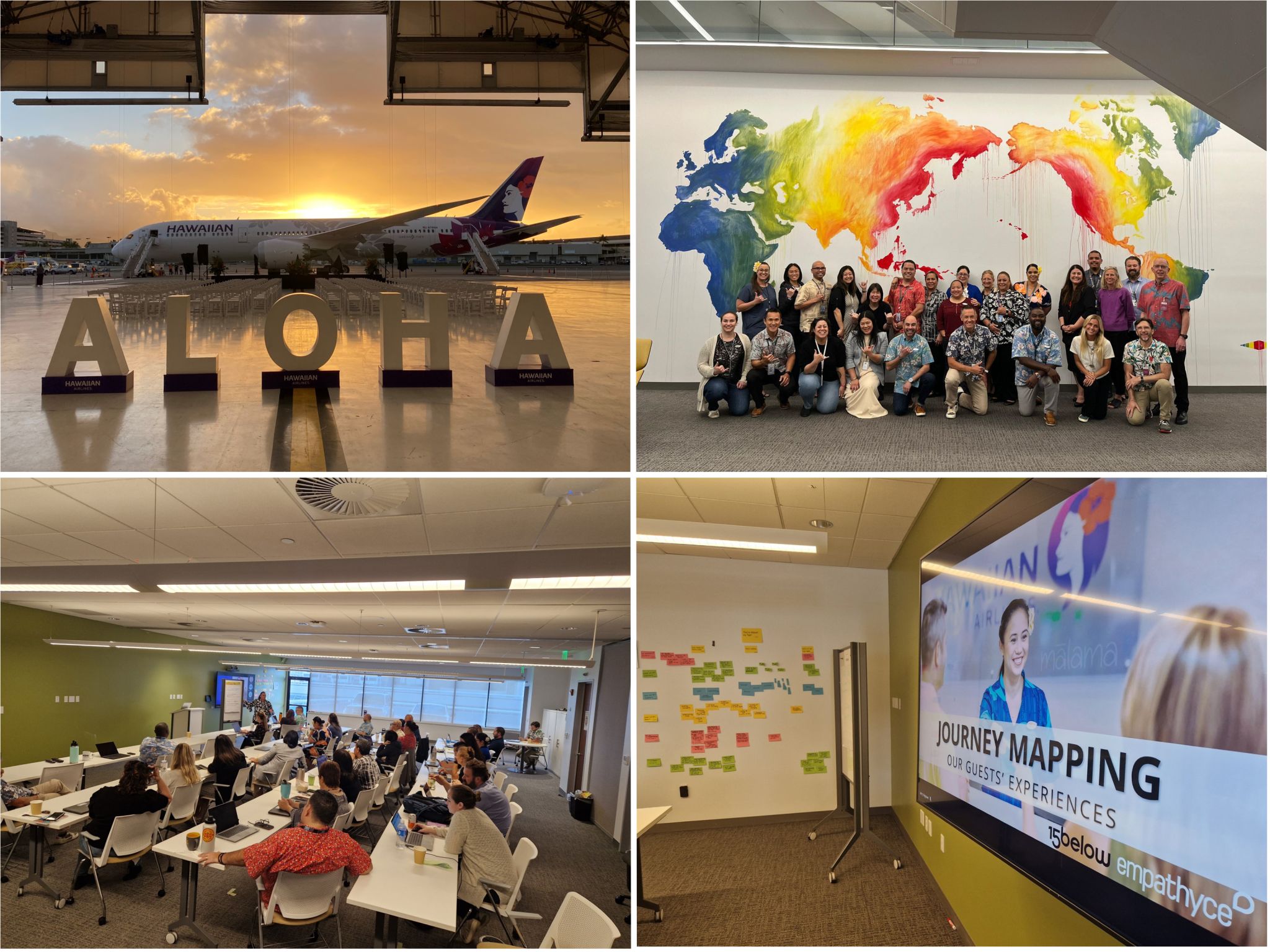
For buyers, this is a useful glimpse of what implementation involves. Software can deliver a decision quickly; departments still have to agree what that decision should be. Walking the actual passenger route can reveal something a dashboard misses, including the moment a traveller is handed from one team to another.
There is business before the bad news, too
Disruption gives 15below its sharpest examples, but the platform also covers ordinary travel. Flight Status takes events from operational feeds and applies rules about who should hear what, and when. A gate change, departure delay or arrival update may matter to passengers, staff and people meeting the flight.
Pre-Departure Communications combines practical trip information with reminders and commercial offers. Checklists, booking details and prompts to complete check-in can sit alongside relevant extras. That creates two possible returns for the airline: fewer avoidable enquiries and additional sales. It also requires editorial judgment. A passenger looking for an essential instruction should be able to find it.
The attention to timing extends to a quietly appealing feature: disruption notifications can be configured for “friendly hours,” avoiding unnecessary overnight interruptions. Personalisation, in this setting, includes knowing when a message can wait. The customer’s first name is a comparatively easy detail.
The airport joins the conversation
LDC invested in 15below in February 2024, backing a five-year growth strategy and further technology development. Former Amadeus executive Ian Wheeler joined as chair. In July 2025, 15below made its first acquisition, buying Airport AI, whose conversational software already served more than 80 airports. PhocusWire reported that the purchase price was undisclosed.
“For too long, airports and airlines have operated in silos when it comes to engaging with passengers.”Pierre Cuquemelle, Airport AI CEO · July 2025
The deal addresses a familiar mismatch: travellers experience one journey, while the airline and airport operate different systems. Airport AI adds passenger-facing conversations across digital channels. 15below brings integration with airline bookings and workflows. The intended combination would let a traveller ask for help with more context available behind the answer.

There is newer airport evidence, too. A Brussels Airport case study published in June 2026 says its BRUce assistant automates 98% of passenger enquiries and supports more than 500,000 travellers annually. Those are the airport case’s reported measures, rather than proof that every proposed airline-and-airport integration is complete.
The human work behind fewer manual tasks
Inside 15below, the public account of working life emphasises flexibility and trust. Its people page describes a Work From Anywhere scheme introduced in 2023, flexible public holidays and offices that welcome dogs. Its careers page records Living Wage Employer status and a commitment to the Diverse Sussex initiative. These are concrete policies behind the recruitment language.
The product has an equally human dependency. Its own Workflow Manager description routes cases requiring intervention back to staff. Airlines still need usable contact details, reliable system connections and agreed rules. If the underlying information is wrong, or the offered next step cannot be fulfilled, speed alone will not produce a satisfactory journey.
That is the demanding part of 15below’s business. A useful message has to arrive with enough context, at a sensible time, and leave the passenger able to do something. The airline may still owe an apology. At least it can stop making people wait hours to hear it.