The quiet argument inside Syncro is not about ticket colors, patch policies or even artificial intelligence. It is about what an IT service business should be charged for. Most remote-management vendors count the machines. Syncro counts the people at the keyboard. One technician can watch 100 endpoints or 10,000; the base platform bill does not move until another technician needs a seat.
That choice sounds like an item on a pricing page. In practice, it is a management philosophy with a calculator attached. The better an MSP gets at scripting, standardizing and preventing incidents, the more devices each person can support and the lower the software cost per endpoint becomes. Growth can expand margin instead of merely expanding the invoice.
The product behind the bet is a combined remote monitoring and management system, or RMM, and professional services automation system, or PSA. In ordinary English: it watches computers, deploys patches, runs scripts and opens remote sessions; then it catches the ticket, tracks the labor, invoices the customer and records the payment. The Team tier adds deeper Microsoft 365 security and identity work. Cloud Backup protects Microsoft 365 and Entra ID data. A marketplace pulls security products into the same operational and billing loop.
Two scrappy tools walk into a merger
Syncro’s origin explains its shape. In 2011, Ian Alexander co-founded RepairTech to automate computer repair and built Kabuto, a lightweight monitoring tool. RepairShopr approached the same operator from the business side: customer records, tickets, estimates and invoices for repair shops. RepairTech and RepairShopr merged in 2017, and Syncro emerged later that year.
This was less a grand theory of enterprise software than a collision between two messy workdays. The monitoring tool knew a disk was filling up. The business tool knew which client owned the machine, what service agreement covered it and whether the work had been billed. Joining those facts produced a useful promise: technical work and commercial work should not require duplicate entry.
One incident, one commercial trail
In 2021, growth-equity firm Mainsail Partners invested an undisclosed amount. Syncro also acquired Watchman Monitoring, extending its history in Mac-focused monitoring. That year, Splashtop replaced Syncro’s homegrown Live tool as the default remote-access layer. The change is revealing: Syncro did not need to own every component. It needed the components to feel like one job.
A Tuesday morning, compressed
Consider the small emergencies that make up an MSP’s day. A client laptop falls behind on patches. A server disk crosses a threshold. A new employee needs a Microsoft 365 account, the right licenses and a place on next month’s invoice. None is especially exotic. The expense comes from frequency and fragmentation. A technician checks an alert in one product, opens a ticket in another, launches a third remote tool, records time, then hopes the correct quantity appears when finance bills the client.
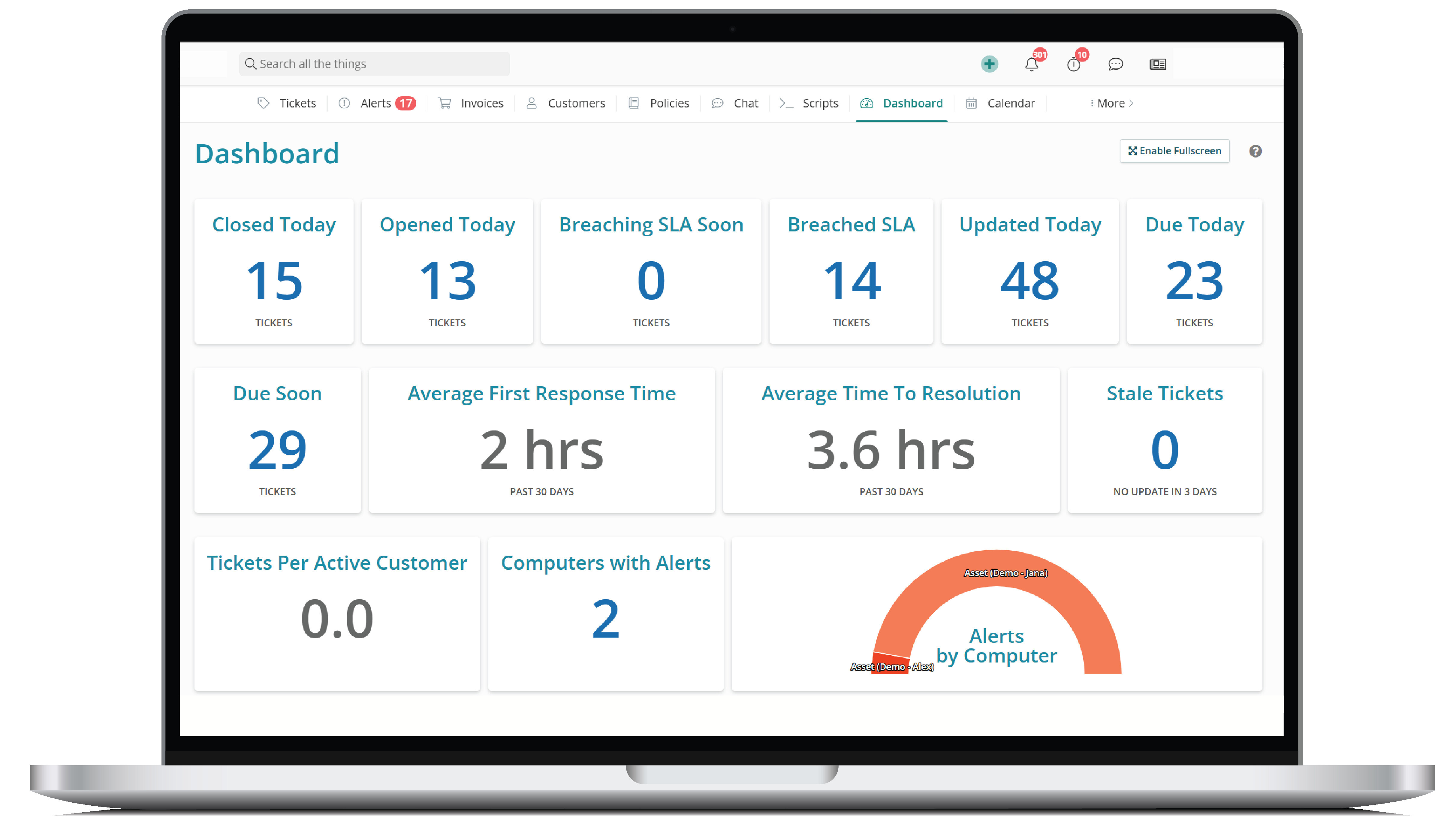
Syncro turns that chain into a set of policies and records. The RMM agent inventories the endpoint and monitors conditions. A policy can trigger an alert, run a PowerShell or Bash script, or create a ticket. From that ticket the technician can start a Splashtop session, inspect services, use a remote command line and document the fix. The PSA applies an SLA, captures labor and carries covered work or billable charges into a recurring invoice. A dashboard shows stale tickets and response times before a customer has to ask.
For Microsoft 365, the Team plan moves identity work beside endpoint work. A technician can sync Entra ID contacts, reset passwords and multifactor authentication, revoke sessions, block a user and monitor configuration drift against CIS-aligned baselines. Branded security assessments give an MSP something concrete to put in front of a client’s leadership. That is both service delivery and sales collateral: a red posture score can become a security project instead of a vague warning.
The billing layer is the overlooked mechanism. Recurring invoice rules can count devices, contacts, licenses or services. Universal Billing pulls changing quantities from supported products instead of asking someone to reconcile a spreadsheet. With Guardz, for example, protected-user counts sync daily and security incidents open tickets in the PSA. The security product is still separate, but the two moments most likely to leak margin - incident handoff and license reconciliation - are connected.
This is what “all in one” should mean in a vertical market. It does not mean every feature is the deepest available. It means the common nouns - customer, contact, asset, ticket, contract, charge - keep their identity from one step to the next. A specialist RMM may offer finer control, and a dedicated PSA may satisfy a more elaborate finance operation. Syncro’s wager is that many teams will trade the last 10 percent of depth for fewer translations across the other 90 percent of the day.
The cost is simple. The consequences are not.
Syncro publishes two main MSP tiers. Core costs $129 per user each month on an annual plan, or $159 month to month. Team costs $179 annually or $209 month to month. Both include unlimited endpoints, full PSA features and remote access. Team earns its extra $50 with Microsoft 365 security baselines, identity controls, real-time ticket automation, guided resolution, network discovery, advanced reports and stronger remote-session features. Cloud Backup is another $1.90 per protected user monthly.
A three-technician shop on annual Team pricing spends $6,444 a year before add-ons. Its cost is identical whether it manages 300 endpoints or 3,000. That is the song. The squeak appears when the firm adds many coordinators, junior techs or occasional users. Seats grow even if endpoints do not. Paid marketplace products and specialist tools can also reintroduce the stack of bills that the platform was supposed to flatten.
“We found a simplified platform that scales not based on the endpoint, but based on the agent.”Vincent Williams, Orchestrate Technologies
Atera is the closest conceptual rival because it also prices per technician with unlimited endpoints. NinjaOne, ConnectWise, Kaseya and N-able often enter the same evaluation, along with newer combinations such as SuperOps or a separate RMM and HaloPSA. Syncro’s distinction is not that rivals lack tickets, scripts or remote access. It is the density of the bundle: RMM, a complete billing-oriented PSA and Microsoft 365 management are designed to share the same records.
What failed first was the handoff
Customer stories make Syncro’s value more concrete than its feature grid. DLL Techs entered the pandemic with a shrinking client base and an expensive ConnectWise setup its staff found complicated. Reporting took days, integrations were clunky and some tasks stayed manual. A recommendation in an MSP discussion group led co-founder Christopher Fischer to demo Syncro. Within days, DLL switched. The company later reported savings equal to a full-time salary, a 25 percent reduction in internal management time and faster onboarding.
What changed their mind was not a dazzling new category. It was the realization that software sophistication had become labor. When technicians avoid the system, managers become translators and reporting turns into archaeology, a powerful suite can be more expensive than its contract. Syncro won by removing steps.
Octopi Managed Services tells the same story at month-end. Its billing process fell from eight hours to one after the move. Orchestrate Technologies reports that Syncro XMM cut ticket-handling time by 43 percent. These are vendor-published case studies, so they should not be treated as universal benchmarks. They are still instructive because the gains came from a recognizable place: the seam between an event, a person and an invoice.
Now the console is learning to leave the console
Syncro’s 2025 and 2026 releases widen the definition of the job. Cloud Backup covers Exchange, SharePoint, OneDrive, Teams and Entra ID. A Linux agent, generally available for Ubuntu LTS in May 2026, put Windows, Mac and Linux fleets into one management environment. Partnerships with IRONSCALES and Guardz turn email and user-security incidents into Syncro tickets, while usage counts flow into recurring invoices.
The August 2026 launch of a native Model Context Protocol server is the more provocative move. A technician can connect live Syncro tickets, assets, customers and billing data to Claude, ChatGPT, Copilot or another compatible assistant. The assistant can prepare a site visit, review SLA risk or clean up billing without forcing the user to hunt through tabs. Each connection inherits the signed-in user’s Syncro permissions, and changes remain subject to the assistant’s approval rules.
That is a better AI thesis than sprinkling a chat box over the dashboard. The model gets operational context; the system of record keeps authority. Syncro has also shipped ticket summaries and opened automated triage and dispatch in beta. Guided Ticket Resolution, intended to match issues with known fixes, was slated for September 2026. The claim that it could resolve up to 20 percent of tickets remains a target, not a result.
The part worth stealing
The copyable lesson is not “bundle everything.” Bad bundles become storage closets. The lesson is to map one customer job from trigger to cash, then own the expensive handoffs. Syncro starts with a device event and follows it through automation, human work and billing. It prices against technician capacity because capacity is what the customer is trying to multiply.
It works when
Endpoints grow faster than headcount; workflows can be standardized; technicians and billing staff share records; and Microsoft 365 is central to the service menu.
It strains when
Many occasional users need seats; the team favors deep best-of-breed tools; unusual enterprise controls dominate; or every client demands a custom process.
A buyer can copy the thinking before buying the software. Count the re-keyed fields in a ticket’s life. Time the distance from alert to invoice. Model the next thousand endpoints and the next five hires separately. Then run a trial with real scripts, real billing rules and the fussiest client, not a polished demo tenant. The crucial metric is not feature count. It is completed work per technician.
Syncro is not the inevitable answer for every MSP. Mature teams may prefer specialized tools and accept the integration tax. A support-heavy firm can find per-seat economics less charming than a device-based contract. But Syncro has made one tradeoff unusually legible. If software can help a small team manage a much larger fleet, that team should keep some of the upside. The company built the meter around that belief.