Company Profile / Health & Clinical Research
THREAD Moved the Clinical Trial to the Patient's Kitchen Table
For decades a clinical trial meant a patient driving to a site. THREAD bet the visit could come to them instead - and then bought four companies to prove it.
Ask a clinical-research veteran why so many drug trials run late, over budget, or short on the right patients, and the honest answer is rarely about the science. It is about a parking lot. Patients quit trials because getting to the research site - the drive, the missed workday, the paperwork, the repeat visits - is exhausting. THREAD, a clinical-research technology company headquartered in Cary, North Carolina, built its entire business around deleting that trip.
The company's product is a single platform for running decentralized clinical trials - studies where data is captured from participants wherever they happen to be, in between and in lieu of in-clinic visits. Instead of stitching together a dozen separate vendors for consent forms, patient surveys, wearables, video visits and recruitment, a biopharma sponsor or contract research organization (CRO) runs the whole study through one configurable system. THREAD says roughly 100 studies and more than 100,000 participants across about 60 countries have moved through it.
A mission you can actually check
The 1/5/30 ruleMost health-tech companies describe themselves as "patient-centric," which means almost nothing. THREAD did something more useful: it wrote its mission as arithmetic. The internal shorthand is 1/5/30 - give customers one comprehensive platform, make research five times more inclusive, and make it 30 percent more efficient. Numbers are harder to hide behind than adjectives. A mission you can measure is a mission you can be held to.
platform
patient reach
research
That middle number carries more weight than it looks. "Five times more inclusive" is not a diversity slide - it is a description of what happens when a trial stops requiring a patient to live near a research hospital. When the visit comes home, the pool of people who can participate widens on its own. Access becomes a feature of the software rather than a hope in a recruitment plan.
One login instead of twelve vendors
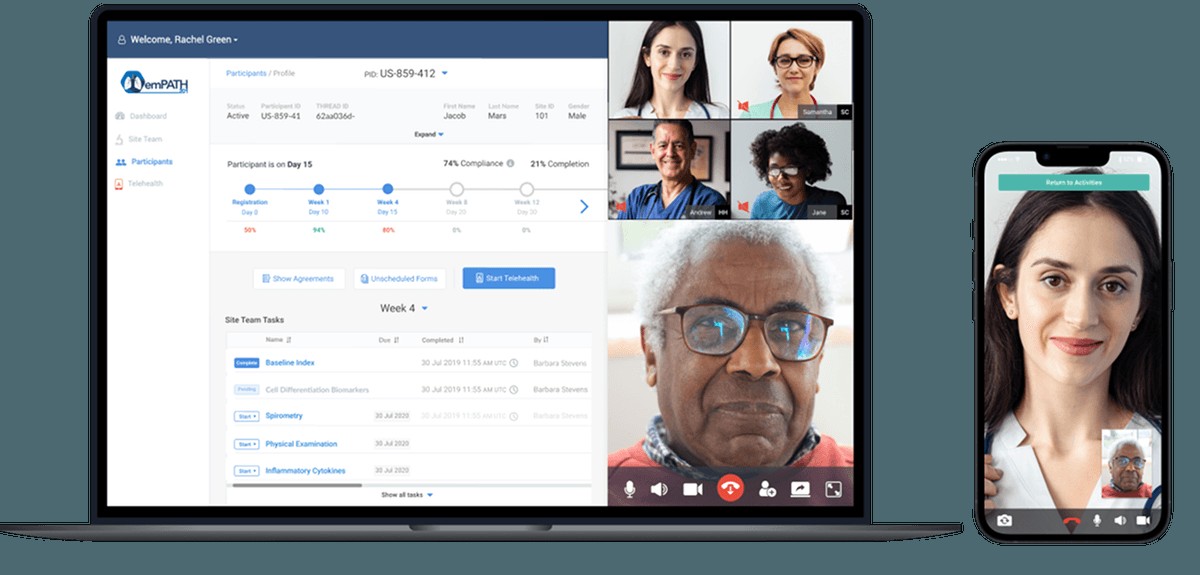
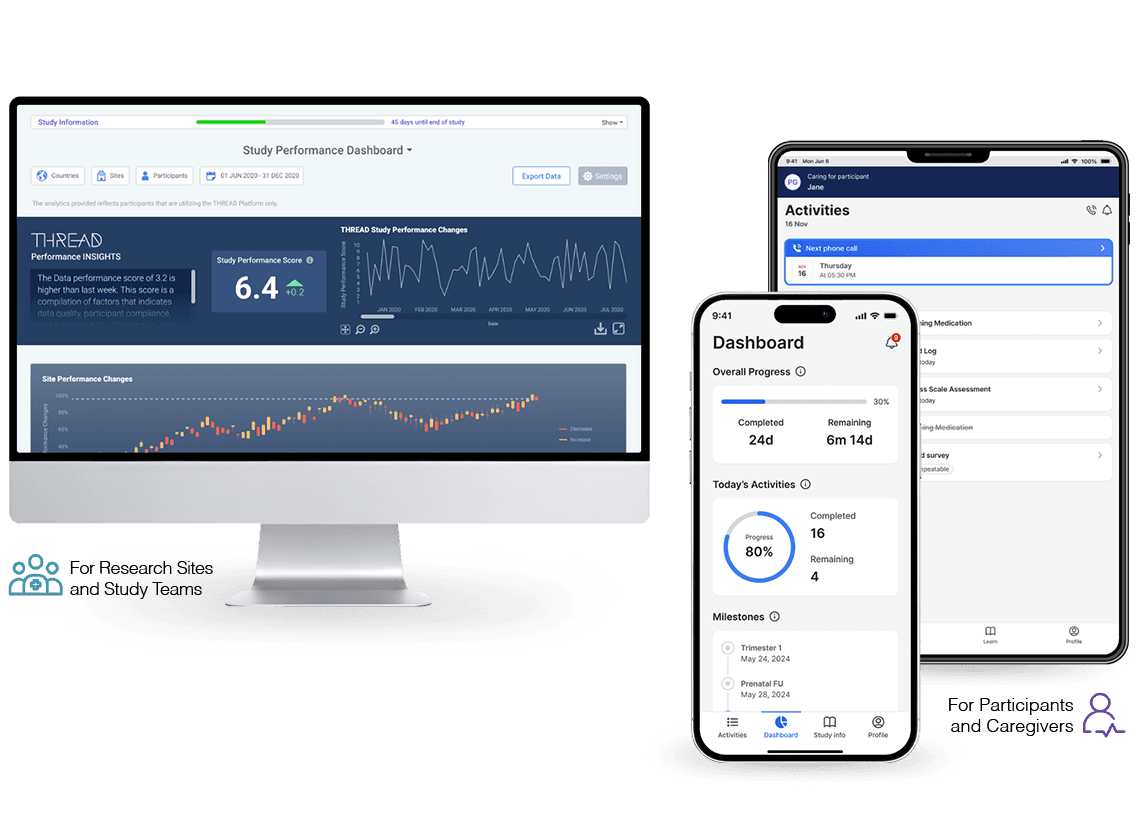
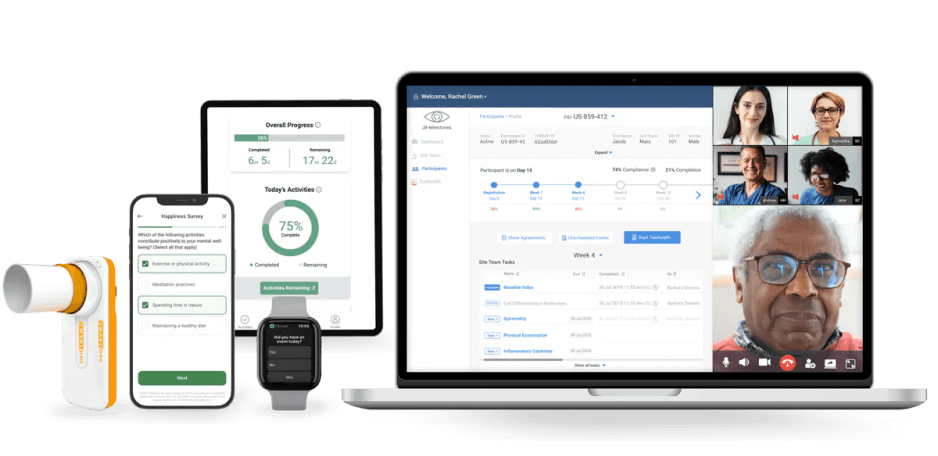
The productUnder the hood, THREAD bundles roughly a dozen research technologies into one system: eConsent for digital sign-up, eCOA/ePRO for electronic patient and clinician outcome assessments, eSource and data-capture tooling, connected sensors and wearables for continuous readings, automated reminders, and telehealth Virtual Visits. The data - a spirometry reading, a nightly survey, a video summary, a wearable's step count - lands in one place, tagged and stored together.
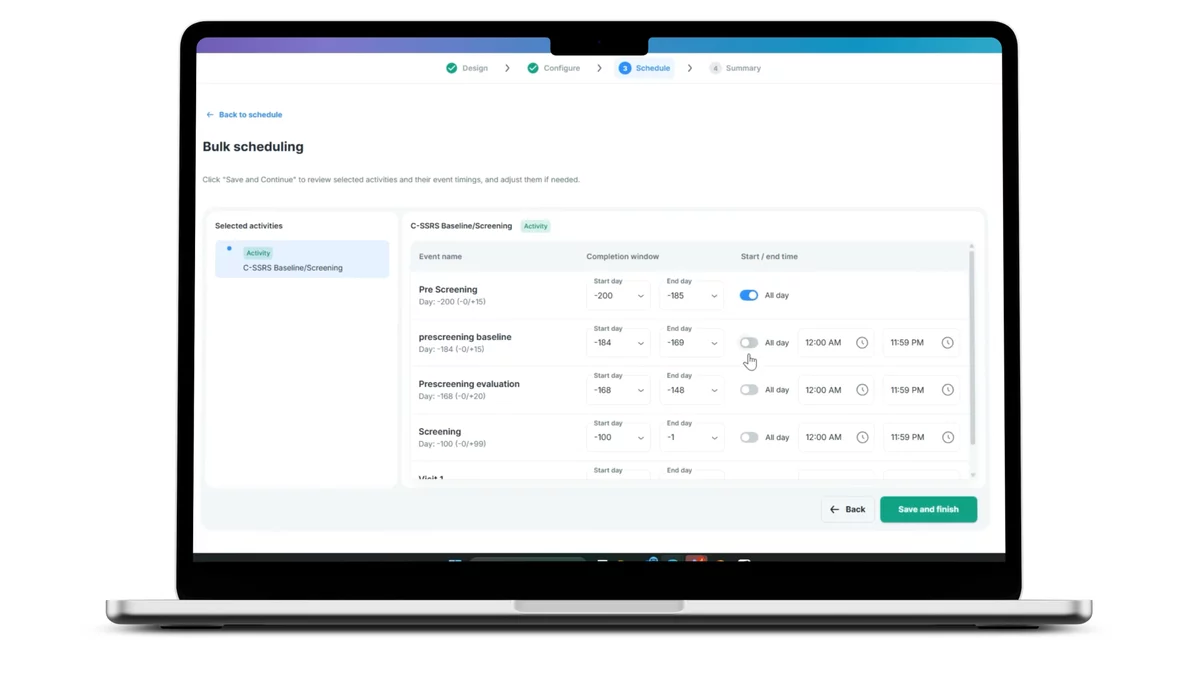
The strategic bet is boring in the best way. A sponsor running a global study does not want twelve contracts, twelve logins and twelve integration headaches. THREAD's whole business is being the one system to answer for - consent to sensors to patient voice, configurable without a rebuild for each study. Bundling, done right, is a moat.
The founder came from the other side
Who built itTHREAD is led by co-founder and CEO John Reites, who spent close to two decades in global drug development - including a stint as a corporate intrapreneur at Quintiles (now IQVIA), one of the giants of the old, site-heavy trial model he now competes against. That background matters. He is not an outsider guessing at what slows trials down; he watched it happen from the inside, then left to build the platform he wished he'd had. He is also an Entrepreneur in Residence at Duke University, keeping THREAD wired into North Carolina's Research Triangle.
Assembling a patient journey by acquisition
Build vs. buyBacked since 2019 by health-care private-equity firms Water Street Healthcare Partners and JLL Partners - who committed up to $50 million in growth capital in 2020 - THREAD went shopping. In under a year it acquired three companies, each filling a different gap in the patient's path from "never heard of this trial" to "enrolled and reporting data."
Read together, the three deals are not a land grab - they are a deliberate assembly. CureClick handles awareness, Modus handles what you measure, inVibe handles what patients say, and the core platform handles running the study. THREAD bought an entire patient journey and wired it into one login.
The part where patients get to talk back
inVibe & patient voiceThe most quietly interesting piece is inVibe. It records how real patients and clinicians describe a condition - the actual words, hesitations and phrasing - and runs them through natural-language processing, linguist review, and more recently GPT-powered analysis. Why bother? Because trials fail on wording more often than anyone likes to admit. A survey question that makes sense to a protocol writer can be meaningless to a patient. inVibe is, in effect, a focus group wired into the design stage, catching those mismatches before enrollment starts.
The pandemic ran the experiment for them
The proof pointIn early 2020, COVID-19 shut clinical sites worldwide and froze large numbers of traditional, site-based trials. The decentralized ones kept collecting data. THREAD had spent years on the unglamorous plumbing - remote consent, home visits, connected sensors - and a pandemic turned that plumbing into the whole house. Research the company co-authored found decentralized trials proved more resilient than traditional ones through the disruption. What had looked like an experiment suddenly looked like the expectation.
Illustrative comparison of scope, not a benchmark. THREAD's pitch is breadth-in-one-system against best-of-breed single-point vendors such as Medable, Science 37, Curebase and Signant Health.
How the money actually works
Business modelTHREAD is a B2B software-and-services business. It licenses its configurable platform to sponsors and CROs, then layers consulting on top - study design, endpoint and eCOA strategy, recruitment and operations. Revenue scales with the number and size of studies running on the system, which is why the acquisitions matter commercially and not just strategically: each one adds a reason for a sponsor to route more of a trial - and more budget - through THREAD rather than a competitor. Third-party estimates put annual revenue in the high single-digit millions, though the company itself does not publish the figure, and a private-equity-owned business tends to keep those cards close.
The team is roughly 130 people, distributed but anchored in the Research Triangle. That is deliberate. North Carolina's Durham-Raleigh-Chapel Hill corridor is dense with pharma, CRO and academic-medicine talent - the exact people who know why trials stall and how regulators think. Being physically inside that ecosystem, with a CEO who also teaches entrepreneurship at Duke, is a quiet recruiting and credibility advantage in an industry that runs on trust and track record.
Where it fits - and where it wouldn't
The market readTHREAD sells to biopharma sponsors, CROs and life-science organizations; the end users are participants, caregivers, remote nurses and site teams. It competes in a crowded decentralized-trial and eCOA field against names like Medable, Science 37, Curebase, Castor, Signant Health and Medidata. Its differentiation is scope: one configurable system spanning awareness, consent, capture, sensors, telehealth and patient voice, rather than a single best-in-class slice.
The model is not magic. Decentralization fits some studies far better than others - a trial that hinges on an in-person imaging scan or a specialized in-clinic procedure will still need the clinic. Bundling also cuts both ways: a sponsor that already owns strong point tools may not want to swap them for an all-in-one. And running generative AI inside one of the most regulated software categories on earth means moving carefully, not quickly. THREAD's actual edge may be less the AI than the discipline of using it without tripping the compliance wire.
Still, the core insight travels well beyond health care: find the customer's single hardest step, and make it disappear. For clinical trials, that step was the trip to the site. THREAD's entire company is the answer to deleting it.