A startup can have a working prototype and still spend its week looking for an accountant, an introduction or somewhere to meet a customer. The Dot’s proposition begins with that unglamorous problem. In Tunis, it gathers people and programs that entrepreneurs might otherwise have to chase separately. There is room to work, help to ask for and, should the business need a microphone, a podcast studio.
The building is the visible part. The more interesting construction is institutional: Tunisia’s Ministry of Communication Technologies, Fondation Tunisie pour le Développement, Expertise France and GIZ brought their resources into a shared venture. Since its 2021 opening, The Dot has combined startup support with a wider brief covering digital transformation. Its ambition depends on whether that crowded address makes the entrepreneur’s next step easier.
First, put the helpers in the same room
Startup support can become its own navigation problem. A founder looking for workspace may also need commercial advice; a technically capable team may need help understanding its market. The Dot puts several of those needs within one network. The French Treasury reported more than 26 support programs there in March 2024, with some available free of charge.
The partner list is revealing. It includes Flat6Labs, Orange Fab, Smart Capital, investment firms, associations and specialist incubators. Organizations that might compete for a founder’s attention elsewhere can appear here as complementary resources. The Dot occupies the space between them: part host, part organizer, part route into expertise. That makes coordination central to its value.
A standalone coworking space offers a simpler proposition: somewhere to sit and work. A specialist accelerator offers a narrower program. The Dot asks founders to see an advantage in having multiple routes available together. The useful comparison is therefore the time and effort required to reach appropriate help, rather than the number of desks in a photograph.
A year of room to work
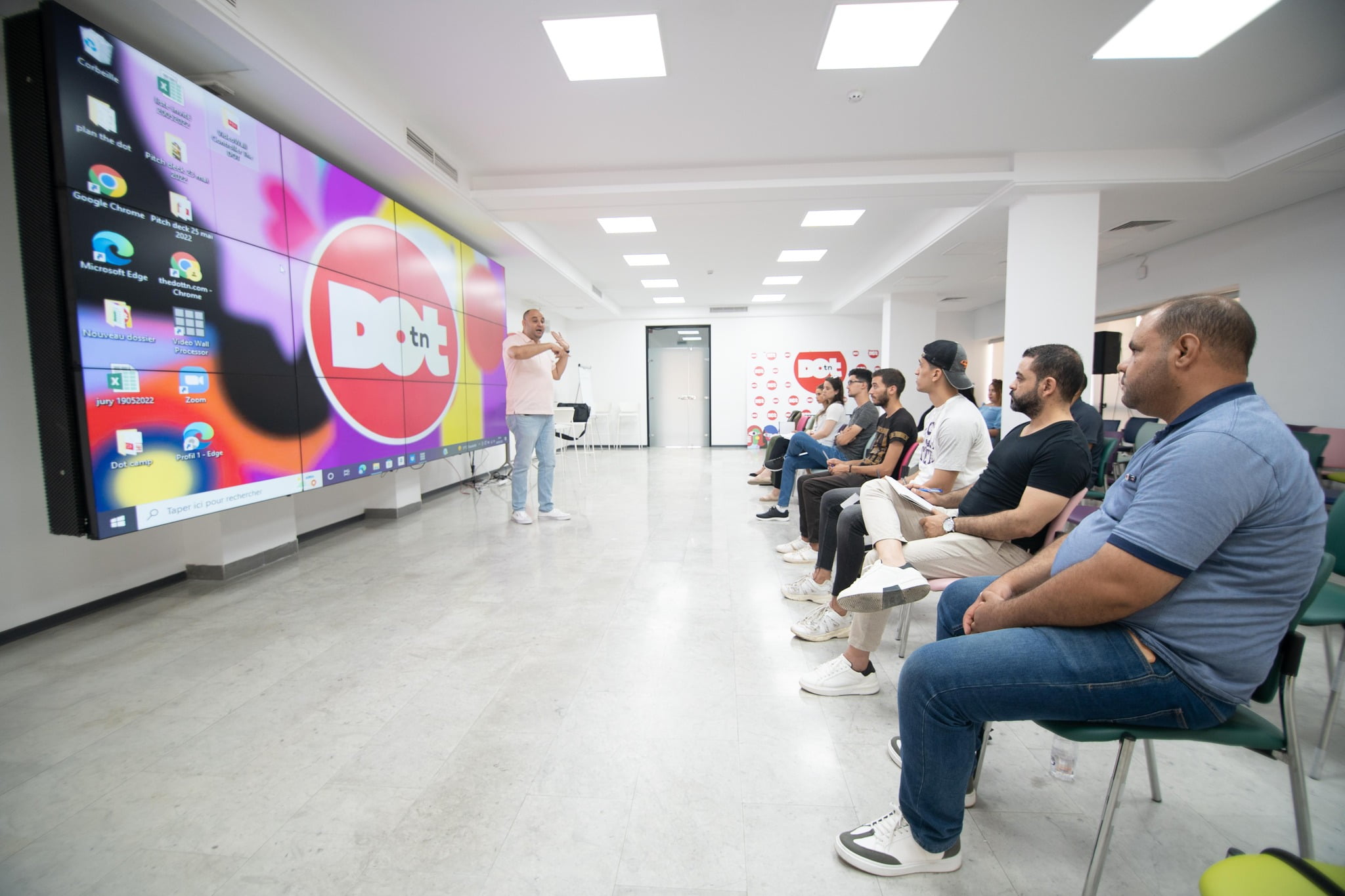
Dot Camp makes the offer concrete. Its published package includes a year of free hosting for an innovative early-stage startup’s team, full-time access to workspaces and meeting rooms, and access to other programs. For a small company, those are practical inputs: a place to assemble the team and somewhere credible to hold the next conversation.
That offer also clarifies who the hub serves. It is built around entrepreneurs trying to develop businesses, alongside the organizations that support them. Space matters because a team has work to do there. Networking matters when it leads to a relevant adviser, partner or commercial conversation. The program’s value is in how those pieces combine during the founder’s working week.
Dot Services opens another door. The resource-center menu covers hot desks, equipped event spaces, audiovisual equipment, a design workstation and the podcast studio. These are shared facilities that a young business might use intermittently. Pooling them makes intuitive economic sense: an entrepreneur may need recording equipment for an afternoon without needing to own a studio.
Related offers, not a mandatory sequence. Access follows each program’s arrangements.
The accountant belongs in the startup story
Dot Expert covers the questions that can stop an otherwise energetic company: accounting, taxation, legal matters, financing, communications and getting a product to market. Its published description is refreshingly practical. Entrepreneurs can ask questions, seek advice and discuss solutions with specialists. A founder’s most useful meeting may concern a contract or a pricing decision.
Executives in Residence adds a different sort of help. The program describes a pool of more than 25 senior executives, with backgrounds spanning technology, telecommunications, commerce, industry, consulting and finance. They devote part of their time to group or individual mentoring. The distinction matters: a specialist can address a defined issue, while an experienced operator can challenge the assumptions behind the business.
This dependence on people shapes the hub’s culture. Shared facilities create opportunities for contact, but advice still requires someone willing to listen and someone willing to ask. In an interview with La Gazelle, launch-era director Zeineb Messaoud described partners contributing different services. The operating idea is cooperation with a practical purpose, rather than everyone delivering the same workshop.
“Each partner at The Dot contributes a building block of services.”
Zeineb Messaoud · La Gazelle interview, translated from French
Free to founders still has a bill
The Dot’s financing belongs to the world of institutional cooperation. A June 2019 agreement brought €60,000 of AFD support for project preparation. European funding through Innov’i then allocated €1 million to the launch phase. Those amounts describe specific support commitments. They should be read separately from a startup’s equity round, annual turnover or the full cost of running a building.
AFD · 2019 agreement
EU · through Innov’i
Different purposes and periods. These figures are not a lifetime funding total or an operating budget.
That model explains the free services better than a conventional software-company description would. Partners and development programs support resources that eligible entrepreneurs can use. The business logic is to strengthen companies and the institutions around them. A founder’s immediate benefit may be access to advice or facilities without paying a commercial rate for every component.
The trade-off sits behind the reception desk. Someone must coordinate providers, maintain equipment, administer programs and secure continued support. Free access makes those tasks no less expensive. For anyone studying The Dot as a model, the financing relationships and the work of keeping partners involved deserve as much attention as the floor plan.
The factory is part of the picture
The Dot’s brief reaches beyond startup incubation. Its Digital Transformation Centre lists an artificial-intelligence hub, an Industry 4.0 hub, a GSMA Mobile Innovation Lab, an academy and soft-landing activity. The combination places industrial and public-sector technology needs alongside entrepreneurship. A company profile that calls it simply a coworking business misses much of the intended work.
A September 2022 GSMA event gives that technical side a specific shape. Held at The Dot, it introduced Platforms for Tomorrow, a program developed with GIZ offering selected innovators customized technical assistance. The stated aim was to improve solutions, their ability to grow and their socioeconomic impact. Here, the hub supplied a meeting point between a specialist program and potential participants.
The distinction is useful for prospective users. An entrepreneur seeking technical support should look for the relevant program and its terms. A public institution or established business has a different starting question: which digital-transformation activity addresses its problem? A broad institutional mission becomes useful only when someone can identify the particular service they need.
A landing pad for people coming back
Dot Landing addresses another kind of distance. Tunisians living abroad may bring commercial experience or a business idea while needing local connections to establish operations at home. The program was announced in Paris in May 2023. Its published offer combines four months of free support with personalized assistance, hosting and access to a platform of verified service providers.
That design treats entry into a market as a sequence of practical decisions. Who can provide the right service? Which local contact understands the business? Where can the team work while it gets established? The program offers an organized setting for those questions, with partners including MEET Africa and the Île-de-France region.
An August 2026 announcement described a new call built around diagnosis, immersion and four months of coaching across six modules, followed by a Demo Day. The subjects ranged from business models and financing to marketing, exports and management. That sequence creates opportunities to prepare and present a business; a presentation to investors remains an opportunity to make a case, rather than an investment award.
The next useful address may be outside Tunis
Geography is the obvious test for a hub with national ambitions. The Dot has reported a Dot Camp+ cohort involving more than 10 founders from seven regions, including Tozeur, Béja and Gabès. Over four months, the reported work included 20 workshops, 70 individual sessions and six pitch sprints. Female participation exceeded 70 percent.
Those numbers describe people reached and support delivered. They are useful evidence of activity, while leaving a separate question about longer-term business results. For the founders, the immediate offer was structured time with experts to examine ideas, develop business models and practice presenting them. For the hub, it was a way of engaging talent beyond its home city.
Physical expansion demands another level of planning. A December 2025 Expertise France brief requested a regional deployment study, considering seven governorates with ELIFE centers and selecting two within available resources. It called for local needs assessment, staffing, governance and sustainable financing. The practical implication is clear: the appropriate service mix depends on the place, the people and the budget.
There is a lesson here for another city tempted to copy The Dot. Start by mapping the help entrepreneurs already seek, then establish which organizations can reliably provide it together. A room full of partner logos cannot compensate for unavailable experts or services that do not match local needs. The building earns its keep when founders can use the connections inside it to get on with their businesses.
Step inside the network
Explore The Dot’s website, follow program announcements on LinkedIn and Facebook, or watch its YouTube channel.
For a longer conversation, listen to Zeineb Messaoud on Startup Story. Read the August 2026 Dot Landing announcement and the foundation’s introduction to the hub.