semantic-layer
(23)
Jedify wants AI to learn the office dialect
An AI agent can read your database and still misunderstand your business. Jedify is building a context graph to teach it the definitions, relationships, and rules that make the numbers mean something.

GoodData.AI wants your AI to agree with your accountant
A tourism platform and a financial software company reveal GoodData.AI’s bet: before machines can make useful decisions, someone has to decide what the numbers mean.
The AI That Needs Your Colleagues to Be Right
PromptQL began with a way to ask questions of scattered company data. Its bigger wager is that the answer only improves when the people who know the exceptions work in the same room as the bot.

Sundial and the Case of the Three Correct Numbers
When three dashboards give three answers to one question, the problem is not a shortage of charts. Sundial wants to make the numbers agree - and teach an AI analyst what to do next.

The Data Catalog Learned to Read the Room
Euno began with an unfashionable question: what if enterprise AI's biggest problem is not intelligence, but office gossip? Its answer is a living map of what a company's data means, who trusts it and where it goes.

AtScale Refused to Kill Excel. Now Its Semantic Layer Has to Keep AI Honest.
The Boston software company spent a decade making old-school BI behave on new-school data. Its next customer is an AI agent - and the same boring layer may be what keeps the answers useful.
Dremio Made the Data Lake Usable. Then SAP Came Shopping
The enterprise-data startup bet that companies would rather query their lakes than keep copying them into warehouses. A decade, roughly $407 million in funding and one SAP acquisition later, that argument has become the center of the AI stack.
Toucan Bootstrapped to $5 Million ARR - Then Bet the Company on Analytics You Can Talk To
The French founders let customers fund the product before investors got a look. A decade later, Toucan is making a sharper wager: the winning dashboard may be the one users never have to learn.
The Tiny SQL Tool That Taught 100,000 Data Teams to Think Like Software Engineers
dbt began as a practical fix for analysts stuck between raw warehouse tables and impatient colleagues. A decade later, its workflow sits inside more than 100,000 data teams - and a completed merger with Fivetran is turning that humble idea into a bid for the data layer beneath enterprise AI.
The Software Company That Turned Its Balance Sheet Into a Bitcoin Machine
Strategy still sells the analytics software that made MicroStrategy a fixture in corporate IT. But its defining product is now the company itself - a public-market structure engineered to accumulate bitcoin at a scale no operating company has matched.
Cashboard
Cashboard is a New York-based, Y Combinator-backed (S22) startup building a semantic layer that sits between a company's financial data and AI. It stores the metrics, data models, mappings and permissions that let AI agents - and finance teams - produce accurate, governed FP&A work: reports, dashboards and analysis pulled from 900+ connected systems. Founder Julian Rowlands frames the goal as turning AI into a 'trusted FP&A machine' and, eventually, the 'solo CFO.' The company raised a $5M seed led by FINTOP Capital in July 2026.

Datost
Datost is a Y Combinator (Spring 2026 / P26) startup founded by Maceo Cardinale Kwik and Jason Wang. It launched as 'the proactive AI data analyst' - a Slack-native agent with a semantic layer that scored 75.2% on the BIRD-Interact text-to-SQL benchmark versus 33% for a frontier model alone - and has since become an applied research lab building ED1TH, a 25-gram pair of AI AR smart glasses with no cameras, an in-lens display, and a companion smart ring. Backed by Y Combinator and OpenAI.
Kaelio
Kaelio is a San Francisco startup (Y Combinator, 2025) building the open-source context layer that makes AI data agents reliable. Its core project, ktx, auto-builds a governed layer of business knowledge and executable metric definitions from a company's data stack - Markdown wiki pages plus YAML that declares tables, joins, grain, measures and filters. Instead of an agent writing raw SQL that looks right but returns wrong numbers, it asks ktx for a metric and ktx plans the joins and compiles warehouse SQL. Kaelio ships ktx (Apache 2.0), a hosted ktx Cloud with governance and observability, and a managed Data Agent that answers questions in Slack, web and email with source-backed results.
Tracer
Tracer is a New York-based collaborative data intelligence platform that aggregates, normalizes, and enriches data from any source - ad platforms, sales systems, commerce, and finance - into a governed, unified layer that non-technical teams can query in real time. Incubated inside VaynerMedia starting in 2015 and spun out as an independent company in 2021, Tracer positions itself as 'the intelligence layer for AI-driven enterprises,' serving more than 200 customers including Sanofi, Papa Johns, Conde Nast, and Headspace. The company has raised roughly $30M-$58M across rounds, including an oversubscribed $18.1M Series A in August 2023.

Lightdash
Lightdash is an open-source business intelligence platform built natively on dbt. It turns a data team's dbt models into a governed semantic layer, letting analysts define metrics as code and letting everyone else explore data - and, increasingly, ask AI agents questions - without writing SQL. Founded in 2020 (originally as Hubble in Y Combinator's S20 batch), it positions itself as an open, developer-first alternative to Looker and is backed by Accel, Shopify Ventures, Operator Partners and Y Combinator.
Zetaris
Zetaris is an Australian enterprise data company building an open, agentic data lakehouse that lets organizations query and prepare data across many disparate sources without moving or copying it. Founded in 2013 in Melbourne by Vinay Samuel and Jason Jaesung Jun, the platform uses federated, in-place querying with intelligent multi-engine routing (Spark, Trino, Presto, DuckDB) and a unified semantic layer to feed private, governed AI workloads. It positions itself as a control plane for enterprise AI rather than another business-intelligence tool.

Rill Data
Rill Data builds the fastest business intelligence tool for humans and AI agents. Founded in 2020 by Metamarkets veteran Michael Driscoll, Rill takes a BI-as-code approach: dashboards, metrics, and business logic are defined in SQL and YAML, versioned in Git, and powered by embedded OLAP engines (DuckDB in Rill Developer, ClickHouse and Apache Druid in Rill Cloud). The result is sub-second, operational dashboards that teams actually use - processing more than 100 billion daily events for customers in programmatic advertising, media, and fintech.

WisdomAI
WisdomAI is a San Mateo-based enterprise software company building a new category it calls agentic analytics. Founded in 2023 by a team of former Rubrik engineers, its platform lets business users ask questions of their structured, unstructured, and even messy data in plain language. Rather than letting a language model write answers (where it might hallucinate), WisdomAI uses LLMs only to generate the queries that pull real data from warehouses like Snowflake, Databricks, and BigQuery. An Adaptive Context Engine governs metrics, definitions, permissions, and business logic so insights stay accurate and consistent. The company has raised $73M total and grown from two enterprise customers to roughly 40, including Cisco, ConocoPhillips, Patreon, and Descope.
Zenlytic
Zenlytic is a New York based AI analytics company behind Zoe, an AI data analyst that answers complex business questions in plain language and returns verifiable, source-cited results. By pairing large language models with a governed semantic layer, Zenlytic lets non-technical teams self-serve trustworthy analytics from warehouses like Snowflake, BigQuery and Databricks, generating dashboards, presentations and models without a data team in the loop.
Shelf
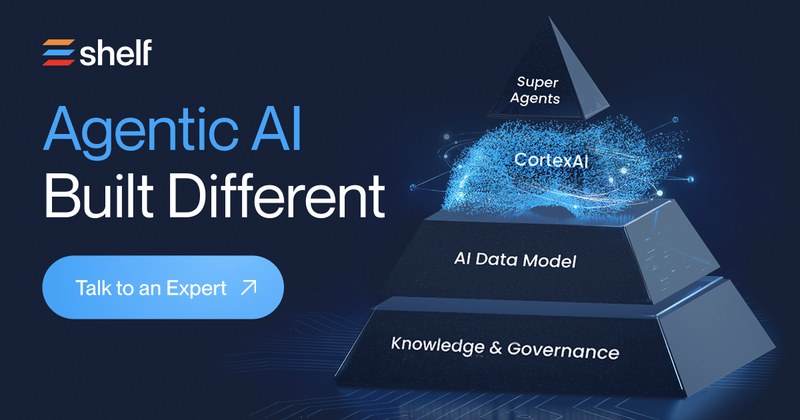
Shelf is an AI-driven knowledge and data quality platform that cleans, enriches, and governs the unstructured content enterprises feed into generative AI. By diagnosing and fixing the messy documents, duplicates, and outdated answers buried across corporate systems, Shelf aims to make GenAI and RAG applications accurate and trustworthy. Founded in 2017 and based in New York and Stamford, Connecticut, it serves enterprises like John Deere, HelloFresh, DSW, and Glovo.
Hex
Hex is a San Francisco-based AI analytics platform founded in 2020 by former Palantir employees Barry McCardel, Caitlin Colgrove, and Glen Takahashi. The company builds an integrated workspace where data teams and business users can analyze data, build interactive apps, and share insights using SQL, Python, and natural language — all in one place. With $177M in total funding including a $70M Series C in May 2025, Hex serves over 1,500 organizations including Reddit, Figma, Anthropic, Brex, and the NBA, replacing fragmented tool stacks with a single governed platform powered by AI agents.
Kyligence
Kyligence is the company behind Apache Kylin, the open-source OLAP engine for big data. Founded in 2016 by the project's original creators, it now sells an AI-powered metrics platform and a copilot that lets non-technical employees chat with their business numbers instead of writing SQL.
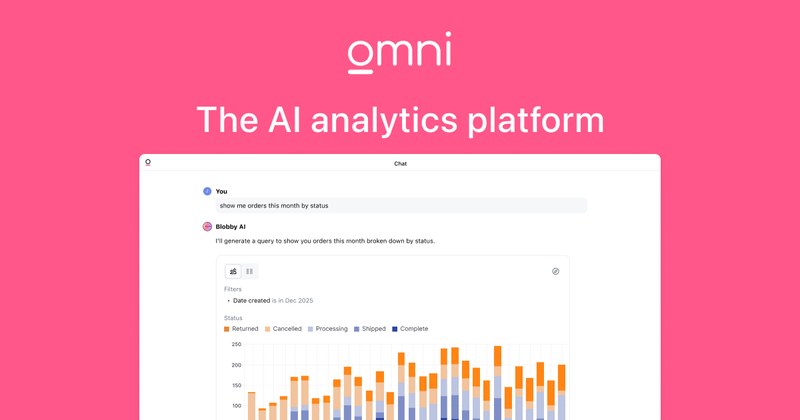
Omni Analytics
Omni Analytics is a San Francisco-based business intelligence platform founded in 2022 by former Looker and Google executives. The company builds a semantic layer that turns raw enterprise data into a governed, AI-ready source of truth. With natural language querying, Git-based version control, and deep dbt integration, Omni enables both technical and non-technical users to get trusted answers from their data. The company reached unicorn status in April 2026 after raising $120M in Series C funding at a $1.5B valuation, led by ICONIQ, with participation from Theory Ventures, First Round Capital, Redpoint Ventures, and GV.