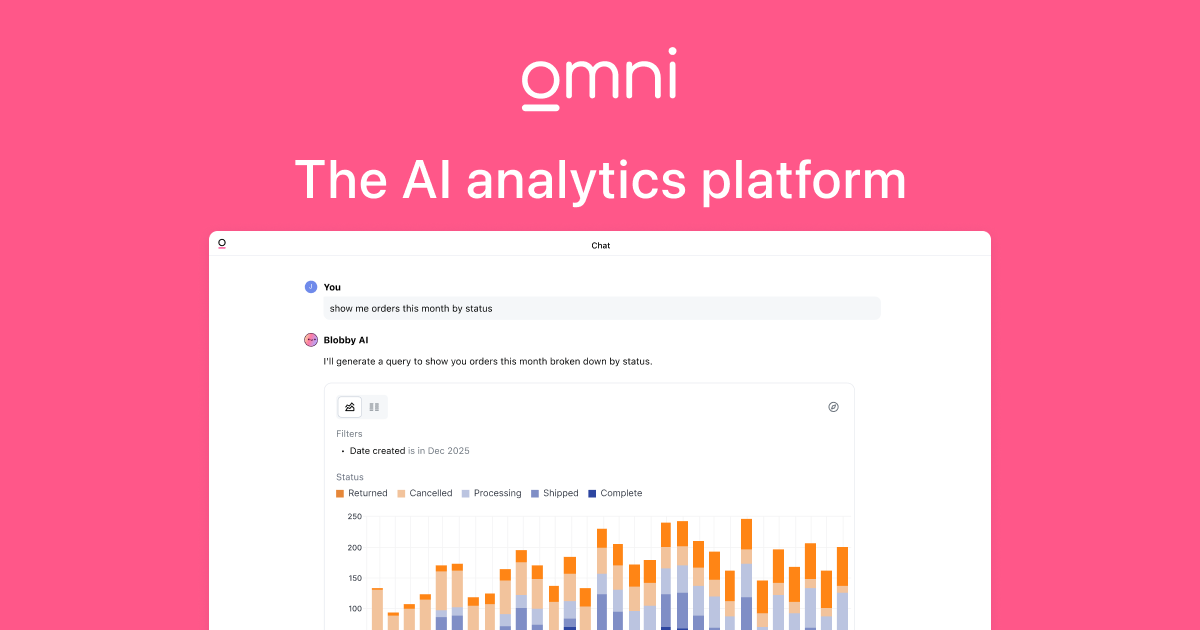
Somewhere in a growth team Slack channel, an analyst just typed "show me orders this month by status" into a chat interface. Three seconds later, a stacked bar chart appeared - accurate, governed, and ready for the exec meeting. No SQL. No waiting on the data team. No prayer that the numbers match last week's dashboard.
This is the promise that countless BI tools have made and broken. Omni, the San Francisco startup that hit unicorn status in April 2026, is betting it can keep it.
The Problem They Saw
The business intelligence market is worth $30 billion. It's also a graveyard of frustrated users. Data teams spend weeks building dashboards that business users never touch. Business users ask questions that take days to answer. Everyone ends up in spreadsheets anyway.
Then AI arrived - and made everything worse.
Large language models can write SQL. They can build charts. They can answer questions in plain English. What they can't do is understand your business. Ask ChatGPT about your revenue, and it will confidently generate plausible-looking nonsense. It doesn't know that "active users" means something different in your company than the industry standard. It doesn't know that Q4 numbers need a specific adjustment for seasonality. It hallucinates metrics that don't exist.
This is the gap Omni exists to fill: the translation layer between what AI can do and what enterprises actually need.
The founding principle of Omni has been to enable every user to get answers fast, trust the data, and take action.
- Colin Zima, CEOThe Founders' Bet
Colin Zima, Jamie Davidson, and Chris Merrick met at Princeton. Then they went their separate ways to build the modern data stack.
Colin and Jamie landed at Looker, the business intelligence company Google bought for $2.6 billion in 2019. Colin ran customer support, then became Chief Analytics Officer. Jamie led product. Chris went to Stitch, the data integration company that Talend acquired, where he helped create Singer - the open-source standard now used by thousands of data pipelines.
By 2022, they'd watched the BI industry evolve for a decade. Cloud data warehouses had solved the storage problem. dbt had solved the transformation problem. But nobody had solved the trust problem: how do you make sure everyone in the company uses the same definitions, applies the same business logic, and gets the same answers?
Colin Zima
CEO
Former Chief Analytics Officer at Looker. Built customer support into a competitive weapon.
Jamie Davidson
President
Led product at Looker. Started as a data scientist at Google on Ads and YouTube Search.
Chris Merrick
CTO
Former VP Engineering at Talend. Co-created Singer, the open-source data integration standard.
They reunited to build Omni around one idea: the semantic layer. Not as an abstract data modeling exercise, but as the foundation for AI that actually works.
The Product
Omni's semantic layer is a governed translation layer between raw data and any query - human or machine. Define "monthly active user" once, set permissions once, version control it in Git like code. Every dashboard, every SQL query, every AI conversation uses the same definition.
Natural Language Analytics
Ask business questions in plain English. Get accurate answers grounded in your semantic model, not hallucinated metrics.
Semantic Layer
Shared definitions, permissions, and business logic. Version-controlled in Git. The single source of truth for AI.
Embedded Analytics
Customer-facing dashboards with multi-tenant architecture. Row and column-level security baked in.
dbt Integration
Bi-directional sync with dbt. Your transformations and your analytics layer speak the same language.
The product lets analysts build models as they explore - what Omni calls "just-in-time data modeling." You don't need to design everything upfront. Start asking questions, and the model grows organically. Reusable metrics emerge from actual work, not theoretical architecture diagrams.
For AI, Omni built an MCP (Model Context Protocol) server. Claude, ChatGPT, and Cursor can query Omni directly, getting answers grounded in the semantic layer. The AI understands "what is our churn rate?" because Omni tells it exactly how your company defines churn.
Compared to Tableau and Looker, Omni was by far the best performer.
- Cody Pulliam, Senior Manager of Business Analytics, AviatrixThe Proof
Numbers first: 4x annual revenue growth. Profitable as of early 2026. Over 200 enterprise customers in under four years. The kind of trajectory that makes VCs write checks.
$1.5B
Valuation
4x
YoY Revenue Growth
200+
Enterprise Customers
~200
Team Members
Total Funding Raised
The Series C also included a $30M employee tender offer - rare for a startup this young.
But the customer stories tell a sharper story:
BuzzFeed migrated their entire analytics infrastructure from Looker in under three months. "Using Omni has reduced the number of new questions and consolidated the reports our Analytics team needs to build," says Lizzy Bradford, Senior Director of Analytics.
Guitar Center unified thousands of users across four different platforms onto Omni. One source of truth for a retail operation spanning 300 stores.
Feeld, the dating app, doubled data adoption and cut time-to-insight by 80%.
Who Uses Omni
The Timeline
August 2022
Launch with $27M Seed
First Round Capital, Redpoint, and GV back three Princeton grads with a plan to fix BI.
2023
Series A - $20M
Theory Ventures leads. Product-market fit confirmed with early enterprise adopters.
March 2025
Series B - $41M at $650M Valuation
Snowflake Ventures and Databricks Ventures join as strategic investors.
Early 2026
Profitability Achieved
Rare milestone for a high-growth AI startup. Capital efficiency becomes a competitive advantage.
April 2026
Unicorn Status - $1.5B Valuation
ICONIQ leads $120M Series C. Includes $30M employee tender offer.
Pretty much everyone is involved in Omni in one way or another.
- Jack Colsey, Analytics Manager, Incident.ioThe Mission
Omni exists to make AI analytics trustworthy. Not "AI that can query data" - dozens of tools do that. AI that understands your business the way your best analyst does. AI that gives the same answer to the same question, every time. AI that respects permissions, applies business logic, and never invents metrics.
The semantic layer isn't glamorous. It's the kind of infrastructure work that doesn't make for viral demos. But it's what enterprises actually need to deploy AI in production. Without governance, AI analytics is just expensive hallucination.
Why It Matters Tomorrow
Every enterprise wants to be "AI-powered." Most can't get there because their data is a mess - inconsistent definitions, fragmented permissions, metrics that mean different things in different dashboards. AI amplifies this chaos. Ask a question, get a confident wrong answer.
Omni's bet is that the semantic layer becomes essential infrastructure, like the cloud data warehouse before it. The translation layer that makes AI actually useful for business decisions. The governed foundation that lets companies deploy AI at scale without losing their minds.
Back in that Slack channel, the analyst just shared the chart to #exec-team. The CFO clicked it, asked a follow-up question, and got an answer in seconds. The same answer the analyst would have given, because it's built on the same model.
The data team didn't get a ticket. The CFO didn't wait a week. Nobody opened a spreadsheet.
That's the change.