BREAKING Akkio raises $15M Series A led by Bain Capital Ventures
Horizon Media wins $800M in new business on Akkio's AI platform
Reports that took weeks now land in dashboards in 90 minutes
Founded 2019 in Cambridge, Massachusetts
Havas folds Akkio into a €400M agentic-AI bet
SOC 2 · HIPAA · GDPR compliant
Who they are now
A media agency wins an $800M account. The new hire was software.
Inside Horizon Media, a question that used to eat an afternoon now gets answered before the coffee cools. Which audience? Which channel? What happens if we move the budget? An analyst types it in plain English. The answer comes back in minutes. The software doing the answering is Akkio.
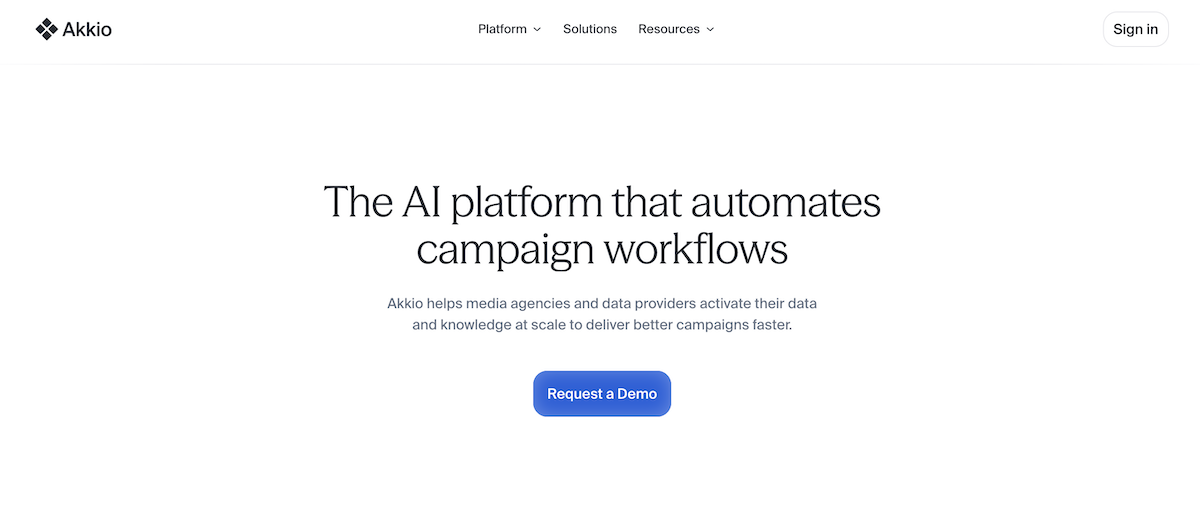
Akkio is a Cambridge, Massachusetts company that builds an AI-native platform for the people who run advertising campaigns. Not for data scientists - for the strategists, client leads and analysts who were never going to learn Python and shouldn't have to. The pitch is unglamorous and exactly right: take the data an agency already has, and let anyone interrogate it, model it, and act on it without filing a ticket to the engineering team.
The problem they saw
The data was always there. The wait was the problem.
Media agencies sit on mountains of data - first-party, third-party, campaign logs, attribution exports. The catch is that turning any of it into a decision meant a relay race: a marketer asks, an analyst queries, a data scientist models, an engineer ships, and three weeks later a slide deck arrives describing a moment that has already passed.
Everyone agreed AI could fix this. Most tools fixed it for engineers. The long tail of business users - the people closest to the actual campaign - were handed dashboards they couldn't change and models they couldn't build. Akkio's read on the situation was blunt: the bottleneck was never the math. It was access.
The bottleneck was never the math. It was who got to ask the question.
- The gap Akkio set out to close
The founders' bet
Four founders, one stubborn idea.
Akkio was founded in 2019 by Jon Reilly, Abe Parangi, Craig Wisneski and Ekin Keserer. Reilly and Parangi run the company as co-CEOs - an arrangement that should not work and apparently does. Their bet was that machine learning would become genuinely no-code: that you could build a predictive model by talking to your spreadsheet, and that this would matter most to people who had never met a data scientist.
The first version of Akkio aimed at small and mid-sized businesses - any team that wanted more from its data but couldn't afford a consulting bill. Then generative AI arrived, the agency world started asking sharper questions, and Akkio made a decision most startups dread: it narrowed. It pointed the whole platform at media agencies and data providers, the customers who had the most data and the least patience.
JR
Jon ReillyCo-Founder & Co-CEO
AP
Abe ParangiCo-Founder & Co-CEO
CW
Craig WisneskiCo-Founder & Head of Product
EK
Ekin KesererCo-Founder · Advisor
The product
One platform where the whole campaign lives.
Akkio installs on top of an agency's existing cloud data infrastructure and stitches the scattered pieces of a campaign into a single AI-native workspace. You can ask questions in plain language, train a model without code, build an audience from first- and third-party data, simulate a media plan, and generate the kind of performance report that used to require a junior analyst's entire week.
Chat with Data
Ask questions of internal documents and datasets in plain language - no SQL, no waiting.
No-Code Models
Train classification, forecasting and scoring models from historical data by clicking, not coding.
Audiences, Activated
Blend first- and third-party data into segments and push them live across platforms in one click.
Plan & Forecast
Simulate media plans and model outcomes to support media-mix decisions before the spend.
Generative Reports
Automated campaign analysis with role-based access controls and global observability built in.
Enterprise-Ready
SOC 2, HIPAA and GDPR compliant, running inside the customer's own cloud environment.
The proof
The numbers that made the agencies look up.
Akkio's argument isn't theoretical. At Horizon Media, audience targeting dropped from hours to minutes. Post-campaign reports that took weeks to months were rebuilt into dashboards that update in roughly 90 minutes. And the agency credits the partnership with helping win $800M in new business - the kind of figure that gets a tool moved from "pilot" to "infrastructure."
From weeks to 90 minutes
Time to produce a post-campaign performance report · before vs. after Akkio (illustrative, based on Horizon Media disclosures)
*Attributed by Horizon Media to its partnership with Akkio.
The customer list reads like an industry sampler: Horizon Media for the flagship integration, LG Ad Solutions mining real-time signal from ACR data, and Havas, which folded Akkio into a €400M push toward agentic AI. When three large, skeptical organizations independently decide the same small platform belongs in their stack, that's not a coincidence - it's a pattern.
The mission
Amplify the human. Don't replace them.
Akkio describes its goal as scaling human intelligence across the media ecosystem with AI that amplifies, rather than replaces, the people doing the work. In a year when most AI marketing pitches lead with how many jobs they'll automate away, that framing is almost old-fashioned. It's also a better description of how agencies actually buy software: they want their experts faster, not absent.
"We aspire to exponentially scale human intelligence across the media ecosystem with AI that amplifies, not replaces, team expertise."
- Akkio
Why it matters tomorrow
Back to that analyst, and the afternoon they got back.
Return to Horizon Media, to the analyst typing a question in plain English. A few years ago that question would have started a three-week relay and ended in a slide nobody had time to read. Now the answer arrives while the meeting is still in the room. The afternoon that used to vanish into a queue is theirs again.
That's the whole point of Akkio, and it's a smaller, sharper claim than most AI companies make. It doesn't promise to think for the agency. It promises to stop making the agency wait. As advertising gets more agentic and more automated, the agencies that win won't be the ones with the most AI - they'll be the ones whose people can move fastest. Akkio is betting the future belongs to the analyst who got their afternoon back. So far, the agencies are agreeing.
Field Notes
- Akkio runs Anthropic's Claude inside its own stack - it uses the kind of AI it sells.
- Two co-CEOs, Jon Reilly and Abe Parangi, share the top job.
- The company pivoted from no-code ML for small business to an AI platform built for media agencies.
- Its logo is four diamonds; its tagline never once mentions writing code.
- One Horizon Media report that took weeks now lands in a dashboard in about 90 minutes.