Before Toucan was software, it was an invoice. In 2013, Charles Miglietti and his future co-founders began making custom data visualizations for companies. They were testing a plain question: would anyone pay to see business data presented with less clutter and more sense? The work paid. Better, it repeated. The team built an early product beside the client projects, incorporated Toucan Toco in Paris in March 2014, and stopped consulting by the end of 2015.
That sequence sounds modest because it is. It is also the most instructive thing about the company. Toucan did not ask venture investors to finance the discovery of its market. Customers did. Miglietti said the founders' principal early costs were salaries and office rent, and that the company became profitable within months. By the time Toucan raised its first institutional round in 2019, he said annual recurring revenue had reached roughly $5 million.
The product has changed since then. The original promise was “data storytelling” - dashboards designed for non-analysts, with visual hierarchy, explanations and suggested actions. Today's pitch is narrower and more technical: Toucan gives software companies an analytics layer they can place inside their own products. The customer sees the SaaS brand they already know. Underneath sit Toucan's charts, semantic definitions, access controls, data connections, self-service tools and conversational AI.
01 / The originThe failure that came first
Toucan's useful failure happened before Toucan existed. Miglietti's earlier consumer project summarized web content. It lasted two years and, by his account, had neither a revenue model nor a clear direction. The lesson was not “fail fast,” that favorite bumper sticker of startup panels. It was more specific: begin with a product, a business model and customers willing to pay.
So the next company began with services, not because the founders wanted a consultancy, but because consulting made demand legible. Each assignment exposed which parts of data visualization were bespoke and which were annoyingly universal. The repeated module became Toucan. This is a playbook a small software team can copy: sell the manual version, observe what repeats, productize that core, then retire the service work before it consumes the company.
“We preferred to find customers rather than to go look for financing.”Charles Miglietti, co-founder and CEO
It will not work under every condition. Services can swallow the product roadmap. A client may pay for a private exception rather than a general need. Founders can also mistake revenue for repeatability. Toucan escaped those traps partly because visualization work generated reusable software and because the intended destination - a product company - was explicit from the start.
02 / The productA dashboard is the visible ten percent
Ask a product manager to add three charts and the request appears harmless. Then come exports, mobile layouts, filters, loading states, themes, accessibility, permissions, tenant isolation and arguments about which definition of revenue is correct. The chart is the photogenic part. Everything around it is the actual project.
Toucan sells that surrounding system. A team connects a database or warehouse such as PostgreSQL, Snowflake or BigQuery. It defines metrics and business rules in a semantic layer, applies row- and column-level security, sets branding, and ships the result through a web component, React component, SDK or web application. Customers may choose hosted or self-hosted deployment where compliance requires it.
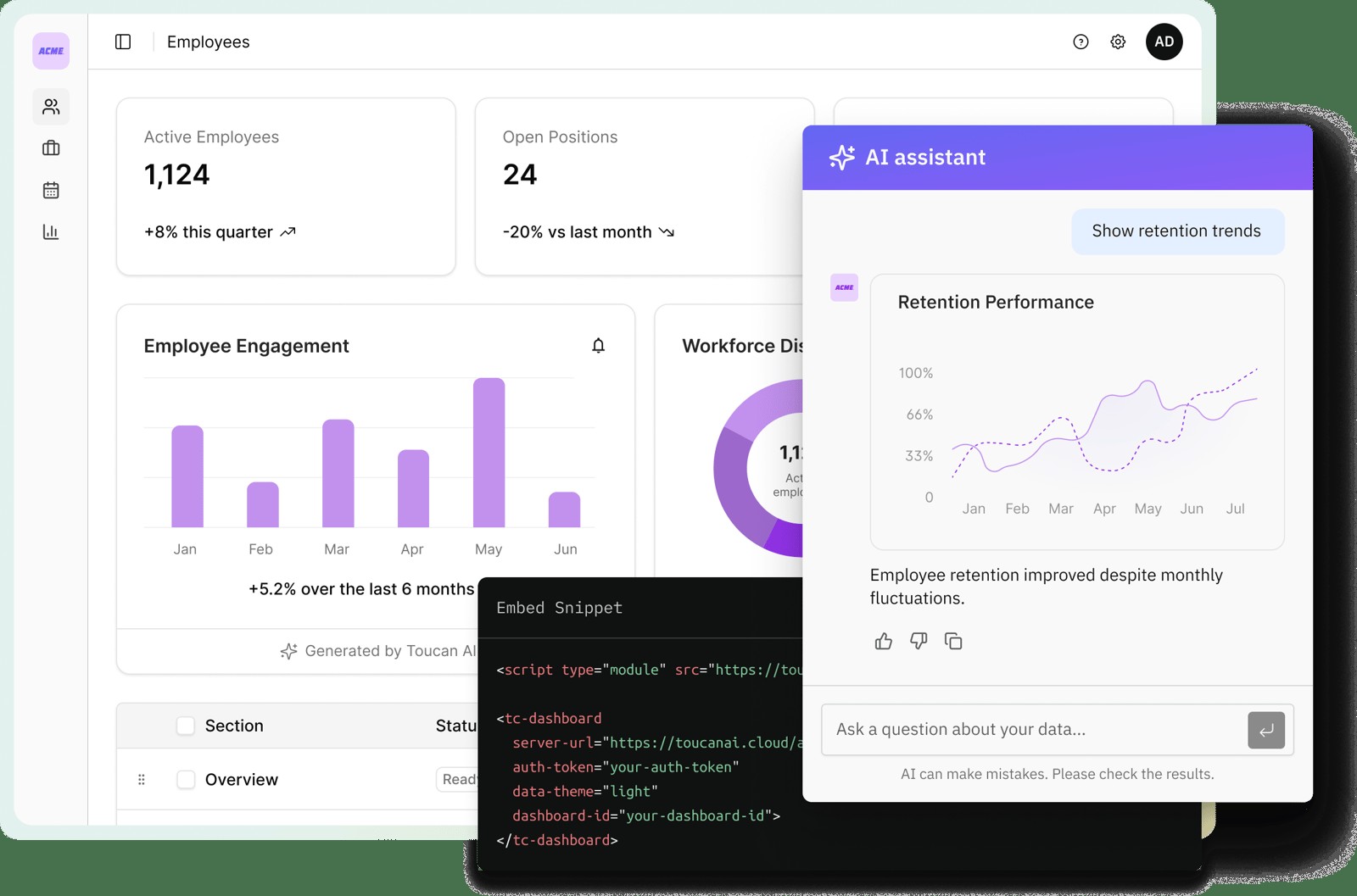
The newest layer lets an end user type a question - which accounts are at risk, how retention moved, what changed by region - and receive a chart and explanation. Toucan says the model works on governed definitions rather than improvising directly over raw tables. Its newer architecture divides the job among specialist agents for coordination, schema exploration, analysis and visualization. The sober selling point is not that AI can make a chart. Plenty of tools can. It is that the answer should respect the same metric definitions and security rules as the rest of the product.
03 / The customerBuying back the roadmap
Toucan's natural buyer is a SaaS or independent software vendor whose customers want reporting, but whose engineers are supposed to be building something else. The platform is also used in finance, consulting, energy, government and human resources, yet its current positioning deliberately avoids the broadest enterprise-BI fight. Toucan says it is not an internal analyst workbench. It is the customer-facing layer inside another product.
That distinction is its best defense against Tableau, Power BI, Looker, Qlik and ThoughtSpot, though those companies also sell embedded products. Other direct alternatives include Sisense, GoodData, Luzmo and Explo. The permanent competitor is “we'll build it ourselves,” which often begins as a sprint estimate and ends as a maintenance team.
The bars above are an editorial illustration, not a Toucan benchmark. The measured customer stories are more useful. PricingHUB reported integrating Toucan in six weeks while testing more than 100 chart versions. Climate-software company Sopht said it avoided six months of development. CATS, which supports Crédit Agricole regional banks, reported 86 percent monthly adoption among more than 800 users and $850,000 in yearly manual-reporting savings. IEIF, a real-estate research group, reported a 76 percent increase in monthly member-portal visits.
Case studies are selected successes, not controlled experiments. Still, they clarify the product's unit of value. Toucan is not merely selling nicer bars and lines. It is selling weeks of launch time, engineering work that did not happen, and a data feature that can become a paid tier, retention tool or reason to choose one SaaS product over another.
04 / The turnWhat changed their mind
Two forces expanded the original storytelling product. First, customers wanted to go further upstream and downstream: prepare data, collaborate on it, embed it, and act on it. Toucan 2.0 moved into those adjacent jobs. Toucan 3.0 added a centralized DataHub, reusable datasets, a guided editor, visual preparation that could generate native SQL, and more flexible filters. Presentation remained the face, but plumbing had entered the building.
Second, generative AI changed what users expect from software. A chart used to be the answer. Now it can feel like a menu the user must decode before asking the real question. Toucan launched its conversational layer in 2025 and followed with self-service creation and an MCP analytics agent that can connect compatible assistants to governed data tools.
The risk is dilution. When Toucan first broadened beyond storytelling, industry observers warned that it could lose the design identity that distinguished it. AI creates the same temptation at higher speed: add every feature a model can produce, then discover the product is harder to explain and no harder to copy. Miglietti's own recent advice is to protect the unique core and avoid easy AI features that dilute it. For Toucan, that core appears to be a usable, governed analytics experience inside someone else's product.
05 / The economicsWhat it costs - and when it does not fit
Toucan sells B2B subscriptions, with terms shaped by deployment, users or usage, support and AI credits. The company does not publish a complete current enterprise price card, so a responsible comparison begins with a quote and ends with total cost, not a mystery number copied from a software directory. Buyers should include implementation, data modeling, support and renewal in the vendor column. In the build column, they should include engineering salaries, security review, design, infrastructure and years of upkeep.
The platform is least persuasive when the hidden build is small. One internal dashboard, a handful of technical users or a mature in-house analytics stack may be served better by an existing BI license or a chart library. It may also fail where the product needs highly unusual interactions beyond a platform's extension points, where source data is too inconsistent to govern, or where nobody owns metric definitions. Conversational access does not repair disputed numbers. It merely makes the dispute faster to summon.
Do not begin with “we need AI analytics.” Begin with one repeated customer decision, the data needed to support it, the permissions that constrain it, and the cost of maintaining the experience for three years. Buy only if that burden is meaningfully larger than the platform bill.
06 / The betThe best dashboard may disappear
Toucan's arc is a useful correction to two startup fantasies. The first says software must begin as software. Toucan began as paid labor, then converted learning into a repeatable product. The second says AI creates value by making an old interface sparkle. Toucan's more interesting bet is that chat may remove part of the interface, while governance preserves the trust underneath it.
There is still a dashboard in the product. There are templates, filters, exports and carefully designed stories. But the center of gravity is moving from “look at this report” to “ask the next question.” If Toucan succeeds, users will spend less time learning analytics software and more time inside the SaaS product they meant to use in the first place. The toucan, in other words, is trying to become invisible.