At HeyMax, people had a perfectly modern problem: plenty of data and no shared answer. Product ran experiments in Statsig. Finance and Operations looked at Superset, Looker Studio and Google Sheets. Ask a question that sounded simple and, by the company’s account, you could get three answers. All had a chart. None had won the argument about what the number meant.
Sundial’s proposed cure begins several steps before the chart. It connects to the warehouse, gives metrics a common definition, and lets an AI agent investigate questions against that agreed vocabulary. For HeyMax, the company says it built a shared semantic layer over the warehouse; Product, Marketing, Operations, Engineering and Finance subsequently consolidated onto Sundial. More than half of HeyMax’s people now use it regularly, according to Sundial’s customer account. That is a useful test of an analytics product: whether the people outside the data team come back.
The short version
- The jobTurn warehouse data into answers people can inspect and use.
- The wedgeDefine metrics once; use agents to investigate why they move.
- The buyerData teams and leaders tired of dashboard queues and conflicting numbers.
A company born from other companies’ blind spots
The origin is less tidy than a pitch deck might suggest. Julie Zhuo had spent nearly 14 years at Facebook, rising to vice president of product design. Chandra Narayanan had led analytics at Facebook and served as chief data scientist at Sequoia Capital. They first chose to work together, then looked for the thing to build. Consulting for startups gave them a close view of the same deficiency in different clothes: teams were building products without dependable metrics or a clear picture of what users did.
Zhuo has described a modest beginning: hire a few contractors, automate some of their own analytical work, see if the idea holds. A few months later it looked like a product. About six months in, they incorporated Sundial, moved contractors into full-time roles and reduced the consulting. In another interview, Zhuo remembered a difficult second year in which the questions became less romantic: who exactly was the buyer, and what exactly was the product? The company’s current answer is unusually precise. It sells an AI analyst and the data machinery required to make that analyst credible.


Their combination explains the product’s peculiar ambition. Zhuo has argued that metrics are proxies for the change a team wants to make. Narayanan knows how much work lies between raw events and a defensible conclusion. Sundial tries to package that work so a product manager can ask, “Why did subscribers fall?” and get an investigation, rather than a chart and a shrug.
The answer begins before the question
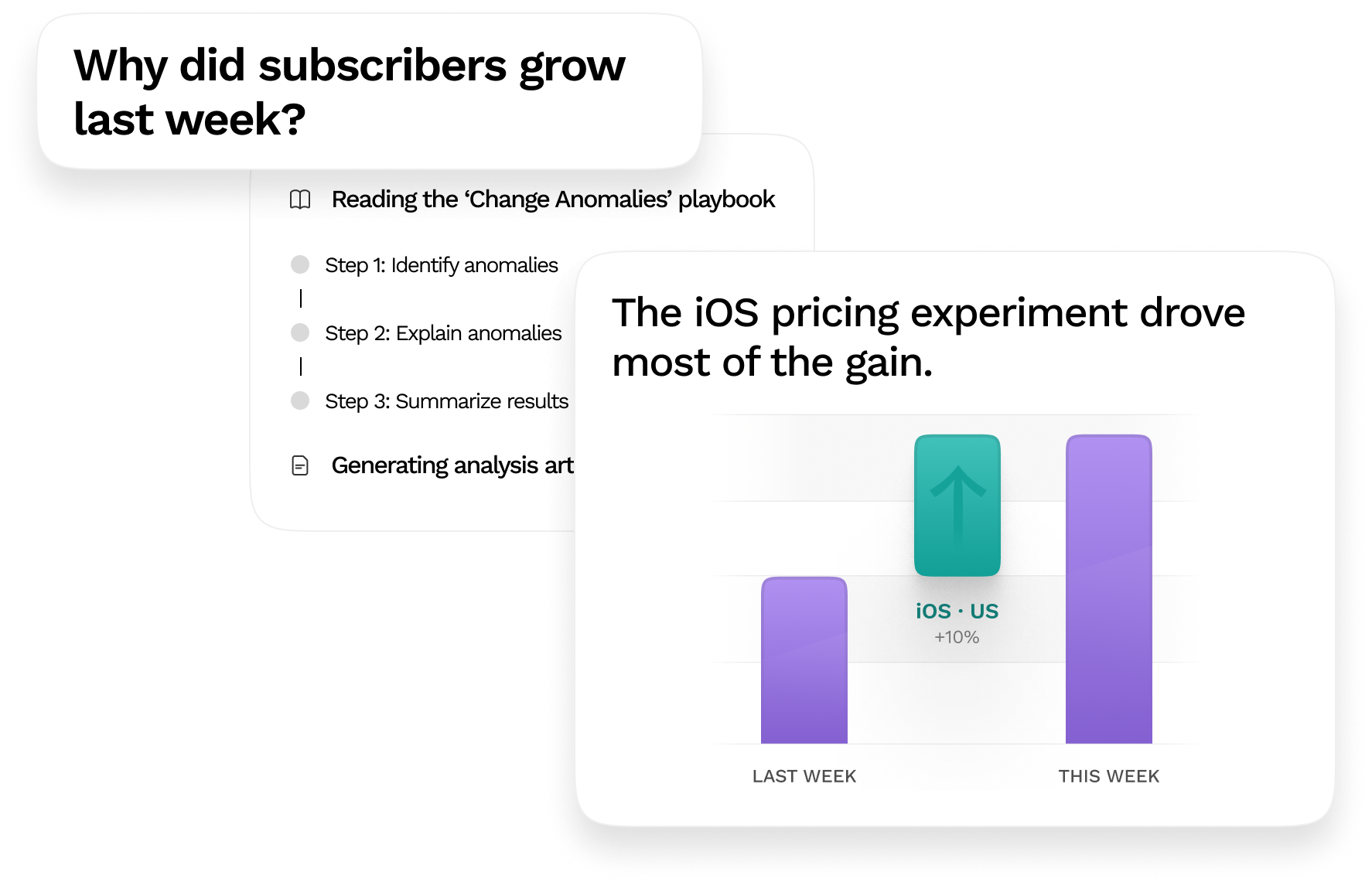
Under Sundial’s interface is a shared semantic layer: the agreed meanings of entities, measures and dimensions. Its Analysis Agent can then use those definitions to answer plain-language questions. For a complicated one, it chooses an expert playbook. A metric-change playbook, for example, checks whether a movement is real, breaks it into likely drivers, tests explanations and rules out data trouble. The system can use SQL or Python where required. It shows its steps and labels the answer with a trust signal, from high confidence to unverified.
That distinction is its position in the market. Looker, Tableau and Power BI helped make dashboards ordinary. Amplitude and Mixpanel specialize in product behavior; Statsig in experimentation. Teams can also build their own warehouse, dbt and language-model workflows. Sundial wants to cover the seam between those systems: model the data, ask open-ended questions, test the answer, and publish a dashboard or report without sending each new question back to a specialist. Its own Data Apps keep recurring views alive. Observability lets a data team inspect weak answers; Evals test whether changes improve them or quietly break something else.
Three insights beat three hundred dashboards
The telling customer story is Mighty Networks. The community platform had hundreds of Looker dashboards. Sundial’s first assignment was to reproduce them. That plan was dropped when the teams decided the dashboards were not the outcome Mighty wanted. Sundial instead brought leadership three initial insights, including which early behaviors predicted whether a community host would still thrive a year later. Mighty’s co-founder and chief product officer says those findings changed the roadmap. The number three appears again, but this time it counts decisions rather than competing answers.
“We didn’t need more data. We needed to know what to do about the handful of things that mattered.”
Gamma offers a different measure of usefulness. It adopted Sundial early and says the platform now handles metric transformation, business intelligence and product analytics in one place. Gamma grew beyond 50 million users while remaining a lean company; co-founder Jon Noronha says Sundial allowed it to delay building a full data team. That is a customer’s account of its own trade-off, not proof that every team can dispense with analysts. Character.AI has described faster analysis of growth and monetization. Sundial’s site also names OpenAI among its customers, though it gives less public detail about that engagement.
Customer and company-reported figures; Gamma’s user count is Gamma’s, not Sundial’s.
The bill, and the catch
Sundial sells to businesses on a usage-based model. Its pricing page says the bill depends on data processed and queries answered, with terms tailored to the customer’s size and stage. It advertises a free trial but publishes no standard dollar figure. The pitch includes human help: an applied AI team works with customers to set up metrics, playbooks and context during the first 30 days. In July 2025, Sundial announced $23 million raised in total, including a $16 million Series A led by GPV partner DJ Patil.
The labor is an important part of the product story. A warehouse connection does not tell an agent whether “active user” means a login, a purchase or something more peculiar to the business. Sundial’s own documentation acknowledges that generated answers can be wrong or incomplete. In Slack, it tells users to verify important numbers in the full app, where they can inspect the query and data. Its confidence labels are helpful precisely because they leave room for doubt.
For a reader trying to borrow the method, the first move is wonderfully unglamorous: choose a disputed metric and write down its definition, owner and source. Then test an investigation against that definition. Save the analytical method for questions that recur. Put the answer where colleagues already work, but preserve a route back to the evidence. Those steps can be copied without buying Sundial. The software becomes more attractive as the questions, teams and data sources multiply.
It also has limits. A young company with no warehouse or consistent event data must fix those foundations before an agent can reliably explain its business. A team asking only a few stable questions may be well served by a small set of dashboards. And any business facing a consequential decision still needs a person to judge whether the analysis describes the world it operates in. Sundial’s most persuasive claim is not that judgment disappears. It is that fewer people should spend their day reconciling three versions of the same number before judgment can begin.