payment-automation
(19)
Turno Runs on the Space Between Guests
A vacation rental earns its keep when someone checks in. Turno built a business around everything that has to happen before they do.
Upflow and the art of getting paid without losing a customer
The invoice is correct. The money is missing. Upflow’s wager is that better coordination, easier payments and a little tact can close the distance between the two.
Pelican.ai and the expensive art of the false alarm
A payment can travel the world and still get stuck on a name. Pelican.ai has spent three decades teaching banking software to untangle the instructions, checks and false alarms that hold money up.
Cyntexa Makes a Business of the Work Between the Apps
From a Jaipur basement to enterprise cloud projects, Cyntexa has built its business around a stubborn problem: expensive software still needs someone to make it work together.

Wise wants to get the paperwork out of the driver's seat
A delivery business runs on more than vans. Wise has built a business around the documents, payments and unanswered questions that can turn a driver's working week into an administrative obstacle course.

Modulr wants to make payday boring
Behind the payroll run, the used-car sale and the supplier invoice sits a surprisingly complicated money journey. Modulr is building a business by taking the manual work out of it.

BILL Put the Back Office on Autopilot - Then Turned It Into a $371 Billion Money Highway
Small businesses came for fewer checks and cleaner approvals. BILL stayed to build the payment rails - a network moving more than 1 percent of U.S. GDP while quietly turning accounting chores into transaction revenue.
Kyriba Wants to Put $51 Trillion on Autopilot - With a Human Still Holding the Key
The treasury platform grew from a Paris spinout into a $3 billion enterprise-fintech company by solving an unglamorous problem: big businesses still struggle to see, move and protect their own cash. Its next act is governed AI, real-time settlement and fewer mornings lost to spreadsheets.
Chargebee Wants to Turn Billing From Back-Office Chore Into a Pricing Lab
The Chennai-born software company spent years making recurring invoices less painful. Now it is betting that the hardest part of the AI economy will not be building products - it will be deciding how, when and what to charge.
Corpay's $13 Billion Bet: Make Foreign Exchange Boring for Everyone Else
The Toronto payments operator stitched together decades-old FX firms, a global banking network and a very human service model. Mastercard's $300 million investment says the unglamorous plumbing may be the valuable part.
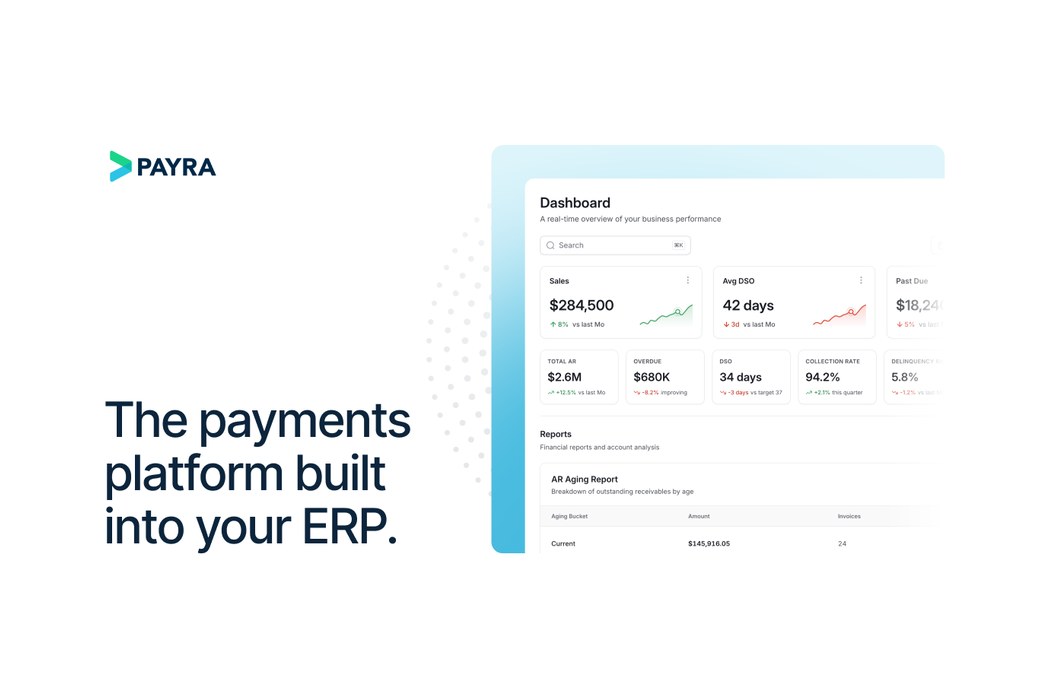
The startup teaching 30-year-old concrete ERPs to take a credit card
Payra bootstrapped its way into a $200 billion corner of the economy that still runs on paper checks and spreadsheets - then took $15 million to speed it up.
Corpay
The company once known for fuel cards now sits inside invoices, hotel bookings, foreign-exchange trades and millions of everyday business purchases. Its next act is a deliberate turn toward corporate payments - with AI, APIs and new settlement rails layered onto an unusually physical financial network.

MHC
For more than two decades, a quiet company in the Minneapolis suburbs has been running the paperwork that keeps large enterprises moving - the invoices, statements and payments most people never see.
Clerq
Clerq is a New York-based fintech building an account-to-account (A2A) bank payments platform for high-ticket transactions. It lets merchants - starting with automotive and powersports dealerships - accept low-cost, guaranteed payments pulled directly from a customer's bank account, with card-like ease and no chargeback, fraud, or funding risk. Founded in 2022 by former Citadel and JP Morgan investors Truett Dwyer and Ben Markowitz, Clerq raised a $12M Series A led by 645 Ventures in October 2025, bringing total funding to roughly $21M.

Plooto
Plooto is a Toronto-based fintech that automates accounts payable and accounts receivable for small and medium-sized businesses and the accounting firms that serve them. It unifies invoice capture, approval workflows, domestic and international payments, and two-way reconciliation with QuickBooks, Xero, and NetSuite - giving finance teams one place to control money moving in and out. More than 10,000 organizations across North America use the platform.

Atomic Insights
Atomic Insights is a San Diego-based wealthtech company building a centralized treasury and money-movement platform for registered investment advisors (RIAs) and family offices. Its software captures payment requests, orchestrates approvals, and executes wire and ACH transfers end-to-end through real-time custodian and bank APIs, replacing the manual, error-prone workflows that wealth managers have long stitched together by hand. Founded in 2023 and led by co-founder and CEO Lucas Babbitt, the company raised a $10 million seed round in January 2026 led by Aquiline Capital Partners, with participation from Northwestern Mutual Future Ventures.

illuno
illuno is a Plano, Texas technology company that runs an on-demand marketplace connecting businesses, schools, houses of worship and event organizers with fully certified, off-duty police officers. Working like a ride-share app for policing, it lets a business post an event and have local officers claim the shift within minutes, while illuno handles compliance, insurance, scheduling and payments. Backed by Mark Cuban Companies and co-developed with input from the Fraternal Order of Police, the platform reports a 99% fill rate and roughly 24-hour turnaround versus an industry norm of 3-5 days.
Boost Payment Solutions
Boost Payment Solutions is a New York-based fintech that quietly removes the friction from large commercial card payments. Founded in 2009 by payments veteran Dean M. Leavitt, Boost uses patented straight-through processing and a rules-based payment engine to let buyers pay with cards while suppliers get paid automatically, with the data and reconciliation already handled. Operating in dozens of countries and partnered with Visa and Mastercard, Boost has positioned itself as a leading independent infrastructure layer for B2B card payments.
Lumanu
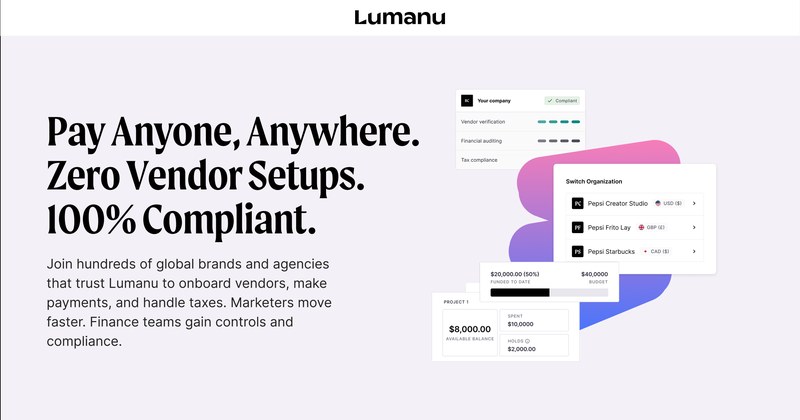
Lumanu is a fintech platform built for the creator economy that lets enterprise brands and agencies pay influencers, creators, freelancers and other vendors anywhere in the world. By acting as a single 'master vendor of record', Lumanu absorbs the administrative burden of onboarding, tax compliance (W-9s, 1099s), and global multi-currency payouts, so marketing teams move faster while finance teams keep control and compliance. The company has processed well over $1 billion in creator payments and onboarded hundreds of thousands of vendors.