●Breaking: $1B+ in creator payouts processed
●400K+ vendors onboarded
●180+ countries · 132 currencies
●$12M Series A led by Origin Ventures
●Zero vendor setups · 100% compliant
●900K+ invoices automated
●Breaking: $1B+ in creator payouts processed
●400K+ vendors onboarded
●180+ countries · 132 currencies
●$12M Series A led by Origin Ventures
●Zero vendor setups · 100% compliant
●900K+ invoices automated
Who They Are Now
Somewhere, a finance team just paid 600 strangers - and barely noticed
It is the last week of a campaign. A brand worked with hundreds of creators across a dozen countries, each one owed money, each one a tax form waiting to happen. In the old world this is a finance department's nightmare: hundreds of W-9s, wire fees, currency conversions, a 1099 pile come January. In the world Lumanu built, the accounting ledger shows a single line item. One vendor. Paid.
That vendor is Lumanu. Headquartered in New York and run remotely, the company has become the unglamorous, indispensable layer that moves money from brands to the people who make the internet worth scrolling. It has processed more than a billion dollars in creator payments. Most of the people it pays have never heard its name - which is exactly how infrastructure is supposed to work.
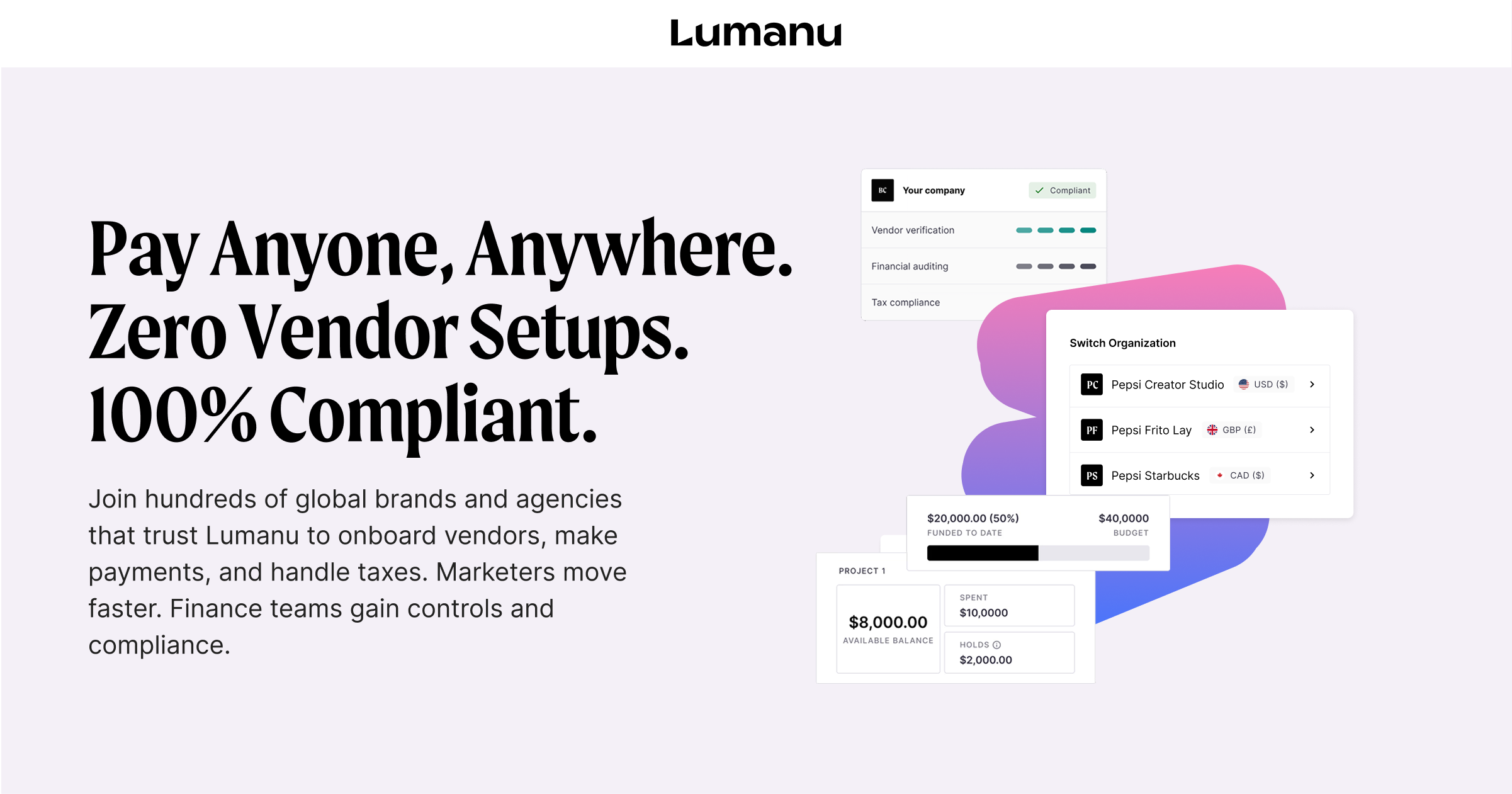
“Pay Anyone, Anywhere. Zero Vendor Setups. 100% Compliant.”
- Lumanu's homepage, which has never been accused of subtlety
The Problem They Saw
The creator economy got huge. The way it pays people did not
Here is the awkward secret of influencer marketing: the marketing part is easy and the paying part is miserable. A brand can identify a creator, agree on a price, and shake hands in an afternoon. Then the deal hits the finance department, where it sits. Because to corporate accounting, every freelance creator is a new vendor - and a new vendor means tax verification, compliance review, banking details, and procurement approvals.
Multiply that by a few hundred creators, sprinkle them across 40 countries with different currencies and tax rules, and you have a problem expensive enough to make brands work with fewer creators than they want to. The bottleneck was never talent. It was the plumbing.
The math that broke finance teams
One campaign × 300 creators = 300 vendor setups, 300 tax forms, 300 chances for a payment to go wrong. The administrative cost of paying a small creator could exceed what you paid them. So brands quietly capped how many creators they would touch - a tax on the entire economy nobody put on a balance sheet.
“The bottleneck was never the talent. It was the paperwork sitting between a handshake and a bank account.”
- The thesis, more or less
The Founders' Bet
An iPad, a 70-something mother, and a very specific idea
Tony Tran did not set out to build payments software. He had the resume of someone meant for something else - computer science at MIT, then Google, McKinsey, and Booz Allen. The kind of path that usually ends in a corner office, not a startup wrestling with 1099 filings.
The turn came from his mother. A Vietnamese immigrant in South Carolina, she received an iPad in her mid-seventies and discovered YouTube content in her native language. Tran watched the transformative pull of creators up close and walked away from the safe path. In 2017 he started Lumanu with co-founders Nhan Nguyen, who became CTO, and Paul Johnson, who took marketing. The bet: creators were becoming businesses, and businesses need to get paid properly.
The founding three
Tony Tran - Co-Founder & CEO. MIT computer science; ex-Google, McKinsey, Booz Allen.
Nhan Nguyen - Co-Founder & CTO, based in the San Francisco Bay Area.
Paul Johnson - Co-Founder & Head of Marketing.
The first instinct of the creator-economy gold rush was to build more discovery tools - ways to find and rank influencers. Lumanu zagged. It decided the boring, back-office money problem was the one worth owning. It turns out the unsexy parts of a market are often the most defensible.
“I wanted to make it simple, fun, and collaborative for creators to do business.”
- Tony Tran, Co-Founder & CEO
The Product
Be the only vendor in the room
The trick at the heart of Lumanu is almost suspiciously simple: become a single “master vendor of record.” A brand signs up Lumanu once. After that, every creator, freelancer or partner gets paid through Lumanu, but to the brand's accounting system they all collapse into one approved vendor. Lumanu collects the W-9s, verifies tax identities, files the 1099s, handles the currency conversion, and pushes the money out.
Marketers get speed - same-day payouts in local currency across 180+ countries. Finance gets control and compliance - wallets, approvals, campaign-level spend visibility, and one tidy relationship to audit. Creators get the best deal of all: it is free for them, and the money tends to arrive fast.
Master Vendor
Hundreds of creators consolidated into one vendor of record for finance and procurement.
Managed Onboarding
Automated W-9 collection, tax-identity verification and invoice processing.
Global Payments
Same-day payouts in 180+ countries and 132 currencies, no fees on standard payments.
Tax Compliance
1099 filing and tax liability handled, so brand finance teams do not have to.
Payments & Compliance API
Integrations into SAP, Oracle, Coupa, Ariba and ZIP for programmatic payouts.
Instant Pay / EarlyPay
Creators access earnings early via available funds or Lumanu's credit line.
“Marketers move faster. Finance teams gain control and compliance.”
- Lumanu, summarizing its entire reason to exist
The Mission
Make doing business in the creator economy boring
Lumanu's stated mission is to eliminate the complexity of working with creators and freelancers - onboarding, compliance, payments - so teams can move faster. Strip away the startup gloss and it reads as something humbler: make the money part disappear. The highest praise for payments infrastructure is that nobody thinks about it.
There is a values layer underneath, traceable straight to that iPad in South Carolina. Tran talks about creators living life on their own terms. Getting paid quickly, in your own currency, without chasing an invoice, is what “on your own terms” actually looks like when rent is due.
Who it serves
Enterprise brands, marketing agencies, finance and procurement teams, influencer-marketing managers - and the global population of creators and freelancers on the receiving end. It is a two-sided promise: control for the payer, speed for the paid.
Why It Matters Tomorrow
The creator economy is becoming the freelance economy
The label says “creator,” but the machinery underneath works for any global, on-demand workforce - freelancers, contractors, partners. As more work fragments into project-based, cross-border arrangements, the company that already files the taxes and moves the money in 132 currencies is well-positioned. Competitors exist - Stripe Connect, PayPal, Tipalti - but Lumanu's bet is that owning the creator-specific compliance and experience beats being a general-purpose pipe.
Return to that finance team in the last week of a campaign. Hundreds of creators, a dozen countries, a January 1099 pile that used to require a dedicated headcount. Now it is one vendor, one ledger line, one Tuesday. The work that once capped how many creators a brand would dare to hire has quietly stopped being work at all. That is the whole company, in one unremarkable, fully-reconciled transaction.
“The best infrastructure is the kind you forget is there. Lumanu is building toward being forgotten - profitably.”
- The closing argument