The parcel gets a tracking number. The driver's paperwork gets a chase. Somewhere behind the reassuring delivery notification sits a business trying to collect a licence, explain an invoice and work out which document is about to expire. Wise has made those chores its territory. The Solihull software company sells the administrative machinery that helps delivery operators organise the people doing the driving.
Its proposition is unusually specific: put onboarding, compliance records, invoice administration and driver support close enough together that the operator stops playing messenger between them. This is With Wise Limited, the business at withwise.com, separate from the international money-transfer company. The distinction matters when looking for the right app. Here, the currency of convenience is a working day with fewer loose ends.
A spreadsheet can only chase so many people
Maps Logistics offers a useful starting point. In a June 2024 case study published by Wise, the Swansea operator described running its business through Google Drive and Google Sheets. It had more than 70 self-employed drivers and found record-keeping and onboarding increasingly confusing. Wise brought those processes together, including a single place to handle weekly driver payments.
The appeal is easy to understand. A shared folder holds a file; a workflow tells someone what needs doing with it. Once a business has repeated that distinction across dozens of drivers, the difference becomes operational. A spreadsheet remains an alternative. It simply leaves more of the remembering, chasing and explaining to the people maintaining it.
Ebee Logistics had already tried another software provider. According to its May 2024 Wise case study, drivers found that system difficult to use, while paperwork and invoices were becoming burdensome. Ebee chose Wise after an Amazon recommendation, citing the approachable interface and hands-on support. The lesson for a buyer is concrete: test the software with the driver who must upload the document, as well as the manager buying it.
“The Wise services help build the foundations of our business.”
Ebee Logistics · company-published customer account, May 2024
The first tool did not fit
Wise's own beginnings contain a similar frustration. A 2025 court judgment records chief executive Simon Hills' account that the business initially used an existing cloud-based customer relationship management platform. Finding it unsatisfactory, the team developed its own system. That is a more instructive origin than a grand prediction about the future of delivery: the first tool did not do the job well enough.
Established in December 2019, Wise was founded by Hills, Dan Richards and James Orton. Its published history puts the platform and driver app launch in 2021, payment technology in 2022, and the Expiry Hub in 2023. Each addition reaches into another part of the same working relationship. Getting a driver through the door creates the next task: keeping the records useful after arrival.
In December 2021, Inflexion took a minority stake through its Enterprise Fund V. TheBusinessDesk reported an eight-figure investment. At the time, coverage described a platform used by 250 UK logistics firms and 14,000 self-employed drivers. Those dated figures show that the company had attracted a substantial specialist customer base before expanding its product range.

A licence goes in. A workflow comes out.
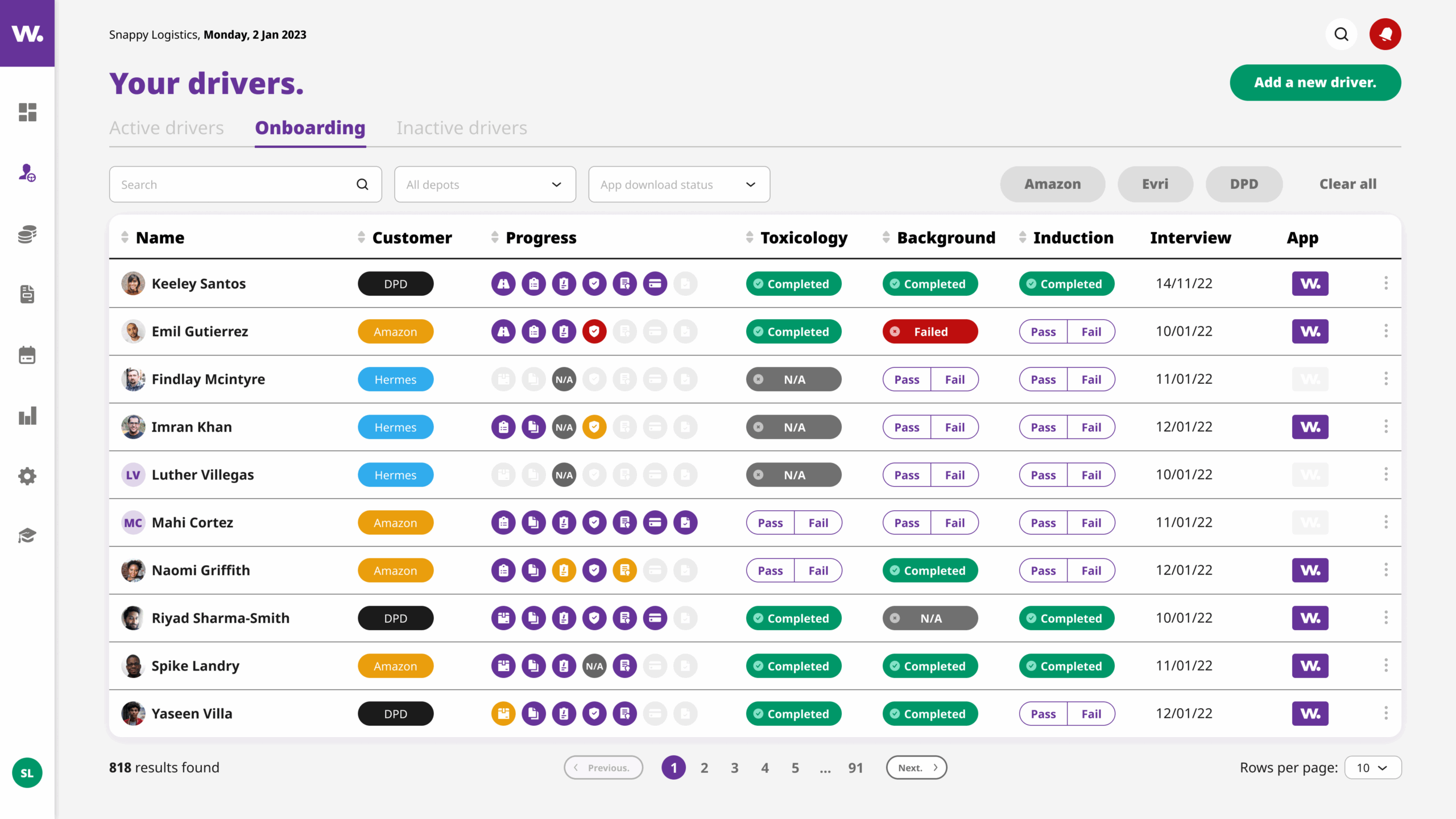
The driver-facing process starts on a phone. Users upload identification, licences and right-to-work evidence, and can sign contracts digitally. Operators configure the required steps for different roles and track progress on a live dashboard. Wise advertises onboarding in as little as ten minutes. That is a company claim about a favourable journey, rather than a sensible deadline for every applicant.
The more interesting feature may be what happens later. The Expiry Hub monitors evidence that needs replacing; downloadable audit packs assemble documents for review. Wise also offers contract guidance and compliance support. These are connected jobs: collecting a document is useful, but being able to retrieve the current version when somebody asks is the real operational test.
- 01CollectUpload evidence and sign documents.
- 02MaintainTrack expiry dates and replacements.
- 03PrepareAssemble invoices and payment runs.
- 04SupportResolve questions and access perks.
Editorial map of Wise's published features, not a mandatory sequence.
For payments, Wise provides administration software and uses partner Modulr for processing. The platform supports automated invoicing, default rates, payment holds and bulk workflows. Combining these tasks can reduce repeated data entry. It also creates a practical buying question: how well does the proposed setup handle the exceptions that already consume the operator's time?
A useful demonstration would follow an incomplete application, an expired licence and a disputed invoice through to resolution. Watching a clean example fly through the system reveals less. The buyer needs to see who receives the problem, what the driver sees, and whether the next person can understand what happened without another phone call.
£12.50 a week deserves a second look
Wise's February 2025 product comparison listed its invoicing service at £12.50 a week. Multiply that example by 52 charged weeks and the annual arithmetic is £650. The calculation does not establish any individual driver's bill, but it makes a weekly price easier to assess. The same material distinguishes invoicing from Beamin's broader VAT administration offering.
An April 2025 proposal prepared for Smiths News makes the allocation of costs particularly visible. It offered combinations ranging from a £100,000 operator contract fee with a £5 weekly driver product to a zero operator contract fee with a £12.50 weekly driver product. These were proposed commercial options, not evidence of an executed contract or a tariff available to everyone.
Weekly invoicing example × charged weeks = illustrative annual cost.
February 2025 material. Historical example; current terms and individual arrangements may differ.The proposal exposes a question that software purchasing can obscure: whose budget gets the saving, and whose pays the fee? A lower bill for the operator can accompany a higher recurring charge for the driver. An informed assessment follows both sides. Count the administrative service received, the support used and the actual fees charged, rather than treating the operator's headline price as the whole cost.
The winning feature was an answer
Owens Group's March 2025 account supplies a welcome qualification. General manager Darren Mayers said weekly invoicing had not delivered a major time saving, although service and the system were better. Previously, unresolved driver questions, particularly about VAT, had repeatedly escalated. Wise supplied a dedicated contact, Zac Cummings, and improved document administration.
One change was gloriously unglamorous: the ability to give a reason when rejecting a document. It is easy to picture why that matters. A rejection without an explanation invites another question; an explanation gives the person a chance to fix the problem. Owens' experience suggests evaluating support quality alongside processing speed. A business can benefit even when the stopwatch barely moves.
This is also where Wise's market position becomes clearer. It bundles specialist software with people who support its use. Generic document storage, separate invoicing tools and outside advisers remain possible substitutes. The case for combining them depends on how much coordination the customer currently performs and how reliably the replacement service handles it.
Why the invoice app has van assistance
Wise began adding driver perks in 2022. Its app now advertises access to services including digital GP appointments, mental health support, retail discounts and van assistance. The company presents these as tools for recruiting and retaining drivers. Its support guidance also makes clear that access can depend on product selection and completion of background checks.
The product logic is straightforward: give drivers reasons to value an app they already use for administration. Vehicle assistance relates directly to a working van; discounts reach into life beyond the depot. Whether those benefits influence a particular driver's decision to stay is a different question from whether the benefits exist. Buyers should judge the offering against what their own drivers actually use.
In October 2025, Wise extended that relationship to suppliers through Wise Advantage. The launch named Hamilton Robertson Insurance Brokers and van supplier Vanaways as partners, with client access beginning on October 31. It also invited customers with secondary businesses, such as repair services, to participate as suppliers. An administrative platform had acquired a marketplace.
By July 2026, the Talking Wise podcast was discussing logistics teams, insurance and fleet management. Alongside the January 2025 appointment of enterprise sales director Richard Tucker, the activity points to a company cultivating a broader role with operators. That is an interpretation of its expansion, not proof that every new service will become essential.
Copy the follow-through
There is a useful pattern here for other businesses to borrow. Start with a recurring task people dislike, observe where the handoff fails, then make the next action obvious. Wise's early CRM replacement, Maps' move from spreadsheets and Owens' rejection-reason field all illustrate different versions of that work. None requires a buyer to believe that another dashboard automatically improves a business.
The fit is strongest when driver administration is frequent, fragmented and consequential. If an operator's main problem is route planning, a shortage of work or vehicle availability, these features address a different need. And if drivers cannot complete the mobile process or staff ignore document alerts, the workflow still stalls. Wise's promise depends on adoption and follow-through. The delivery notification may look effortless; the people behind it deserve tools that make their part less of a chase.