The couch arrived with a problem: a cushion was missing. Satish Natarajan and Shailu Satish had enjoyed buying their new furniture. Receiving it was another matter. They could not tell when it would arrive, and nobody seemed able to locate the missing piece. In DispatchTrack’s account of its beginnings, this small domestic irritation became the starting point for a software company.
- The job: connect delivery planning, drivers, and customer communication.
- The buyers: retailers, distributors, and logistics operators.
- The useful idea: fix the handoffs before adding capacity.
The revealing detail is the cushion. The furniture had moved. Something had plainly been delivered. Yet the customer still had an unfinished purchase and an unanswered question. A map showing a truck’s location would have answered only part of the complaint. The missing information was attached to the order, the appointment, and the people responsible for making both come together.
01 / A route is a promise
DispatchTrack sells software for that coordination problem. Its cloud platform lets businesses plan routes, schedule appointments, dispatch drivers, send updates, track progress, and collect evidence that the job was completed. A driver’s mobile app carries the operation into the field, capturing photographs, signatures, and job status. The audience includes furniture retailers, food distributors, building suppliers, and third-party logistics providers.
These customers share an awkward constraint: arrival alone is an inadequate measure of success. A restaurant needs its ingredients within a workable window. A household needs to be available for an appliance. A delivery involving installation needs enough time at the address. DispatchTrack’s expertise sits where routing mathematics meets those physical and human constraints.
One delivery. Three connected jobs.
The distinction matters in a crowded market. Alternatives include Onfleet, Bringg, FarEye, and OptimoRoute. DispatchTrack’s case is especially intelligible when a delivery involves an agreed appointment, bulky goods, recurring stops, or several operational handoffs. Buyers should compare those workflows directly. A long feature list says less than a demonstration using tomorrow’s awkward orders.
02 / The expensive space between screens
Consider Freedom Fresh, the South Florida produce distributor. Its DispatchTrack case study describes dispatchers moving among separate tools for routing, telematics and compliance, and asset management. The first thing to fail was their ability to see exceptions early. Information existed, but assembling it demanded attention that could otherwise go toward customers.
The company connected those workflows through DispatchTrack, including Geotab integration. Its reported result: $120,000 in savings over two years from operating efficiencies and reduced inventory shrink. That is a customer-specific result published by the vendor, rather than a guaranteed return. The mechanism is more interesting than the number: fewer disconnected views, less chasing information, and clearer decisions while trucks are moving.
Reported savings over two years at Freedom Fresh.
Customer case study; results vary by operation.
Wismettac offers a second example. The Asian-food distributor had relied on dispatchers’ and drivers’ local knowledge to construct routes, while also managing vehicle weight restrictions and changing demand. Its case study reports complete driver adoption of the mobile app and the ability to serve additional customers without adding trucks. Existing expertise became something more people could act on.
“Now, we can actually take on more customers with the same equipment thanks to DispatchTrack.”Alvaro Celis · Wismettac
Vision Logistics, serving healthcare deliveries in the UK, reports a different combination: 23% more stops per day and a 7% reduction in carbon footprint per delivery. Barcode scanning, delivery visibility, and photographic documentation accompanied the routing changes. Again, these are vendor-published outcomes. They illustrate several ways an operation can improve without treating faster driving as the answer.
Furniture Village’s experience makes the distinction particularly clear. The UK retailer already had routing software. What it needed was proactive communication and live tracking for customers. Replacing an existing tool therefore meant changing what the delivery organization could promise and show. The buying question had moved beyond drawing routes: could the retailer keep people informed without making them telephone for every update?
03 / Ten years before the check
The founders started DispatchTrack in 2010 and bootstrapped for a decade. In May 2020, the company announced its first outside funding, a $144 million growth transaction led by Spectrum Equity. The money followed a working business. In 2021, DispatchTrack acquired Beetrack, adding more than 850 customers across 20 Latin American countries.
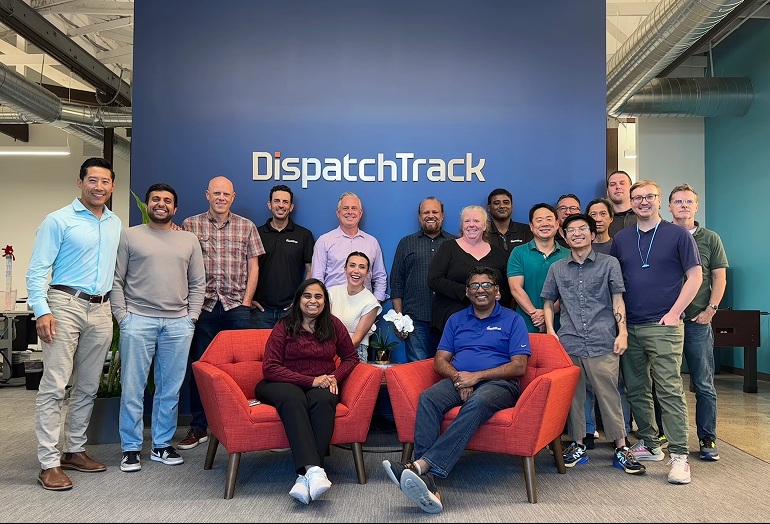


Today, DispatchTrack reports more than 2,500 customers globally, including Ferguson, Samsung, Mattress Firm, and Ryder. It earns money through business software subscriptions; its Gartner product profile describes pricing that varies with fleet size. For a prospective customer, the relevant calculation is a scoped proposal against current operating costs: planning labor, duplicate software, failed appointments, and the effort required to reconcile delivery records.
The economics also depend on what an organization already owns. Replacing disconnected tools may offer a different return from adding another layer to a well-integrated operation. The subscription is one expense; configuring workflows and getting field teams to use them are part of the practical calculation.
04 / Back to the cushion
The newer products extend the same argument. DT Agent, introduced in March 2025, handles delivery questions and customer updates, with escalation to a person when needed. DataSense, announced in July 2026, lets managers question operational data in ordinary language. Both put existing information closer to the person who needs an answer.
DT WMS, announced in May 2026 as invitation-only, reaches into multi-client warehouses, including inventory ownership, cross-docking, and billing. August’s Strategic Planner addresses recurring delivery cycles, with controls that preserve established routes while operators weigh changes. These are attempts to connect decisions made before departure with what actually happens on the road.
Then came Vision AI in October 2026: checks for damage, missing items, and unusable delivery photos, plus advance site-readiness photographs. The connection to that original cushion is almost mischievously neat. The company is now trying to make the doorstep record useful before the driver leaves.
For an operator evaluating the platform, a useful demonstration would follow one difficult order all the way through: a revised address, a narrow appointment, a delay, a customer question, and a photograph that needs retaking. Watch who has to retype something, who sees the change, and who still has to make a call. That exercise would test the central claim more directly than a beautifully optimized route on a clean sample map.
The lesson a reader can copy is practical. Pick one costly handoff. Establish its baseline. Connect the information, then measure the result. This approach depends on accurate orders, usable delivery constraints, and drivers consistently recording what happens. If those inputs are missing, a shared dashboard can spread confusion efficiently. DispatchTrack’s proposition becomes persuasive when the people doing the work can trust the same account of the day.