A restaurant that runs short of an ingredient has a peculiar logistics problem. Its regular food delivery may arrive next week. Dinner arrives tonight. Gordon Food Service saw an opening between those two clocks: use its stores as small fulfillment centers and send individual items out the same day. Then came the less glamorous question. Who would work out where the vans should go?
- The job: connect delivery planning, drivers, carriers and customer updates.
- The sweet spot: complex enterprise networks with different delivery promises.
- The next bet: AI agents that help dispatchers act on problems.
01 / Dinner cannot wait for the weekly truck
Gordon’s existing distribution model was built around weekly truckloads. Same-day replenishment required a different rhythm. According to FarEye’s customer case study, manual van-route planning consumed time, missed delivery windows and left customers unable to track orders. The first thing that struggled was the coordination around the new service.
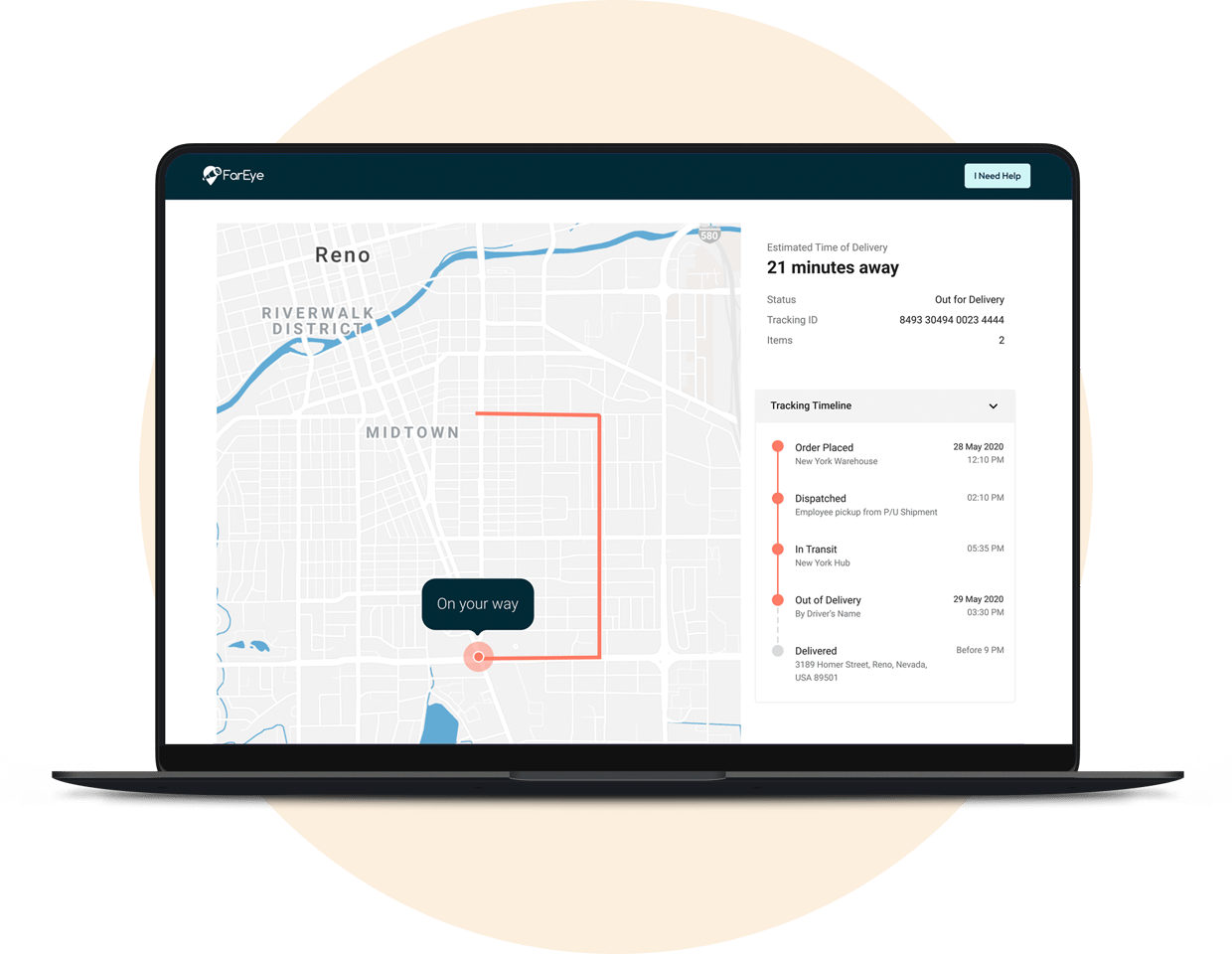
FarEye connected capacity planning, order management, a driver app and customer tracking. Gordon could offer a three-hour delivery window from its stores. The case study reports that sales grew 8.6% in 2021, with store-based last-mile delivery accounting for 36% of that growth. Those are vendor-published results, rather than proof that software alone produced the increase. Still, the customer problem is wonderfully concrete: keep a kitchen cooking.
of reported sales growth came from store-based last-mile delivery.
02 / The map leaves out the difficult bits
Founded in 2013 by Kushal Nahata, Gaurav Srivastava and Gautam Kumar, FarEye sells software for these interlocking decisions. Nahata leads the business, Srivastava product and technology, and Kumar operations. Its delivery management platform serves retailers, manufacturers, postal operators and logistics providers. The company reported more than 150 customers across 30 countries in its April 2026 launch announcement.

The products divide the work into recognizable jobs. Ship selects carriers and handles shipping workflows. Route plans journeys around constraints. Track watches shipments. Execute gives drivers instructions and captures proof of delivery. Experience manages customer communication and returns. Analyze turns operating data into dashboards. Businesses can connect individual functions through APIs, including delivery slots and shipment-status updates.
The public API documentation makes the connections tangible. A retailer can check serviceability and rates, retrieve an available slot, reserve it against double booking, create a consignment and receive tracking events through a webhook. Each step passes information to the next. The promise made at checkout can therefore draw on the delivery operation’s actual capacity, rather than an isolated estimate.
That breadth places FarEye among enterprise delivery orchestration vendors such as Bringg, Locus and Shipsy, with overlap against DispatchTrack and Onfleet. Its pitch centers on connecting decisions across owned fleets and outside carriers. A buyer should compare integration depth, scheduling requirements and operational fit. A long feature list is only useful when the features solve the same customer’s problem.
03 / A washing machine changes the equation
Consider the difference between delivering a parcel and installing an appliance. The latter may require two people, installation skills, a particular vehicle and access arrangements. In February 2026, FarEye announced a Miele partnership covering Europe and Australia, implemented with FourPL. Scheduling, routing, pre-delivery checks and mobile installation workflows sit together. A plan becomes useful when the right crew can actually complete it.
JB Hi-Fi Group presents another variation. Its March 2026 announcement describes a platform live across JB Hi-Fi and The Good Guys, bringing managed fleets and outside carriers together across a network of more than 350 stores. The assortment stretches from small electronics to bulky appliances. A delivery system has to accommodate that difference before the driver starts the engine.
- 01PromiseChoose an available slot.
- 02PrepareMatch capacity and crew.
- 03DispatchRoute, track and respond.
Sometimes the constraint is a gate. FarEye’s January 2026 collaboration with Amazon Key embeds verified access to enabled apartment buildings and gated communities in the United States. The qualification matters: the access technology must be present. No routing algorithm can grant permission to enter a building that has never joined the system.
04 / Expansion meets the operating budget
FarEye’s own journey has involved a change of pace. In May 2021 it raised $100 million from a round led by TCV and Dragoneer, with plans to expand its platform and presence in Europe and North America. Capital supported an ambitious growth agenda.
Job cuts followed in 2022 and again in February 2023. IANS reported 90 roles eliminated in the second round. Management cited economic conditions and the need to align strategy with demand, while emphasizing product differentiation and automation. This was a costly adjustment for employees. It also complicates the company’s culture page, which celebrates employee initiative, collaboration and learning.
By January 2026, FarEye was reporting FY25 revenue of ₹197.5 crore, up 25.9%, with more than 85% recurring. It also reported an improvement in EBITDA, which does not establish a profit. The commercial model is enterprise SaaS with negotiated contracts. Buyers need to budget for subscription scope, implementation and integrations; the customer announcements do not disclose project prices.
05 / Give the dispatcher a smaller pile
In April 2026, FarEye launched PILOT, an AI dispatcher coordinating eleven specialist agents across planning, execution and control. Their remit includes bad-address checks, driver rosters, scheduling, delivery recovery, proof-of-delivery audits and invoice reconciliation. High-risk exceptions retain human oversight.
“The dispatcher is the most underserved role in logistics”
Gaurav Srivastava / PILOT launch, April 2026
A partnership with Tech Mahindra, announced the following day, adds implementation, managed services and joint sales efforts. The useful test is operational: can a team resolve a problem earlier, with fewer manual handoffs, while keeping control?
For an operations manager, the attraction is understandable. Every extra carrier or fulfillment location introduces another set of handoffs to coordinate. Putting the information together can make exceptions easier to spot. That is also where an evaluation should get demanding: test awkward addresses, unavailable crews and late changes, rather than judging the software by a clean demonstration with convenient orders.
FarEye offers a four-week, single-hub proof of value for PILOT. There is a practical idea to borrow: choose one constrained operation, establish its baseline and measure what changes. Check failed attempts, planning effort and cost per completed delivery. Reliable addresses, capacity data and system connections matter; a small fleet with simple routes may need much less machinery. Start with the kitchen’s emergency. Build the delivery promise around it.