Simon Hills wanted an app. He called a technology agency, and Dan Richards answered the phone. That is an agreeably practical way for a founding partnership to begin: someone has a problem, someone else picks up. Richards and his colleague James Orton would leave the agency to join Hills. The three went on to build Wise, a business concerned with the considerable amount of work that surrounds getting other people to work.
The problem Hills brought to that conversation came from supporting logistics businesses. Again and again, he had encountered manual onboarding, payment administration and the demands of keeping records in order. A delivery driver’s job might be described by a route and a pile of parcels. The business engaging that driver also needed applications, agreements and documents. Before anything could travel, information had to make its own rather less photogenic journey.
There is an entire economy behind the phrase “could you send that over?” Hills chose to work in it. His company’s name carries the intention: We Improve Self Employment. It is a mission with room for both ambition and a missing attachment.
The call that became a company
Wise was founded in December 2019. Hills became chief executive, with Richards and Orton alongside him as co-founders. The partnership combined a view of the customer’s difficulties with the ability to build software around them. Its subject was specific enough to explain without a slide deck: delivery businesses were spending time on repetitive administration, and self-employed drivers had their own side of the same process to complete.
A useful detail in the early history is that the first solution did not settle the matter. Wise initially used an existing cloud-based customer relationship management system. Hills later described it as unsatisfactory, and the business developed its own system. Buying a tool had exposed the need to build one. Anyone who has adapted their working day to suit an obstinate piece of software will recognise the temptation.
That decision gave the young company a demanding assignment. It would have to understand the work closely enough to translate it into screens, requests and records. A process can look admirably simple in a presentation while remaining thoroughly annoying to the person completing it. Wise’s founding problem lived at that distance between the diagram and the working day.
“We wanted to alleviate these issues through innovation.”
Simon Hills, November 2022
The work before the work
On 7 June 2021, Wise announced its new system and accompanying mobile app. The business platform let companies manage recruitment and onboarding, see signed policies and contracts, and handle compliance tasks. On the other side, a subcontractor could complete an application and submit supporting documents through the app. The design joined two people who needed different things from the same exchange.
For the business, the appeal was a process it could organise. For the driver, it was a process they could complete. The distinction matters. A manager might admire a dashboard; an applicant needs to get past the next field. Software serving both has to make the handover work, because a tidy record is only useful once someone has supplied the information.
The launch announcement also described access to an approved accountant. Wise was reaching into the practical surroundings of self-employment as well as the application itself. These are unglamorous details, but they explain the opportunity more clearly than a sweeping prediction about the future of work. An invoice has a way of making the future feel quite immediate.
A company needs somewhere to sit
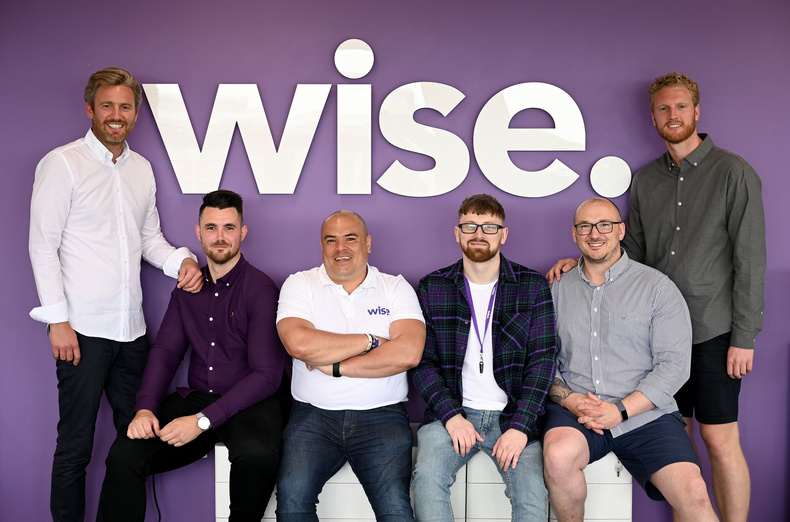
While the product was taking shape, the organisation around it was growing. In September 2021, Wise moved into Radcliffe House in central Solihull. Teams from London and Solihull came together for a ribbon-cutting on 15 September. Development, product, project management, design, marketing and operations could now work under one roof. The company’s expanding list of functions had acquired a shared address.
Hills wanted the business to “stay rooted within the Solihull community”. That phrase gives a geographical edge to a story otherwise told in software. Location was part of the choice. Bringing people together also made room for conversations across departments, the everyday exchanges through which a customer’s difficulty can become a developer’s next task.
The office move offers a modest, useful picture of his job. A founder identifies something worth doing; a chief executive has to help an organisation do it repeatedly. That involves people who build, people who explain, people who answer questions and people who keep the business running. A product on a phone depends on quite a lot that happens away from the phone.
Wise employees by February 2022. A point in the company’s early growth, rather than a current headcount.
By 10 February 2022, Wise was celebrating its fiftieth employee. It had also been named Digital Startup of the Year at the 2021 West Midlands Tech Awards. For Hills, these milestones placed the company beyond the intimate scale of its founding trio. More colleagues meant more capacity, along with more relationships to maintain inside the business.
The other system: how people work together
Wise tested its workplace culture while it was expanding. In September 2021, it announced Great Place To Work accreditation and an employee satisfaction score of 89%. Hills spoke about creating a “diverse, inclusive and compassionate environment”. The words concerned the people making the software, rather than the people buying it. Both groups had become part of the chief executive’s responsibility.
There is a pleasing complication in a company devoted to reducing other people’s administrative friction: it must organise its own work too. Hiring cannot guarantee that teams exchange information well. An office cannot guarantee collaboration. The accreditation and employee feedback offered a way to examine the working environment while the business was adding people, rather than relying entirely on the founders’ impressions.
Today, Wise’s recruitment materials describe trust, flexibility, open communication and learning as part of its approach. Those are stated commitments, with the real test occurring in ordinary working relationships. They also reveal the sort of organisation Hills and his colleagues want prospective recruits to see: one in which initiative and shared responsibility have a place alongside technical expertise.
Capital, with a job to do
In December 2021, Wise announced an investment from Inflexion Enterprise Fund V. The minority backing arrived two years after the company’s founding. At the announcement, Wise’s platform was being used by more than 250 UK logistics firms and 14,000 self-employed drivers. Those figures belong to that moment; their value here is to show the scale the business had reached when the partnership became public.
Hills described a next stage involving better technology for existing clients and a move into additional sectors. The investor’s involvement also extended to the workings of product development. Inflexion’s account of the partnership describes its digital team working with Wise’s technology leadership on scaling the development function and defining the product roadmap. Its commercial team worked on product bundling.
Money, in this account, had practical assignments. The business needed to decide what to improve, how to build it and how to put related services together. Investment adds possibilities; a roadmap gives them an order. For a company whose appeal rests on making daily tasks easier, choosing the next task to address becomes a consequential part of the job.
- 2021Platform + driver app
- 2022Payment technology
- 2023Expiry Hub
The paperwork keeps coming
Wise’s subsequent product history follows the continuing relationship between a business and its workforce. Payment technology arrived in 2022. The Expiry Hub followed in 2023, providing a place to track driver documents that needed updating. Getting an application completed was the beginning of an ongoing record, with deadlines and changes still to come.
The Expiry Hub used colour-coded indicators and allowed businesses to request updated documents from drivers. It addressed a small but persistent fact of administration: information ages. A document can be perfectly acceptable when somebody starts and require attention later. The calendar is an industrious producer of follow-up work, and has never shown much interest in reducing its output.
In a November 2022 interview, Hills set out ambitions for more functionality, other industries and possible expansion into European territories. These were plans, with the work of carrying them out still ahead. They suggest how he understood the original opportunity: logistics supplied a clear starting point, while the surrounding problems of self-employment could give the business further places to go.
In March 2026, Hills sat down with Richards and Orton for the first episode of Talking Wise. The founders returned to the company’s beginnings, its early days, growth and future plans. The three people at the centre of that original partnership were again discussing the enterprise that had grown around them.
The opening phone call remains a useful place to understand Hills. He saw repeated difficulties in a particular kind of business and sought help building something to address them. The resulting company has occupied his working life as a founder and chief executive. Somewhere between a driver’s application and the next document request lies its continuing test: whether the work becomes easier for the people who actually have to do it.