ehr-integration
(78)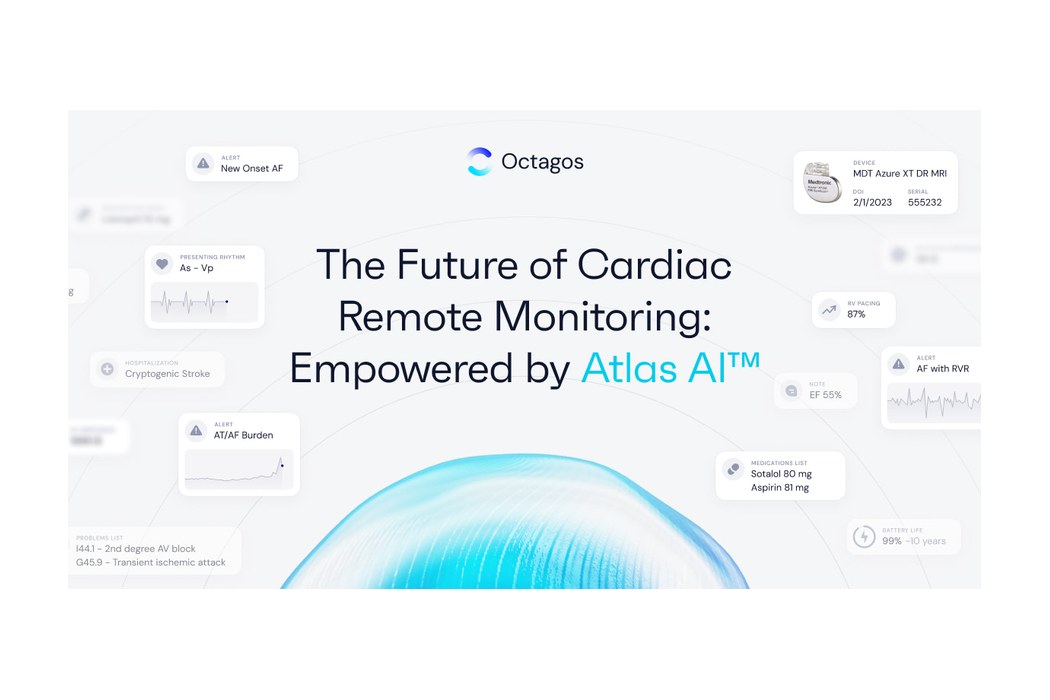
Octagos Built a Bouncer for the Cardiac Data Flood
Remote heart devices produce a blizzard of alerts. Octagos raised $43 million to decide which ones deserve a clinician's attention - and to make the rest of the clinic run on time.

The Hospital Call That Fell From $82 to $2 - and the Workflow CipherHealth Built Around It
CipherHealth did not invent the follow-up call or the nursing round. It made both harder to lose - then tied the answers to the people who can act.

Hyro Bet the Future of Healthcare AI on the Least Glamorous Part: Answering the Phone
The Cornell Tech startup learned that a pleasant chatbot is worthless if it cannot touch the calendar. Eight years, $95 million and 100 million patient interactions later, Hyro is selling hospitals the decidedly unglamorous plumbing behind AI that can actually finish a job.
The Company Trying to Make Prior Authorization Disappear Before the Doctor Leaves the Room
Rhyme spent a decade turning healthcare's least musical ritual - portals, phone trees and fax machines - into a shared data network. Its next trick is harder: making the authorization vanish at the point of care.
ELLKAY’s $5 Million Case for Boring Healthcare Software
It started in a New Jersey basement, cleaning up lab orders. Today ELLKAY sits beneath 58,000-plus practices and a national exchange reaching 261 million people - proof that the dullest layer of healthcare can carry the clearest ROI.
IMO Health Quit Building the Medical Record - and Became the Dictionary Inside Nearly All of Them
The Chicago health-tech company spent a decade trying to build the whole medical record. Then it kept the least glamorous piece - the dictionary - and turned that narrow wedge into a clinical-data business valued at more than $1.5 billion.

Artera Turned Healthcare's Phone-Tag Problem Into a $100 Million AI Business
Hospitals bought dozens of digital tools and accidentally created a communications traffic jam. Artera's bet is that the valuable layer is not another chatbot - it is the switchboard that lets software, staff and AI speak with one voice.

The Outlook Guys Found a $100 Million Problem Hiding in Your Doctor's Phone Queue
Pretty Good AI is betting that the useful future of healthcare AI is not a robot doctor. It is a tireless operator that answers on the first ring, knows the scheduling rules and puts the result in the right athenaOne field.
RhythmX AI's $50 Million Bet: The Useful Part Comes After the AI Scribe
Most clinical AI is trying to write the note. RhythmX AI wants to decide what deserves the doctor's attention next - and its merger with Get Well reveals why distribution may matter as much as the model.

InteropX Sold the Plumbing: How a Five-Person Health-Data Company Made Stale Records Useful
Health plans had APIs, repositories and a stubborn problem: the records still arrived stale, duplicated or trapped in documents. InteropX built the virtual pipe between payers and providers, priced retrieval as low as $1 a chart, and eventually sold the system to Onyx.
The 115-Page PDF Problem: How Milliman Pluritem Turns Medical Records Into a Patient Story
A clinician gets a 115-page PDF. CareFlowIQ wants to turn it into the few facts that matter - with the source still attached. The wager is that healthcare's next useful AI product starts with unglamorous data plumbing.

The Chicago lab teaching hospitals to read your blood before sepsis reads you
Sepsis kills more Americans than all cancers combined and hides in plain sight. Prenosis spent a decade building a biobank and an algorithm to catch it in the first 24 hours - and got the FDA to say yes.

The Surgeons Who Taught Software to Argue With Insurance Companies
Prior authorization is the paperwork chokepoint that delays surgeries and burns out staff. ClinicalBox built an AI that does the arguing - reading the chart, matching the policy, and building the case in about a minute.

Langate Spent 30 Years Learning What Old Software Won’t Tell You
The New York-born, Ukraine-powered engineering company has built a quiet specialty: modernizing the healthcare and enterprise systems that cannot afford to stop working while they change.

Aegis
Aegis is a San Francisco healthtech startup (YC X25) that automates the insurance denial appeals process for healthcare providers, hospitals, and medical billing groups. Its AI detects denied claims, pulls supporting records from EHRs and clearinghouses, drafts policy-specific appeal letters, and submits and tracks them through payer portals - helping providers recover revenue that would otherwise go unclaimed because appeals are too slow and costly to file by hand.

BitBoard
BitBoard is a San Francisco startup (Y Combinator Spring 2025) that lets AI agents like Claude, ChatGPT and Cursor build hosted dashboards and recurring reports. Connected through the MCP protocol, it turns throwaway AI chat sessions into persistent, reproducible workbooks that teams can share and re-run. The company launched in 2025 as AI back-office workers for healthcare clinics before refocusing its product on agent-built analytics.
HealthKey
HealthKey is an AI-powered patient identification platform for clinical trial sites. It connects directly to a clinic's electronic health record system, reads every patient chart - including scanned and faxed PDFs - and scores each patient against a trial's eligibility criteria. Doctors get a ranked list of likely-qualifying candidates with the supporting evidence highlighted, replacing slow manual chart review. HealthKey charges success fees per enrolled patient, so sites pay only when it works. Founded in 2025 by Josh Sabol and backed by Y Combinator (W25), the company is based in Austin, Texas.
Klarify
Klarify is an AI agent for therapists that automates the administrative, operational, and financial work surrounding mental-health care - clinical notes, treatment plans, insurance claims, clinical letters, between-session resources, and client acquisition - so clinicians can spend more time in session and less on paperwork. Founded in 2024 by Moody Abdul and Alexander Bergholm and backed by Y Combinator's Spring 2026 batch, it is used by thousands of therapists across five countries.

Opalite Health
Opalite Health is a San Francisco-based Y Combinator (W26) startup building an AI-powered, real-time medical interpreter that lets clinicians speak with patients in 150+ languages without waiting for a human interpreter. Founded by physician Cathleen Kuo and former Apple engineer Alex Mehregan, the platform is validated against certified medical interpreters, HIPAA compliant and SOC 2 Type II certified, and is used daily by hospitals, community health centers, home health organizations, telehealth providers, and clinics across 10+ states.
Penciled
Penciled is an AI front office assistant for physical therapy clinics. It plugs into the clinic's existing EHR - primarily WebPT - to text and call patients, book and confirm appointments, complete plans of care, send reminders, and fill last-minute cancellations from an automated waitlist. Founded by Shawn Shivdat and Deniz Sert in the Y Combinator W24 batch, the company now serves 200+ providers across 50+ clinics and books thousands of appointments a month.

Perspectives Health
Perspectives Health builds AI agents that take on the paperwork behind behavioral health care. Its software reviews patient charts every night, flags documentation that would trigger an insurance denial, writes clinical notes, and assembles utilization-review packets - so addiction and mental health programs get paid and clinicians spend less time on forms. Founded in 2024 and backed by Y Combinator's Summer 2025 batch, the company reports piloting across a dozen-plus clinics and reaching $250K in committed ARR within four weeks of launch.

Prana
Prana is a San Francisco startup building a 24/7 AI doctor that watches your health data between checkups. It pulls your medical records and wearable data into one clinical timeline, watches for early warning signs the company calls 'clinical drift' - rising blood pressure or glucose weeks before a crisis - and lets you chat with its AI for free or see a real physician for a flat $39 visit. Founded by Meer Patel, Vishvam Rawal, and Sanjit Menon, Prana launched out of Y Combinator's Winter 2026 batch.
Respiree
Respiree is a Singapore-founded digital health company (an A*STAR spin-off) building clinically validated AI that pairs FDA-cleared cardio-respiratory wearable sensors with software to track lung and heart biomarkers over time. Its 1Bio platform helps hospitals, health systems and biopharma detect patient deterioration - such as COPD flare-ups and heart failure - days in advance, powering remote patient monitoring, clinical decision support and decentralized clinical trials across Asia-Pacific, Australia and the United States.

Amigo
Amigo is a New York-based healthcare AI company that builds a platform for designing, training, and deploying patient-facing clinical AI agents. Using a 'digital residency' model, its agents train on millions of simulated patient scenarios before handling real interactions such as intake, triage, care navigation, and 24/7 patient support. Founded by Ali Khokhar and John Xing, Amigo integrates with major EHRs (Epic, Oracle Health, Athenahealth), operates in 100+ languages, and reports more than three million patient encounters with zero safety incidents. It raised an $11M Series A in March 2026 led by Madrona, bringing total funding to $17M.
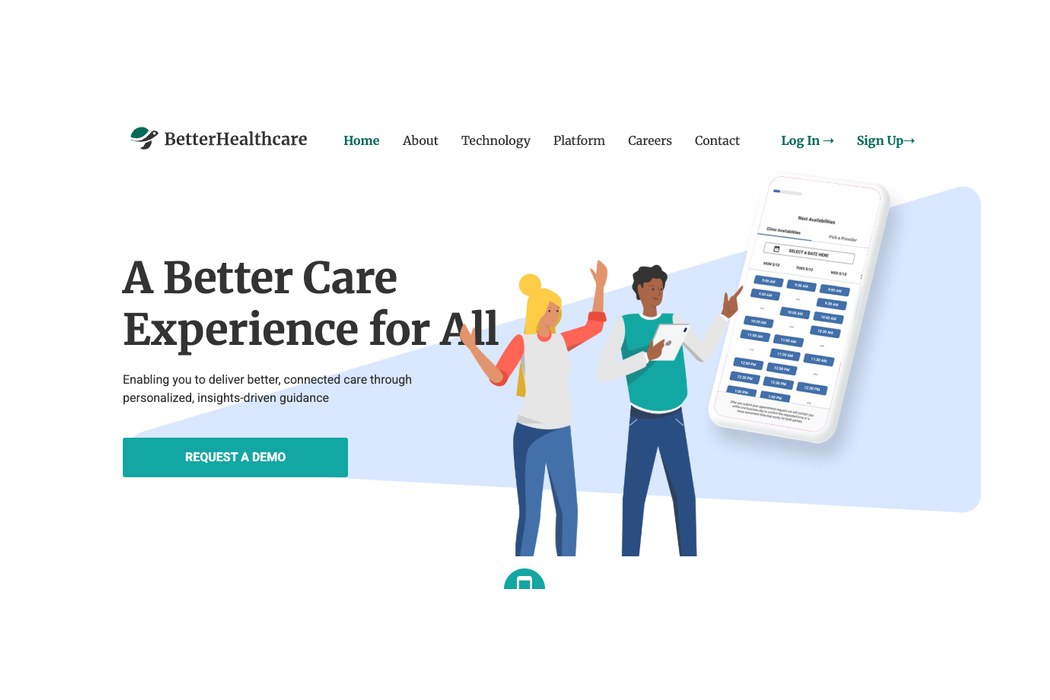
BetterHealthcare
BetterHealthcare is a New York-based healthcare technology company that modernizes patient access through its BetterAccess platform, a HIPAA-compliant SaaS product for online self-scheduling, telehealth booking, automated reminders and bi-directional integration with practice management and EHR systems. Founded in 2016 as BetterPT - a booking app for physical therapy - the company broadened into a full patient-access platform used across the continuum of care and was acquired by HealthBus (TRCM Fund) in January 2025.

Confido Health
Confido Health builds AI voice and messaging agents that answer patient phone calls for healthcare providers around the clock. The agents pick up on the first ring, authenticate callers, check insurance eligibility, and resolve routine requests end-to-end - scheduling, refills, referrals, payments, intake and post-visit follow-up - writing every interaction back into the practice's EHR or practice-management system. Founded in 2023 and based in New York, the company raised a $10M Series A in September 2025 and provides access to more than 1 million patients.

Corti
Corti is a Copenhagen-based healthcare AI company that builds clinical-grade models and APIs helping developers and health systems automate medical conversations. Its Symphony model powers speech-to-text, medical coding, clinical note generation, and agentic workflows, serving roughly 100 million patient interactions a year across providers, insurers, EHR vendors, and public-safety dispatch centers - including the NHS. Corti positions itself as privacy-compliant, healthcare-specialized infrastructure that outperforms general-purpose models on medical tasks.
Ethermed
Ethermed is a Philadelphia-based health technology company that uses large language models and clinical reasoning to automate prior authorization - the paperwork-heavy approval process between healthcare providers and insurers. Its platform intercepts physician orders, gathers documentation, compares payer guidelines, fills forms and submits requests with an audit trail, cutting approval times from days to minutes. Founded in 2021 by Dan Friedman and Michal Such, the company raised an $8.5M Series A in April 2026, bringing total funding above $15M.

Insight Health AI, Inc.
Insight Health AI is a physician-built healthcare technology company in Austin, Texas that builds voice-first and chat-based AI agents to automate routine clinical and administrative work - from patient intake, phone triage, and fax and referral processing to ambient clinical documentation. Founded in 2023 by a former Segment sales-engineering leader and two practicing physicians, the company sells its Lumi care assistant, Aura AI scribe, and specialty-specific agents to clinics and regional health systems. It raised an $11M Series A led by Standard Capital in April 2026, and reports more than 3 million autonomous patient interactions and roughly $50 million in annualized administrative savings across its customers.
medaptus
medaptus is a Boston-based healthcare software company that automates the mid-revenue cycle for hospitals and physician groups. Its EHR-integrated tools - Charge Pro, Charge Infusion, Assign and medaptus Command - capture billable charges, code outpatient infusions, and distribute patients across care teams. Founded in 2000 by two physicians, the company has been trusted by hundreds of hospitals for more than two decades and was acquired by Volaris Group in 2020.