Company Profile / Health AI / Chicago
The Chicago lab teaching hospitals to read your blood before sepsis reads you
Sepsis kills more Americans than all cancers combined and hides in plain sight. Prenosis spent a decade building a biobank and an algorithm to catch it in the first 24 hours - and got the FDA to say yes.
Every year sepsis kills more Americans than breast, prostate, lung and colon cancer put together, and it does it fast. A patient can walk into an emergency department looking stable and be on a ventilator by morning. The condition is the single costliest thing U.S. hospitals treat, and it has no targeted, FDA-approved drug. For decades the standard tools for catching it early were a nurse's judgment, a handful of vital signs, and time nobody had. Prenosis, a company working out of a lab on Chicago's South Side, decided that was a data problem.
In April 2024 the Food and Drug Administration granted Prenosis a De Novo marketing authorization for a product called the Sepsis ImmunoScore. It was the first time the agency had ever authorized an artificial intelligence tool to help diagnose sepsis. That "first" is the headline, but it is not really the story. The story is what it took to earn it: roughly ten years, ten hospital partners, and a biobank of blood that most pharmaceutical companies would envy.
01 / The pivotFrom a blood chip that didn't sell to a company that did
Prenosis did not start as an AI company. Around 2012, Bobby Reddy Jr., then finishing a PhD in electrical and computer engineering at the University of Illinois Urbana-Champaign, began working with bioengineering professor Rashid Bashir on a point-of-care device to measure cell biomarkers from a drop of blood. They moved the work close to a hospital in Champaign. The device was clever. It also lacked a market.
Instead of forcing the hardware, Reddy asked a different question - what is the costliest, least-understood problem inside the hospital, and could biology solve it? The answer kept coming back to sepsis. The company, founded in 2014 as a University of Illinois Research Park spinout, pivoted toward data science and the immune system. Bashir has been blunt about who drove that turn.
Tremendous credit goes to Bobby for pivoting the company towards data science and AI.
Rashid Bashir, Co-Founder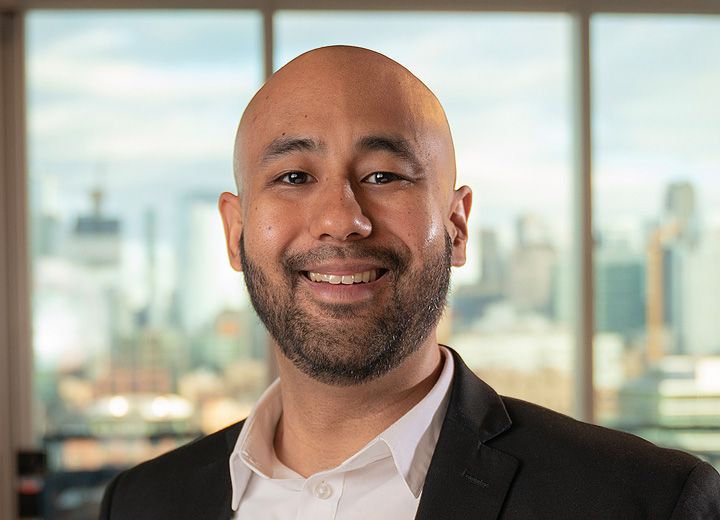
02 / The moatTen years of blood before a line of the model
The thing that makes Prenosis hard to copy is not the algorithm. It is the dataset the algorithm learned from. Working with more than ten partner hospitals across the country, the company assembled what it describes as the world's largest biomarker-plus-clinical-data resource for acute care patients with suspected serious infection. The current count sits above 138,000 longitudinal specimens drawn from more than 35,000 patients, stored in a Biosafety Level 2 lab in Chicago and linked to the clinical outcomes that actually happened to each patient.
That linkage is the point. A blood sample is only useful for training if you also know whether the patient it came from went to the ICU, went on a ventilator, or went home. Everyone wants the AI. Almost nobody wants to spend a decade collecting the biology to train it on. Prenosis did the slow part first, and that patience is the whole moat.
What the four risk tiers predicted
In-hospital mortality by Sepsis ImmunoScore category, external validation cohort (NEJM AI).
03 / The productA score, not a siren
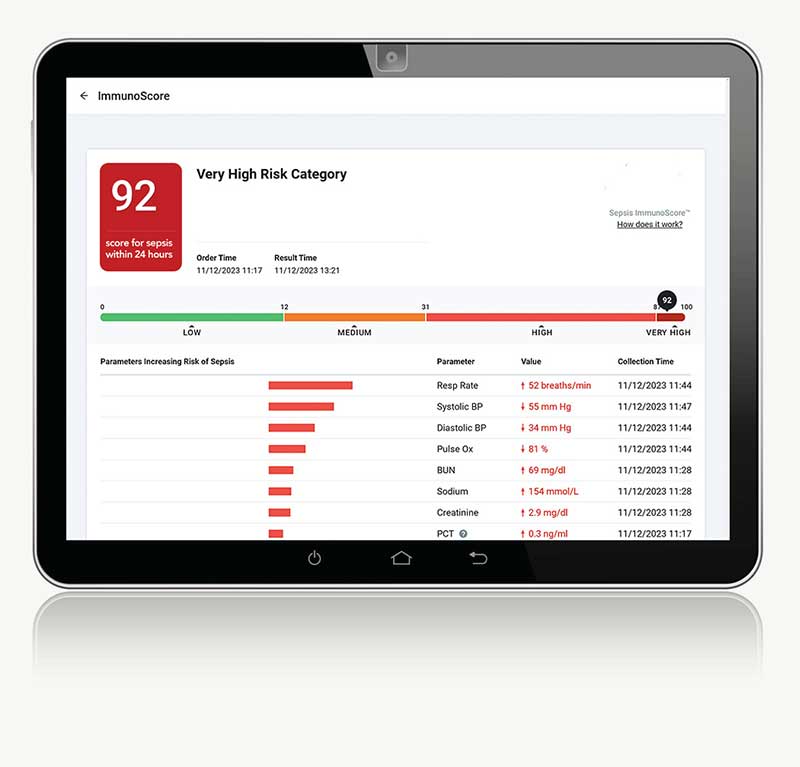
The Sepsis ImmunoScore reads 22 parameters from a patient - biomarkers such as procalcitonin and C-reactive protein, white blood cell counts, other lab values, and vital signs - and folds them into a single risk score plus four discrete categories. Within 24 hours of a patient's assessment in the emergency department or on the floor, it estimates the risk of sepsis and of the outcomes clinicians actually fear: ICU admission, mechanical ventilation, vasopressor use, and death.
The design choice that matters most is what the tool refuses to be. It is deliberately not an alert system. Anyone who has worked in a hospital knows what happens to the fortieth pop-up of a shift - it gets clicked away. Instead, the ImmunoScore integrates into the electronic health record and shows clinicians exactly how each of the 22 inputs pushed the score up or down. It is built for a clinician-AI partnership, not for a klaxon. That distinction is a direct answer to the alert fatigue that sank earlier tools.
FDA authorization of a sepsis diagnostic tool with significant predictive power is a landmark event for people that could ever be at risk of sepsis at some point in their lives.
Bobby Reddy Jr., Co-Founder & CEO04 / The evidenceWhat NEJM AI found
In late 2024 a validation study appeared in NEJM AI under the title "FDA-Authorized AI/ML Tool for Sepsis Prediction: Development and Validation." The numbers held up across cohorts: a diagnostic area under the curve of 0.85 in the derivation cohort, 0.80 in internal validation, and 0.81 in external validation. More useful to a bedside clinician, the four risk tiers cleanly separated who was likely to deteriorate - from essentially no in-hospital deaths in the low tier to roughly 18% in the very-high tier. A follow-up study in 2025 reported the score beat standard clinical scores and common standalone biomarkers.
05 / The competitionWhy this is not the Epic sepsis model
Prenosis is not the first company to point software at sepsis. It is the first to get the FDA to authorize a diagnostic. The incumbent most hospitals already have is the Epic Sepsis Model, an alert baked into the dominant electronic health record. It became a cautionary tale - criticized for uneven real-world performance and for adding to alert fatigue. Others in the field include Bayesian Health, Beckman Coulter's Early Sepsis Indicator, and Cytovale's IntelliSep.
| Approach | Output | FDA-authorized diagnostic | Shows its reasoning |
|---|---|---|---|
| Prenosis Sepsis ImmunoScore | Risk score + 4 tiers | Yes (De Novo) | Yes |
| Epic Sepsis Model | Alert / flag | No | Limited |
| Biomarker-only tests | Single value | Varies | N/A |
Where rivals tend to be either a diagnostics company or a clinical-decision-support company, Prenosis is trying to be both - closer to a GPS for acute care than to a single warning light. Combining biomarkers and clinical data across 22 signals, and handing back a graded score instead of a binary alarm, is the difference it is selling.
06 / The businessRoche out front, BARDA at the back
Accuracy gets a tool published. Distribution gets it used. Prenosis licenses the ImmunoScore to hospitals as software-as-a-medical-device, delivered either through direct Epic integration or through Roche's navify Algorithm Suite marketplace under an exclusive five-year U.S. distribution deal. Roche reportedly vetted several sepsis algorithms before choosing this one - a useful signal about which way the market is leaning. Around eleven hospitals are implementing Prenosis solutions today, including LifeBridge Health, whose own researchers helped develop the tool.
The money arrived in a rush. In late January 2026 the company announced a $20 million Series A led by PACE Healthcare Capital - with UC Investments, UCI Health Ventures, the Labcorp Venture Fund, Global Health Investment Corporation, the Illinois DCEO and Carle Health alongside - and, the same week, a separate $20 million contract from BARDA. The federal money funds a roughly 800-patient randomized trial and the spread of the Immunix platform into as many as 40 academic medical centers.
By combining AI-driven diagnostics with targeted therapeutics, we're identifying which patients will benefit most from specific interventions - moving beyond one-size-fits-all protocols.
Carlos Lopez-Espina, SVP of R&D07 / The roadmapSepsis is the demo, not the destination
The reason to watch Prenosis is not one product. It is the recipe. A proprietary biobank nobody else has, a regulatory pathway nobody else walked, a distribution partner with reach, and a UI doctors trust - stack those and the underlying platform, Immunix, should port to other acute conditions. Management has named the next targets: pneumonia, acute heart failure, ARDS, and acute kidney injury. If sepsis was the proof, the bet is that the same biology-first approach works across the rest of critical care.
The mission the company keeps returning to is smaller and larger than any single disease: get clinicians to "see people differently" by handing them a read on each patient's own biology, rather than a symptom checklist that treats everyone the same. For a condition that has outrun doctors for decades, having a score that shows its work - and that the FDA signed off on - is a concrete place to start.