Jim Sweeney began with the accoutrements of a respectable 1980s agency: an office, a copier, a computer and a car. Four leases. Three months later, he became a single father to a one-year-old boy. The office fantasy did not survive contact with life.
So he worked from home, from the car, from client offices, late at night and on weekends. There was no cloud, no Slack and certainly no cheerful square of colleagues waving from a laptop. There was a telephone, a fax machine and overnight delivery. The improvised arrangement worked. Deadlines were met. His son got a father. The agency grew.
That episode is more than a charming prehistory of remote work. It explains the company Sweeney became: a privately held strategic marketing agency that resists organizing itself around a single deliverable. It can act as an outsourced marketing department, join an internal team or assemble specialists around a launch. The modern service list stretches from research and brand identity to public relations, paid media, websites, video, events and AI marketing. The consistent product is judgment about what to use when.
The first product was adaptation
Sweeney founded the firm in Cleveland in 1986 after working at Burson-Marsteller. He had studied mass communication at Cleveland State and imagined a career in journalism. Instead, he built a company that has spent four decades translating complicated organizations into stories that people can act on.
Today Jennifer Manocchio is CEO and president; Jim is founder and chief growth officer. The agency lists 11 to 50 employees on LinkedIn and maintains roots in Cleveland and Wilmington, North Carolina, while describing its reach as global. Its buyers span B2B, consumer and government markets: manufacturers, banks, technology companies, health organizations, retailers and public-interest groups.
The competition is broad because the job is broad. A client might choose a Cleveland peer such as Marcus Thomas or Dix & Eaton, a global network agency, a specialist PR or digital shop, or another in-house hire. Sweeney's pitch is that fragmented problems do not improve when handed to fragmented vendors. One accountable team should be able to discover, define, deliver and optimize.
That method is simple enough to copy. Start with interviews, research and a sharp statement of the business problem. Decide the message before the medium. Give one team visibility across channels. Instrument the campaign while it is running, not at the postmortem. Add specialists only when the brief requires them. Sweeney itself publishes a named "circle of experts" that includes creative, production and media partners - an unusually frank acknowledgment that a small agency does not need every capability sitting on payroll every Tuesday.
“Marketing is not about being seen, it's about being remembered.”Sweeney's stated brand belief
When an impression is not enough
Agency case studies love large numbers, and Sweeney has them. Its work for workplace-technology company Enlighted reports 1.3 billion media impressions, 900,000 social impressions and 23,000 social clicks. A program for Commonwealth Savers reports 32 billion impressions. The first Ohio Shake Shack opening generated a reported 68 million media impressions and brought 3,000 people to events.
The more interesting number is 14.5 percent. Cleveland MOTTEP, a minority organ and tissue transplant education program, needed to encourage flu and COVID-19 vaccination in two Cleveland ZIP codes. Sweeney built the identity and messages, then carried them across bus interiors, outdoor placements, a website, social posts, newsletters, releases, bumper stickers and yard signs. The campaign ran from June 2021 to April 2022 and was credited with driving 14.5 percent of vaccinations among the target population. MOTTEP continued to receive the supporting grant.
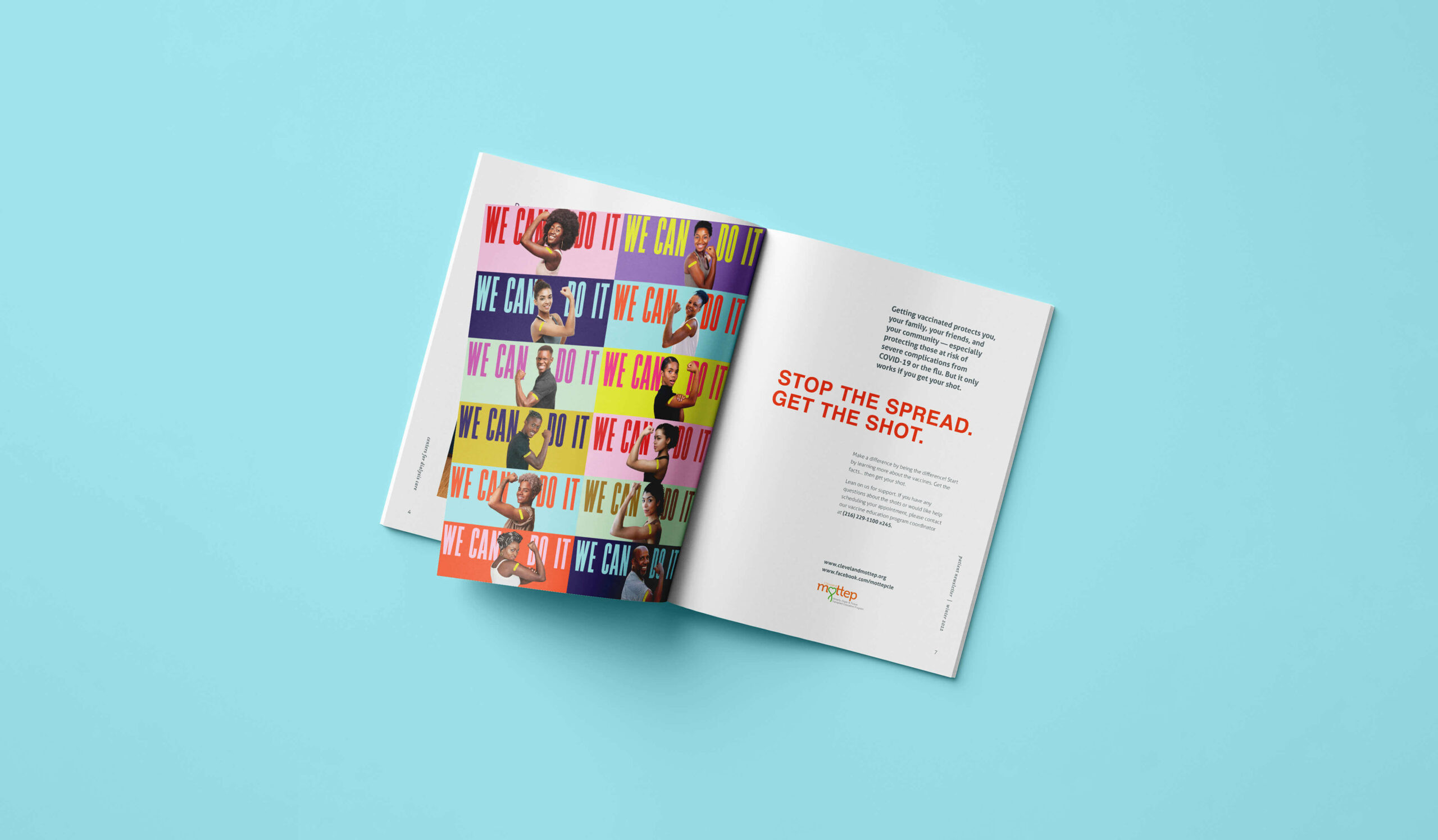

This is the virtue of integration when it is real: the newsletter and the bus ad do not merely share colors. They perform different jobs in one behavioral argument. The lesson is portable. Pick a measurable action, map the moments that lead to it, then let each channel handle the moment it is best at.
The price of not buying a preset answer
Sweeney does not publish a rate card. The Manifest, an agency directory, lists a $10,000 minimum project size. Treat that as a screening signal, not a quote. A one-off identity, a national product launch and an embedded marketing team are different businesses hiding beneath the same agency name.
The custom model costs clients in another currency: access. The agency needs leadership interviews, internal context, quick decisions and performance data. Atlantic Union Bank's pandemic-era campaign worked in part because CEO John Asbury could respond to media while Paycheck Protection Program rules were changing. The program ultimately produced a reported 800 national media mentions while the bank helped 10,000 companies access $1.7 billion in loans. Without an available spokesperson and a live news hook, the same media machinery would have idled.
Reported earned or media impressions. Bars use a visual log scale so the smaller campaigns remain visible; the figures are not directly comparable.
What changed his mind
It was not a management book. It was fatherhood. Sweeney's early assumption was that serious agency work required serious offices in major markets. His circumstances showed him that talent could be arranged around a life and still meet the brief. Over the years the firm experimented with offices in other states, homes, shared spaces, partial schedules and contractors. Jim has admitted that some arrangements were train wrecks. The important habit was not remote work itself; it was revising the system when evidence objected.
That habit now appears in the agency's language: no preset playbooks, real-time optimization, direct access to the full team. It appears in the product menu, too. An agency born before the commercial web now offers SEO, programmatic advertising, martech integration and AI enablement. Longevity here is less about guarding an old formula than keeping one rule: the tool must serve the objective.
It fits when…
- The problem crosses several channels.
- Leadership can give the agency access.
- Success can be observed while work is live.
- A small core team may need specialist reach.
Look elsewhere when…
- You need the cheapest isolated deliverable.
- The strategy is fixed and only production remains.
- No one can share data or approve quickly.
- A narrow technical specialty is the whole assignment.
There is no magic in calling an agency full-service. The phrase can mean deep coordination, or it can mean a long navigation menu. Sweeney is most persuasive when the work reveals the former: the message on the bus connects to the website; the CEO's availability connects to the news cycle; the event connects to the earned media; the metric connects to an action someone took.
Forty years after four leases briefly defined the company, Sweeney is still betting on a useful inversion. Infrastructure should follow the work. Channels should follow the strategy. And when reality changes the brief - as reality reliably does - the plan should be the first thing willing to move.