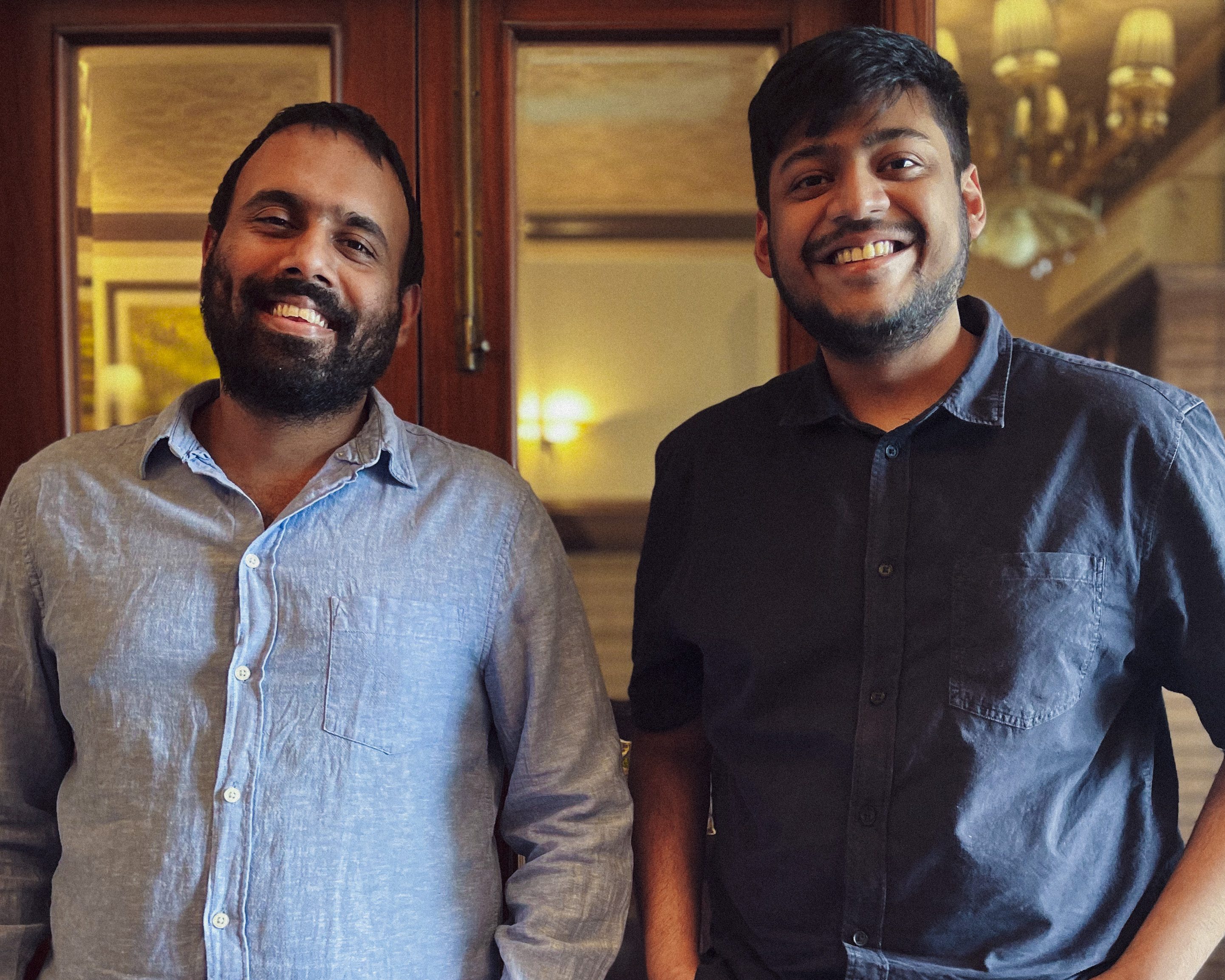
The man who looked at 250 million trucks and saw a software problem
There's a number that Shridhar Gupta comes back to often: 30 percent. That's the fraction of commercial vehicles in emerging markets that use any fleet management technology at all. The other 70 percent - roughly 175 million trucks, buses, tankers, and vans - move through the world's fastest-growing economies with no GPS, no fuel tracking, no driver safety layer, nothing.
In 2016, Shridhar and his LocoNav co-founder Vidit Jain decided that 70 percent was a market, not a gap. They had just crossed paths at ClearTax, India's first Y-Combinator product backed by Sequoia Capital - Vidit as Lead Engineer, Shridhar running Sales and Partnerships. They saw the same thing there that they'd each seen in earlier startups: that accessible, affordable technology could move whole sectors, not just early adopters.
LocoNav was built on a contrarian thesis. The fleet management players targeting large enterprise fleets in developed markets had no interest in building for a trucking operator in Rajasthan running six vehicles, or a logistics company in Lagos managing a mixed fleet across three countries. The price points were wrong. The hardware requirements were wrong. The assumption - that fleet owners saw technology as investment rather than expense - was wrong.
So Shridhar and Vidit built something else: a device-agnostic platform compatible with 2,200+ hardware types, available in 15+ languages, priced for the actual market. By the time they closed their Series B in 2021 - $37 million led by Quiet Capital, with Sequoia Capital India, Anthemis Group, and others - LocoNav was already operating across Middle East, Africa, Southeast Asia, and Latin America.
In global developing markets, no one has ambitiously built a large player and we see ourselves as the first mover there.
- Shridhar Gupta, 2021Shridhar grew up in Kolkata, the city that produced both Rabindranath Tagore and some of India's most tenacious entrepreneurs. He was 20 when he co-founded his first business - DNG Enterprises, which he ran for five years, building out a healthcare division. At Jadavpur University he studied marketing; at the West Bengal National University of Juridical Sciences he picked up a diploma in entrepreneurship law. His education was parallel tracks: formal academics and building things from scratch at the same time.
The Fitho chapter was formative in a different way. The fitness tech startup was one of India's early consumer internet stories - a platform that built real traction before the smartphone era had fully arrived. When Practo acquired it in 2015, Shridhar got a close look at how a startup exit actually works. He arrived at ClearTax soon after, and within a year he was co-founding LocoNav with the engineer he'd met across the office.
The pitch to the market wasn't just cheaper GPS. LocoNav built real-time fuel monitoring, driver behavior analytics, video telematics with AI-driven safety alerts, EV fleet management with battery health tracking, and an e-lock system for cargo security. Today the platform processes over one billion data points daily and tracks more than 9 million kilometers of vehicle movement every 24 hours - roughly 225 circumnavigations of the Earth.
Revenue tells the same story from a different angle. LocoNav recorded $25.4M in 2023, $48.7M in 2024, and $75M in 2025. That's not a linear progression - it's a company finding its pace after a decade of infrastructure-building. The 388-person team serves 90,000+ customers across 25+ industries in every postal code in India.
On fleet operators and perception: "We aim to bring a radical change in emerging markets where no more than 30 percent of the 250 million commercial vehicles use any form of fleet management tech. This is because the end customer perceives using fleet technology as an additional cost rather than a driver of business growth."
What's less reported than the fundraising numbers is the decision Shridhar and Vidit made in 2022: a $3 million ESOP and equity buyback program for employees. At a company still years from a public listing, returning capital to the team is unusual enough to be notable. Their own framing was simple - gratitude, wealth creation, collective ownership. It's the kind of move that reads as culture more than finance.
The Locus partnership that same year was about filling the last mile. LocoNav handles the vehicle layer; Locus handles route optimization and last-mile delivery logistics. Together they form an end-to-end visibility platform for supply chains in emerging markets - which is, as it turns out, a very large market.
By 2025, Shridhar was speaking at the Commercial Vehicle Forum alongside policymakers and industry veterans. The startup founder from Kolkata who decided trucking technology was underinvested had become a voice on the future of commercial mobility. LocoNav's EagleAI product - its AI-driven fleet intelligence layer - had moved the company from GPS tracking toward something closer to a virtual fleet manager: predictive, autonomous, continuously learning.
The mission statement he keeps returning to is the same one he gave in the Series B announcement: democratize access to fleet technology. It's a deliberately simple north star for a product that now touches oil & gas, emergency services, passenger transit, food & beverage, construction, and two dozen other verticals across five continents.