At first glance, a bottle of Coca-Cola, a freezer full of Berkshire pork and an auto-insurance quote do not belong in the same marketing plan. One promises refreshment, another dinner, the third a line item in the household budget. Sherryl Woodward has worked across all three. Her career makes the categories look less like separate worlds and more like variations on one problem: a customer faces a crowded field of choices, and someone has to make the next move feel clear.
Woodward is now Chief Marketing Officer at Rates.ca, the Toronto comparison business for insurance and financial products. The role sits at a revealing intersection. Marketing has to bring people through the door, but the door opens onto a product whose value is comparison itself. The promise is not merely a memorable campaign. It is a useful decision.
That distinction matters in consumer finance. A person shopping for car or home insurance is not browsing for amusement. The variables stack up quickly: coverage, deductible, price, provider, eligibility, service and the consequences of getting the balance wrong. A comparison platform has to organize those variables without pretending they have disappeared. Woodward's task is partly to make a marketplace visible and partly to keep it human.
The thread hiding between categories
Woodward studied at McGill University. The public account of her education does not specify a degree or dates. Her professional record later places her inside one of the world's most familiar brand systems. At Coca-Cola North America, she held senior roles in integrated marketing and end-to-end experience and design.
The phrase “end-to-end” can sound like corporate upholstery. In practice, it forces an exacting question. Does the promise made in an advertisement survive the trip into every place where a person meets the brand? Woodward was credited as Director of Integrated Marketing on Coca-Cola's Unlock Summer work. By 2021, she was identified as Group Director for North American end-to-end experience and design and served on the final-round Effie Canada jury.
The Coca-Cola years supplied scale. The next public chapter supplied something else: the need to explain an unfamiliar retail proposition from scratch. Wild Fork was already operating in the United States, Brazil and Mexico when it launched in Canada in January 2023. The business sold frozen meat and seafood online for same-day delivery, then opened its first Canadian physical location in Whitby that May. Woodward was Head of Brand Experience.
“You want people to say, ‘Oh man, I want to eat that.’”Sherryl Woodward on the job of food photography
Make the product visible
A new food retailer needs to answer objections before customers phrase them. Why frozen? How broad is the assortment? Can the quality be trusted? Is this a replacement for a supermarket or something alongside it? Woodward's launch language was concrete. She described Wild Fork as a protein company, not simply a frozen-food company, and called it complementary to a conventional grocery store. She talked about chefs trying every item before it appeared online and about freezing products at peak freshness so the first defrost happened in the customer's kitchen.
Then there was the store itself. The 4,000-square-foot Whitby location extended the e-commerce experience into pale wood, open sightlines and large food imagery. Woodward did not treat photography as ambience. “We're selling food. It's different than selling fashion,” she said. The image on the wall had a job: create appetite.
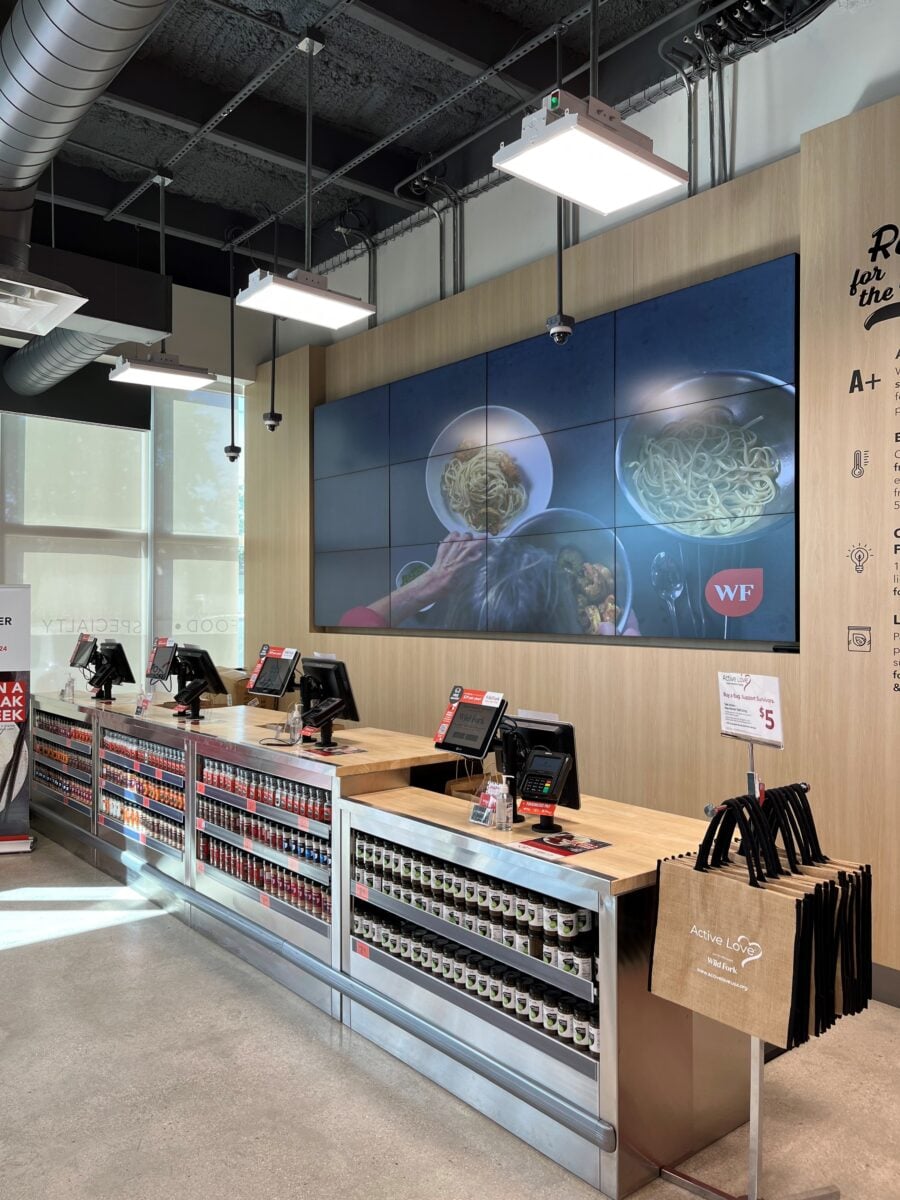
The same plain-spoken quality appeared in the value proposition. During the launch, Woodward said the company was “constantly every day trying to offer Canadians bang for the buck.” There was no mystery to the customer problem. Food prices mattered. Variety mattered. Convenience mattered. The brand needed to demonstrate all three.
Wild Fork's marketing could also be playful. For Thanksgiving in 2023, a flock of inflatable turkey costumes moved through downtown Toronto handing out postcards for the brand's Wish Granted promotion. The stunt came with a tangible offer: a discount on a first order. The joke had feet, feathers and a checkout code.
The Woodward pattern
From appetite to confidence
Moving from food retail into financial comparison sounds like a sharp turn. It becomes more logical when seen through the work rather than the inventory. A Wild Fork shopper has to understand why frozen can mean quality. A Rates.ca visitor has to understand why one coverage-and-price combination may fit better than another. Both businesses depend on making invisible attributes legible.
At Rates.ca, the canvas is a digital marketplace. Consumers can compare insurance quotes and financial products, while the business connects demand with providers. The marketing challenge is unusually close to interface design. The headline, form, result screen and explanation each affect whether a visitor feels informed or merely processed.
Woodward's LinkedIn summary describes her expertise as revitalizing and leading multi-brand, nationwide marketing communications. Her current public activity is consistent with the Rates.ca brief: household insurance costs, the forces moving premiums and the data that can help explain them. It is marketing rooted in the questions people arrive with.
Her colleagues' public recommendations add a view from inside the work. One former teammate describes a mentor who takes time to understand and develop people, then remains calm and strategic when a start-up environment becomes unpredictable. An agency partner credits her with honesty, openness and consideration - qualities that improved the work and the relationship around it.
Three habits that travel
The first is to define a business in the customer's language. At Wild Fork, “protein company” did more work than a catalogue of freezer technology. It told shoppers where the brand belonged in their routine. Calling the store complementary to a supermarket answered another practical question: this was a place for the centre of the plate, not every item on the grocery list. A useful position can be stated in the words a customer might use while planning the week.
The second is to connect brand expression with proof. Wild Fork's quality story included chefs testing the assortment, photographs showing the food and a store designed as a physical extension of the website. Each element reinforced the same claim through a different sense. At a comparison site, proof takes another form: understandable inputs, visible alternatives and explanations that help a visitor interpret a result. The category changes, but the discipline remains. A promise becomes stronger when the product keeps repeating it.
The third is to make room for memory without losing utility. Inflatable turkeys are easy to remember, but the promotion also carried a price and a deadline. Coca-Cola's summer work connected a familiar brand with a seasonal occasion. Rates.ca occupies moments when a household has a specific money decision in front of it. Attention can open the encounter; relevance has to finish it.
These habits help explain why Woodward's leadership reputation matters to the story. End-to-end work crosses departments. A Canadian retail launch pulls together e-commerce, property, merchandising, operations and communications. A financial comparison experience connects marketing with product, technology, analytics, partnerships and insurance expertise. None of those systems can be managed by a slogan. They require a leader who can hold the customer objective steady while specialists solve different parts of it.
Woodward's professional connections reflect that cross-functional terrain. At Rates.ca, the public leadership roster places marketing alongside product, technology, finance, people operations, partnerships and underwriting. Her earlier work joined agencies and internal teams around large campaigns. The connective work is easy to overlook because it rarely appears in the finished advertisement. It shows up instead as consistency: the same idea surviving the handoffs.
Clarity is not the finishing touch on a comparison product. It is part of what the customer came to buy.The operating idea across Woodward's career
The patient part of marketing
In 2025, Woodward joined other Canadian marketing leaders in a discussion about the pressure for instant results and the need to preserve long-term brand value. The tension is familiar: a quick campaign can produce a number this quarter while teaching customers something unhelpful about the brand for years.
Her career offers a practical way through that tension. Start with the consumer's actual job. At Coca-Cola, the work had to connect a huge brand across touchpoints. At Wild Fork, it had to explain a new way to shop for food and turn the explanation into appetite. At Rates.ca, it has to earn attention while helping a person compare consequential options. The immediate action and the lasting meaning meet in the same experience.
This is also why Woodward's category changes are instructive. Marketing careers are often narrated as expertise in a single vertical. Her public record suggests another kind of compounding. Learn to see where people hesitate. Learn to translate a system without flattening it. Learn to connect campaign, product and place. Those abilities travel.
The move into financial comparison puts that portable skill under a bright light. Insurance can be dense, rates can change and every household arrives with different conditions. A CMO cannot make those realities simple by decree. She can make them navigable. The useful question remains the one Woodward's work has asked across bottles, freezers and browser tabs: what does this person need to understand next?