The most revealing object at Rates.ca is not a dashboard, an algorithm or a stack of venture-capital pitch slides. It is a form. A long one, naturally. Insurance pricing needs a postal code, a driving history, a vehicle, a home, a date of birth and enough other personal detail to make a suspicious browser hover over the close button. Rates.ca asks anyway. Then it tries to repay that small act of faith by turning one set of answers into multiple quotes.
That exchange has been the Toronto company’s central idea since 1999, when it launched as Kanetix. Back then, comparison shopping meant calling insurers and repeating yourself. Co-founders Gregory Ellis and George Small proposed a tidier bargain: tell the internet once, see competing offers, choose where to continue. In its first decade, the company said it connected roughly half a million consumers with providers and expected more than two million visits in 2009.
Today the storefront is broader. Canadians can compare car, home, condo, tenant, life and travel insurance, plus mortgage rates, credit cards and banking products. Rates.ca says its network includes more than 50 partners and its site carries more than 10,000 verified reviews. The shopper pays nothing. The company is compensated when a user connects with a participating provider. It is lead generation with regulated plumbing and a friendlier face.
What it actually built
Calling Rates.ca a price-comparison website is accurate in the way that calling an airport a departure board is accurate. The visible list is only the end of the work. Behind it sit provider integrations, province-specific rules, underwriting questions, product normalization, consent, security and the human handoff required when a customer wants to buy. The wider group includes Scoop insurance brokerage entities, which help bridge the gap between a screen full of quotes and an issued policy.
The company also builds calculators, renewal reminders, rate maps, guides and news. Those extras are not decorative content marketing. Insurance is a low-frequency purchase with a high penalty for misunderstanding it. A calculator gives the shopper a reason to arrive before renewal. A guide explains why the cheapest premium may carry a painful deductible. Rate data becomes research, research becomes a headline, and the headline sends someone back to the quote tool. It is a small media business orbiting a marketplace.
“There is more to choosing an insurance provider than just looking at the bottom line.”Gregory Ellis, co-founder, in 2000
What failed first: the category
The first obstacle was not a broken quote engine. It was a basic identity question. Was Kanetix an information service or was it selling insurance? In 2001, Canadian Underwriter chronicled the uncertainty around electronic signatures, provincial licensing and the company’s role. Kanetix argued that it supplied comparison information and passed interested buyers to product providers; no insurance contract was completed on its site. Regulators in several provinces allowed that interpretation, sometimes reluctantly.
That boundary explains the business that followed. Rates.ca does not need to manufacture a policy or hold insurance risk. It organizes demand, standardizes the first shopping step and makes the handoff valuable. Providers get a prospective customer who has supplied real underwriting information. Customers avoid a phone-tree tour of the Canadian insurance industry. Rates.ca gets paid for the connection.
The company also learned early that price alone was too thin. By 2000, Kanetix was comparing insurers on financial strength, claims ratings, service hours and payment methods. That was a quiet but important change of mind: the quote attracts attention, but context earns the decision. The current site continues that approach with coverage explanations, calculators and editorial guides.
The consolidation years
Through the 2000s, Kanetix expanded across Canada and added property and life insurance. In the following decade it moved into mortgages and credit cards, acquired RateSupermarket.ca and Rates.ca, and developed its Auto and Home Insuramap products. Ontario Teachers’ Pension Plan acquired the business in 2018.
Then came the great simplification. In 2020, Kanetix and RateSupermarket.ca were folded into the Rates.ca brand. The new name sounds less like a software company and more like the browser tab a hurried customer hoped to find. It also concentrated years of brand equity and search behavior on one domain. A designer’s case study from the rebrand shows bright product icons, a province selector and the line “We Don’t Believe in Love at First Rate.” The joke does a job: compare before committing.
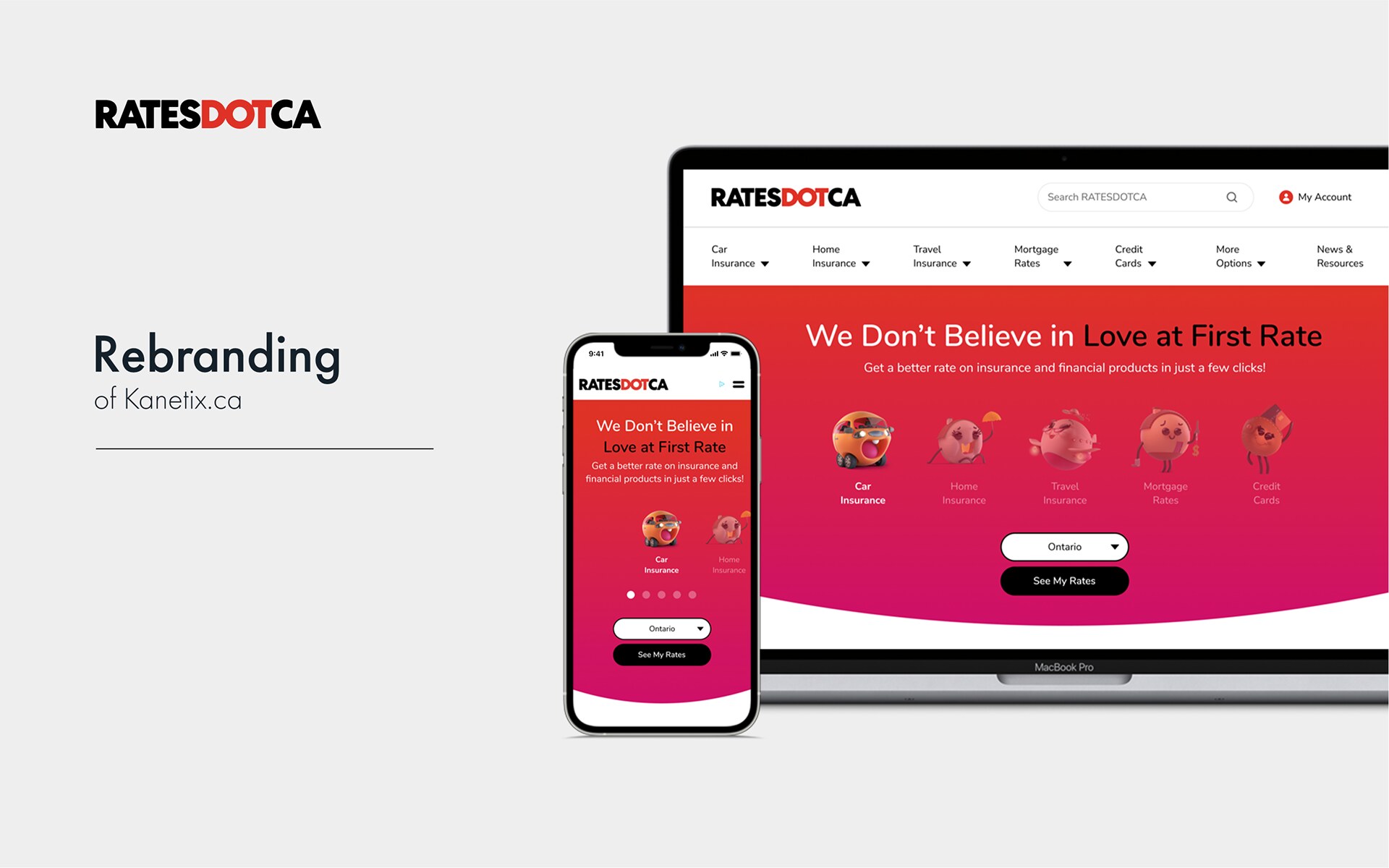
The rebrand was followed by money and muscle. In March 2021 the group raised C$51 million through additional equity from Ontario Teachers’ and debt financing led by BMO, with TD participating. Management said the capital would fund technology, brand awareness and a more digital insurance-buying experience. That September, the group acquired LowestRates.ca, another large Canadian comparison site. The price was not publicly disclosed.
What did it cost?
There is no public bill for the original 1999 build or the 2020 rebrand. The clearest disclosed investment is the C$51 million financing package in 2021. It arrived after two decades of company building, not before product-market fit. That timing matters. Rates.ca first proved that consumers would compare and that providers would pay for qualified connections; the large financing was meant to digitize and amplify an operating marketplace.
The company spent some of its attention budget with unusual enthusiasm. Its 2021 “Don’t Get Milked” campaign, made with Zulu Alpha Kilo, put a dangling sack of udders beneath a car. A Leger survey for the campaign found 77 percent of Ontario policyholders had not compared auto rates in the previous year. The prop was absurd; the behavioral problem was not. Renewal inertia is the comparison marketplace’s real competitor.
The customers, and the double sale
Rates.ca serves two audiences with opposite anxieties. Consumers worry they are overpaying or choosing the wrong protection. Insurers, lenders and card issuers worry about expensive acquisition and low-intent traffic. The quote process filters one for the other. A completed form signals more intent than a casual click; a set of live offers is more useful than a generic promise to save.
That makes Rates.ca different from a direct insurer, which can show only its own products, and from a general search engine, which can rank pages but does not normalize a driver’s risk across providers. Traditional brokers can offer advice and a panel of carriers, but their reach and digital experience vary. Rates.ca combines broad online discovery with licensed brokerage support inside its group. Competitors such as Ratehub.ca, InsuranceHotline.com, Surex, ThinkInsure and My Choice attack overlapping parts of the job. LowestRates.ca is now both an alternative interface and a sister brand.
The company has also turned its provider position into measurement. In 2024, with Pollara Strategic Insights, it launched Home & Auto Insurance Awards based on responses from 8,875 customers in Ontario and Alberta. Its 2025 auto study reported 82 percent overall satisfaction, up two percentage points year over year, even as premiums rose. The study gives shoppers service information that a raw quote cannot, while giving Rates.ca another reason to be quoted outside renewal season.
What builders can steal
- Start with duplicated labor. One form replacing five calls is a product benefit anyone can explain.
- Make the money path plain. Free for the shopper, compensated by the provider after a connection.
- Add context around price. Coverage, claims experience and payment terms prevent a cheap number from becoming a bad decision.
- Turn operational data into useful media. Rate maps and studies create distribution without inventing a separate editorial universe.
- Delay the big spend until the loop works. Rates.ca’s disclosed C$51 million round came after years of transactions and acquisitions.
The lesson is not “build an insurance comparison site.” It is to find a purchase where customers repeat the same structured work across fragmented suppliers. Standardize the input, make the outputs legible, then charge the side that values qualified intent. The front end should feel like a convenience. The back end must behave like infrastructure.
When the playbook breaks
Comparison works when offers can be normalized, prices vary enough to reward shopping, suppliers want incremental demand and a customer can describe the risk in a form. It weakens when products are bespoke, when only a few providers participate, or when the cheapest headline number excludes coverage the buyer actually needs. It also fails if privacy anxiety outweighs the expected savings. A marketplace cannot compare what users will not disclose.
There is a second danger: marketplace incentives are never perfectly neutral. Rates.ca says consumers see its tools free and partners pay when users connect. That is a workable trade, but the panel is not every provider in Canada. Trust depends on explaining that boundary, protecting the information collected and resisting the temptation to make a referral look like an exhaustive market verdict.
Rates.ca’s endurance is therefore less about a magic rate engine than a maintained promise. Fill out one careful form. See a meaningful slice of the market. Learn enough to notice when cheap is flimsy. Continue with a provider that can finish the job. Twenty-five years after Kanetix first tried it, the promise remains modest. That may be why it lasted.