Danilo Gamboa went looking for an insurance company to invest in and ended up running one. The search began at GP Investments, where the appeal was easy enough to describe: a large market, profitable incumbents and room to do more with technology. The difficulty was finding a young business with enough scale. Then an established insurer came up for sale. The route into the future suddenly passed through somebody else’s existing operation.
GP acquired Argo’s Brazilian business in 2021. Gamboa became its CEO in 2022, and the business took the name Akad Seguros. He had crossed a consequential line. An investor can ask how a company ought to change. Its chief executive has to arrange the change, keep the business working and answer for the results. The spreadsheet acquires colleagues.
His proposition has a pleasing complication. A company selling digital insurance might be expected to trim away intermediaries. Gamboa keeps talking about brokers: their tools, their knowledge, their questions and their customers. In his account, the person in the middle has a job worth improving. Akad’s technology is being built around that job.
An investor changes seats
Gamboa brought a career that already connected commerce, management and capital. He worked at Gradus Management Consultants and Submarino before joining GP Investments in 2004. He became a managing director in 2006. His education combines an industrial engineering degree from the University of São Paulo with an MBA from MIT Sloan School of Management.
The boardroom experience was broad. By 2017, his record included board positions at businesses such as Fogo de Chão, Submarino, ALL and Gafisa; he was also serving on the boards of GP, Centauro and Allis. Restaurants, retail, logistics and property have different products, but each requires decisions about how an organization reaches customers and spends money. Insurance gave him another operating setting for those questions.
There is a distinction between bringing experience and bringing a ready-made answer. Gamboa’s move placed him alongside people whose experience was specifically in insurance. Rafael Fragnan, his fellow guest on the first AkadCast in April 2024, described more than 27 years in the industry, beginning as an office boy in claims. Their conversation paired the investor’s view of an opportunity with the insurance veteran’s account of keeping an operation productive through a change of ownership.
“We will invest heavily in technology.”
Danilo Gamboa, June 2022 · translated from Portuguese
The partners brought another kind of experience too. CyberLabs connected the venture to entrepreneurs working in artificial intelligence. Marcelo Sales, a founder of Movile and CyberLabs, joined the effort around technology and innovation. Gamboa’s operating chapter was therefore a collective undertaking, with insurance knowledge and technology experience sharing the table.
The broker stays in the picture
The emphasis on brokers becomes clearer when Gamboa talks about the geography of insurance. At an industry event in 2023, he presented Akad’s estimates that 66% of Brazil’s insurance brokers were concentrated in 40 municipalities and that more than 3,400 municipalities had none. These were figures used in his argument about access, rather than a fresh census of the country today.
His proposed response included training, regional relationships and digital tools. The logic is easy to follow: coverage needs a way to reach the customer, and the customer needs someone who understands what is being offered. A website may be available everywhere while the knowledge needed to use it remains unevenly distributed.
That concern also appears in his product discussions. In 2024, Gamboa described the value of remotely quoting and issuing surety insurance for customers facing deadlines. A supplier seeking to participate in a public tender needs the required protection in time to participate. Speed, in that setting, has a commercial purpose beyond making a dashboard look lively.
He also described tailored work for larger risks and partners with particular requirements. The operating challenge is to make routine work easier while retaining the ability to handle detail. A logistics business and a small enterprise do not arrive with identical questions. The broker’s understanding of the customer helps determine which questions the insurer needs to answer.
A relationship supported by software. A conceptual diagram, not a measure of every sales channel.
A cheque meets the operating ledger
In April 2024, Akad announced a R$110 million Series A. Valor Capital Group and Across Capital co-led the round, with participation from existing shareholders and investors including Endeavor-related funds and Actyus. The financing gave Gamboa and his colleagues more room to pursue expansion. It also put the company’s technology proposition in front of a wider investor group.
At the time, the business reported that roughly 80% of issued policies were generated automatically. That figure describes a substantial share of the issuing process. It also helps explain why Akad could discuss growth through a network of partners: repeated transactions could move through systems while people concentrated on the relationship and the exceptions.
There was tangible work behind the promise of faster service. In July 2024, Akad reported a 94% reduction in waiting time for responses to customers and brokers after introducing its virtual assistant. The assistant supported ticket handling and interactions through WhatsApp. The percentage was a company-reported result, with its own measurement context. It nevertheless identifies the everyday irritation being addressed: waiting for an answer.
The annual ledger supplies a different perspective. Akad’s 2024 report recorded R$1.03 billion in premiums issued, R$27.8 million in net profit and R$439.9 million in claims paid. Premiums measure the insurance written; profit describes an operating outcome; claims payments show money going back out to meet covered losses. The three figures deserve separate labels.
The same report counted 287 employees and 17,796 brokers. For a chief executive focused on distribution, the second number matters alongside the first. Much of the company’s reach depends on people outside its own payroll. Their ability to work with the insurer belongs in the operating picture.
In May 2025, Akad announced that S&P Global Ratings had raised its Brazilian national-scale rating from brA- to brA, with a positive outlook. The discussion concerned capital, profitability and diversification. Insurance growth has to carry those obligations with it. A larger book of business creates more promises to keep, and an attractive interface does not pay a claim by itself.
The room beyond the screen
Gamboa’s public account of Akad also contains an architectural detail. In the inaugural AkadCast conversation, he and Fragnan discussed an open office without enclosed rooms for directors, linking the arrangement to transparency and interaction. It is a small, physical expression of how they wanted the company to work. The executive suite had apparently lost its walls.
The ambitions discussed in that episode had a much longer horizon. They wanted Akad to become one of Brazil’s three largest insurers over the coming decades. The time frame matters. This was an aspiration expressed by the leadership, with years of operating work implied between the present business and the desired position.
On August 8, 2024, Gamboa opened the first Akad Summit. More than 150 guests attended, including brokers, advisory firms and partners such as iFood and Mercado Livre. The programme brought together discussions of customer journeys, partnerships and digital marketing, with economist Ricardo Amorim delivering the main presentation.
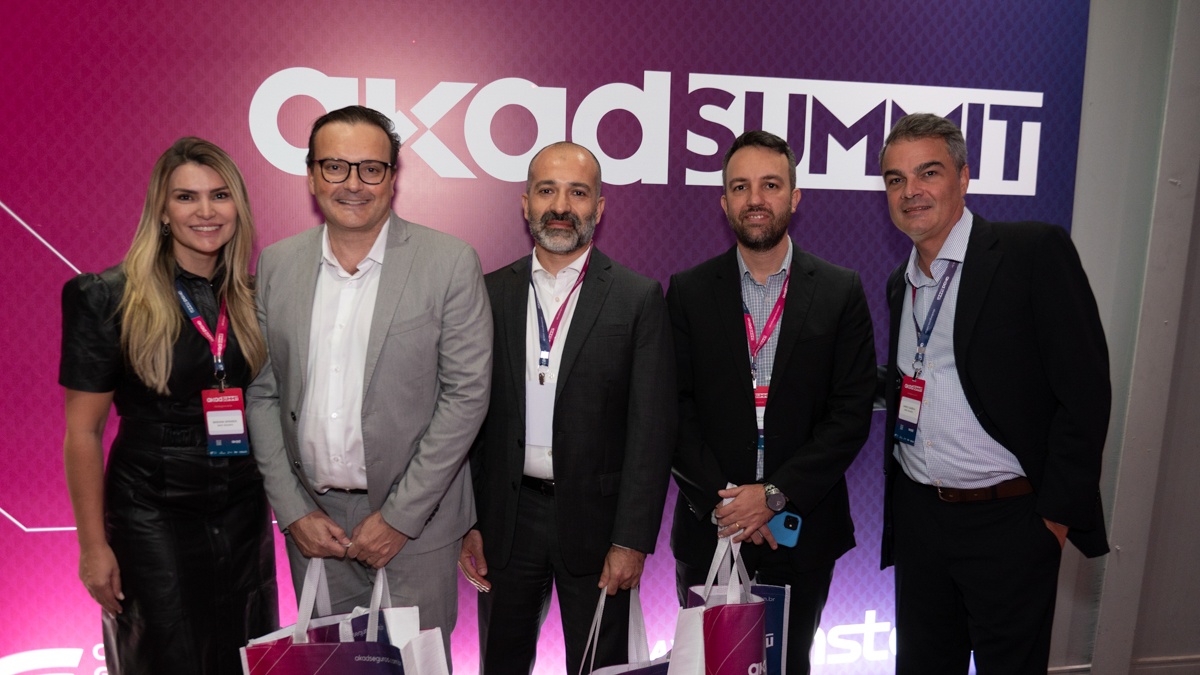
A summit is a familiar corporate device. Here, its guest list connects directly to Gamboa’s distribution interests: people who sell insurance meeting businesses that know something about customer behaviour. The day ended with awards for advisory partners and a cocktail gathering. Even a digital operation occasionally benefits from putting the conversation in a room with refreshments.
Two wheels, specialist knowledge
The bicycle business offers a concrete example of how Gamboa’s partnership approach works. In July 2025, Akad announced an agreement with Clube Santuu under an MGA model, giving the specialist intermediary authority to underwrite policies and administer claims between the insurer and brokers.
Gamboa described a range extending from bicycles worth R$500 to R$500,000, new or used, with or without an invoice. That spread makes the category more complicated than a single tidy product name suggests. A modest everyday bicycle and an expensive enthusiast’s machine both have two wheels. Their owners may need quite different conversations.
The announcement projected that evaluation could fall from as long as two weeks to less than two hours. It also set a target of up to R$25 million in premiums over the following 12 months. Those were expectations, rather than outcomes established by the announcement. The underlying operating idea was to combine Akad’s insurance capacity with a partner’s knowledge of a particular community.
This is a useful glimpse of the executive’s method because it brings the abstractions down to an object someone owns. Technology supports a process. Specialist knowledge helps define it. Brokers carry the offer into conversations with customers. The bicycle gets protection, while the organizational diagram finally acquires handlebars.
The software needs a conversation
By September 2026, Gamboa was still returning to the broker’s working day. He said Akad had more than 100 people dedicated to technology, developing solutions intended to make that work easier. In a related interview discussion, he said a dedicated AI team had been in place for four years and described increasingly specialized internal teams.
He also discussed Universidade Akad, the company’s platform for broker education. His emphasis was on knowing the product and understanding a transport customer’s needs. Information had to help the broker connect a particular problem with the available solution. The classroom belonged beside the software team.
That gives his move from private equity to insurance a continuing thread. The original opportunity was a market that could use technology more effectively. The operating question has become how technology, expertise and distribution work together in a business that owes its customers clear answers and financial protection.
Gamboa now has an insurer’s ledger, a network of brokers and a long-stated ambition to manage. His public remarks suggest where he expects the next useful improvement to appear: somewhere in the daily work between the insurer and the person asking for coverage. There is a middleman there. Gamboa keeps giving that person something to work with.